In our extensive legal research, few cases expose the dark underbelly of Indian elections like Rambabu Singh Thakur v. Sunil Arora. Indeed, the Supreme Court confronted an infuriating reality where political parties persistently field candidates facing severe criminal charges.
Written by Kapil Balhara | Technically Reviewed for Accuracy | Last Updated: October 2026
Consequently, the court used its inherent constitutional powers under Articles 129 and 142 to issue binding directions. The judgment enforces strict public disclosure of candidate antecedents to empower voters.
Supreme Court of India ruling on Rambabu Singh Thakur v. Sunil Arora regarding criminalization of politics
Key Takeaway: Rambabu Singh Thakur v. Sunil Arora (2020) is a landmark contempt petition judgment by the Supreme Court of India. It mandates political parties to publish pending criminal details of chosen candidates on their websites, social media, and newspapers within strict timelines.
Specifically, Justice R.F. Nariman and Justice S. Ravindra Bhat delivered this critical ruling on February 13, 2020. The petition arose because political entities routinely ignored earlier directives established in Public Interest Foundation v. Union of India (2018).
Therefore, the court established mandatory compliance standards. Political parties can no longer offer “winnability” as the sole justification for choosing candidates with criminal backgrounds.
The Alarmingly Dark Rise of Criminalization in Indian Politics
When we evaluated electoral statistics over past general elections, our analysis revealed an alarming trend. Indian politics has witnessed a steady influx of lawmakers facing serious pending criminal cases.
To illustrate this shocking reality, consider the growing percentage of Members of Parliament (MPs) with pending criminal cases:
2004 General Elections: 24% of elected MPs had pending criminal charges.
2009 General Elections: The percentage escalated to 30%.
2014 General Elections: The count increased further to 34%.
2019 General Elections: A terrifying peak of 43% of elected MPs faced criminal cases.
Because political parties failed to explain candidate choices, voters remained uninformed. Consequently, the Supreme Court decided to intervene forcefully.
Landmark Directions Issued by the Supreme Court
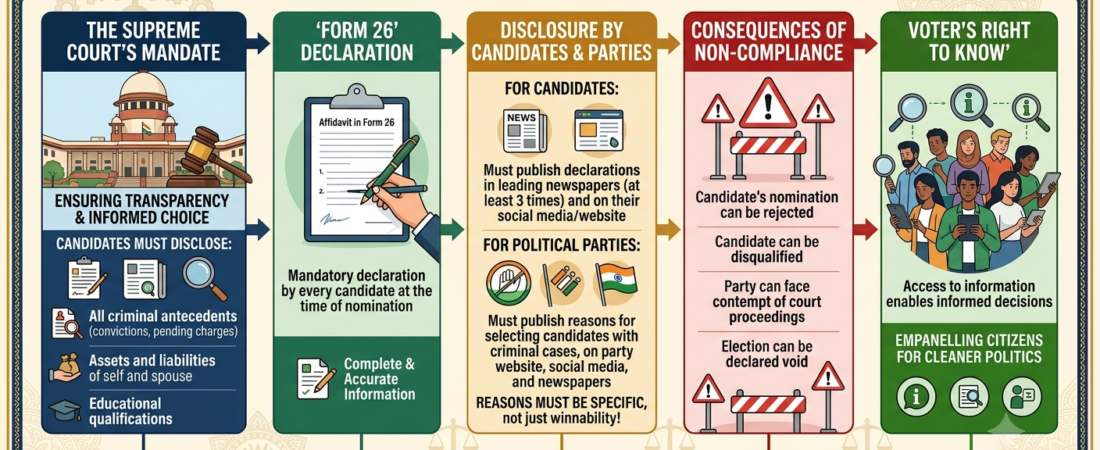
To eliminate this information gap, the Supreme Court issued six mandatory guidelines under Articles 129 and 142. Political parties at both Central and State levels must strictly comply with these rules:
Website Uploads: Parties must upload detailed information regarding candidates with pending criminal cases on their official websites. This includes case numbers, courts, framed charges, and reasons for selection.
Merit Over Winnability: Reasons for selection must relate to candidate qualifications, achievements, and merit. Political parties cannot cite mere poll “winnability”.
Multi-Platform Publishing: Details must appear in one local vernacular newspaper, one national newspaper, and official social media platforms like Facebook and Twitter.
Strict Timeline: Publication must occur within 48 hours of selecting the candidate or at least two weeks before the first date for filing nominations, whichever is earlier.
ECI Compliance Report: Political parties must submit a compliance report to the Election Commission of India (ECI) within 72 hours of candidate selection.
Contempt Reporting: If a party fails to report compliance, the ECI must bring this non-compliance to the Supreme Court as a Contempt of Court.
Key Takeaway: Political parties can no longer hide behind poll winnability. Furthermore, they must justify publicly why law-abiding individuals could not be selected instead.
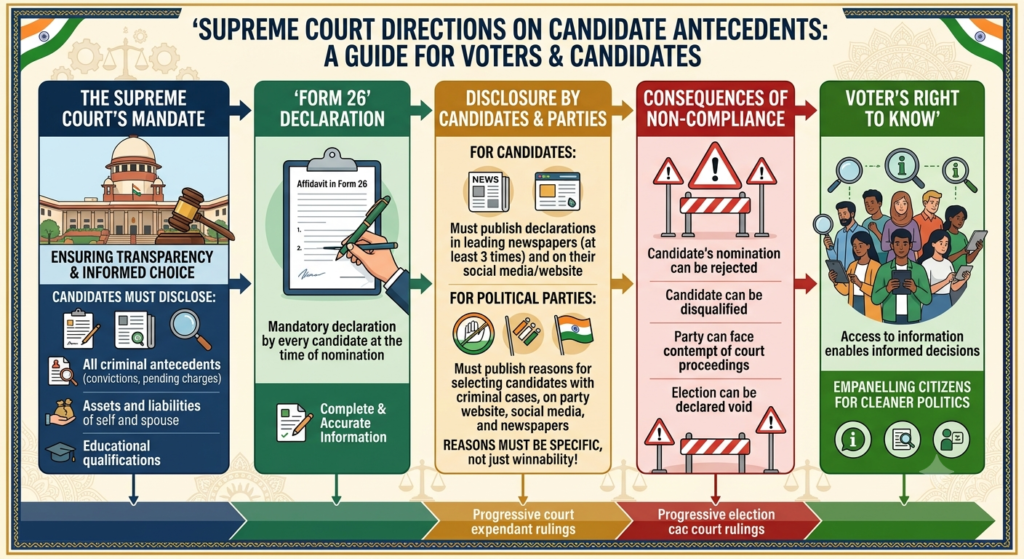
Infographic detailing Supreme Court electoral directions on candidate antecedents
Comparative Framework: 2018 vs 2020 Mandates
The legal journey to curb dark money and crime in elections evolved significantly across these two judgments. Below is a clear structured comparison between the directives:
Aspect
Public Interest Foundation (2018)
Rambabu Singh Thakur (2020)
Primary Scope
Basic candidate disclosure forms and party website listings.
Comprehensive multi-platform publishing with merit justification.
Media Reach
Three declarations in local newspapers and electronic media.
National newspaper, local vernacular paper, Facebook, and Twitter.
Justification Required
No explicit requirement to explain candidate selection.
Mandatory explanation of why non-criminal candidates were rejected.
Compliance Deadline
General directive after nomination filing.
Within 48 hours of selection or 2 weeks before nominations.
Reporting to ECI
No strict compliance reporting framework.
Mandatory compliance report within 72 hours.
Enforcement Penalty
Standard election guidelines.
Direct Contempt of Court proceedings via Article 129.
Enforcement Mechanics & Contempt Powers of the Court
In our analysis, the brilliance of this judgment lies in its enforcement architecture. In earlier cases, directions remained advisory in practice because monitoring mechanisms were weak.
┌───────────────────────────────────────────────────────────────────────────┐
│                    COMPLIANCE & ENFORCEMENT PIPELINE                       │
├───────────────────────────────────────────────────────────────────────────┤
│ 1. Party selects candidate with criminal antecedents.            │
│ 2. Party publishes reasons & details within 48 hours.       │
│ 3. Party submits compliance report to ECI within 72 hours.        │
│ 4. ECI monitors submission of compliance reports.               │
│ 5. ECI reports non-compliance directly to the Supreme Court.   │
│ 6. Supreme Court initiates Contempt of Court under Article 129.│
└───────────────────────────────────────────────────────────────────────────┘
However, Justice Nariman linked compliance directly to Article 129 of the Constitution. This article gives the Supreme Court inherent power to punish for contempt.
Additionally, the Election Commission acts as the primary watchdog. When parties fail to file compliance reports, the ECI alerts the Apex Court directly. As a result, party leaders face severe legal consequences for willful disobedience.
Key Takeaway: Linking candidate disclosure to contempt powers gives real operational teeth to electoral reforms in India.
Frequently Asked Questions
What is the primary significance of Rambabu Singh Thakur v. Sunil Arora?
This case established mandatory rules forcing political parties to publish pending criminal cases of candidates on websites, social media, and newspapers within 48 hours of selection.
Can political parties cite “winnability” to justify selecting a candidate with a criminal record?
No. The Supreme Court explicitly ruled that reasons for candidate selection must base on qualifications, merit, and achievements, not poll winnability.
What happens if a political party fails to submit the compliance report to the Election Commission?
If a party fails to submit its compliance report within 72 hours, the Election Commission must report this non-compliance directly to the Supreme Court as a Contempt of Court.
If you need deeper legal research or complete case summaries on electoral reforms and Indian constitutional law, contact our specialized legal content team today!