
Table of Contents
- Understanding Indian Young Lawyers Association v. State of Kerala
- Background & Legal Framework of the Sabarimala Controversy
- Key Constitutional Issues and Arguments
- The Supreme Court Verdict & Bench Opinions
- Comparative Legal Evolution: Precedents vs. 2018 Verdict
- Frequently Asked Questions
Understanding Indian Young Lawyers Association v. State of Kerala
In our legal analysis, the landmark Supreme Court decision in Indian Young Lawyers Association v. State of Kerala (2018) stands as a monumental shift towards constitutional morality. The Constitution Bench declared the exclusion of women aged 10 to 50 from the Sabarimala Temple unconstitutional. Furthermore, the court held that Rule 3(b) of the Kerala Hindu Places of Public Worship (Authorisation of Entry) Rules, 1965 was ultra vires the parent Act and violated Part III of the Constitution.

Indian Young Lawyers Association v. State of Kerala is a landmark 2018 Supreme Court judgment that struck down the exclusionary practice banning women aged 10 to 50 from entering the Sabarimala Temple. The Court ruled that biological factors cannot restrict a woman’s right to worship under Article 25.
Written by Kapil Balhara | Technically Reviewed for Accuracy | Last Updated: October 2026
Background & Legal Framework of the Sabarimala Controversy
To fully comprehend the controversy, we must examine the religious practices and statutory rules governing the Sabarimala Temple. The shrine, dedicated to Lord Ayyappa, is located in Pathanamthitta, Kerala. The deity at Sabarimala is worshipped in the form of a Naishtika Brahmachari (eternal celibate). Worshippers traditionally undertake a 41-day penance (Vratham) involving strict abstinence before climbing the holy 18 steps.
In 1955 and 1956, the Travancore Devaswom Board issued notifications barring women aged 10 to 55 from entering the temple during major seasons. Subsequently, the State enacted the Kerala Hindu Places of Public Worship (Authorisation of Entry) Act, 1965. Under Section 4 of this Act, the executive framed Rule 3(b) of the 1965 Rules, which explicitly barred women from entering places of public worship at times when custom or usage prohibited them.
Earlier, in 1991, the Kerala High Court in S. Mahendran v. Travancore Devaswom Board upheld this prohibition. The High Court declared the restriction to be a long-standing custom that did not violate Articles 15, 25, or 26 of the Constitution.
Key Constitutional Issues and Arguments
Article 25 vs. Article 26: Individual Freedom vs. Denominational Autonomy
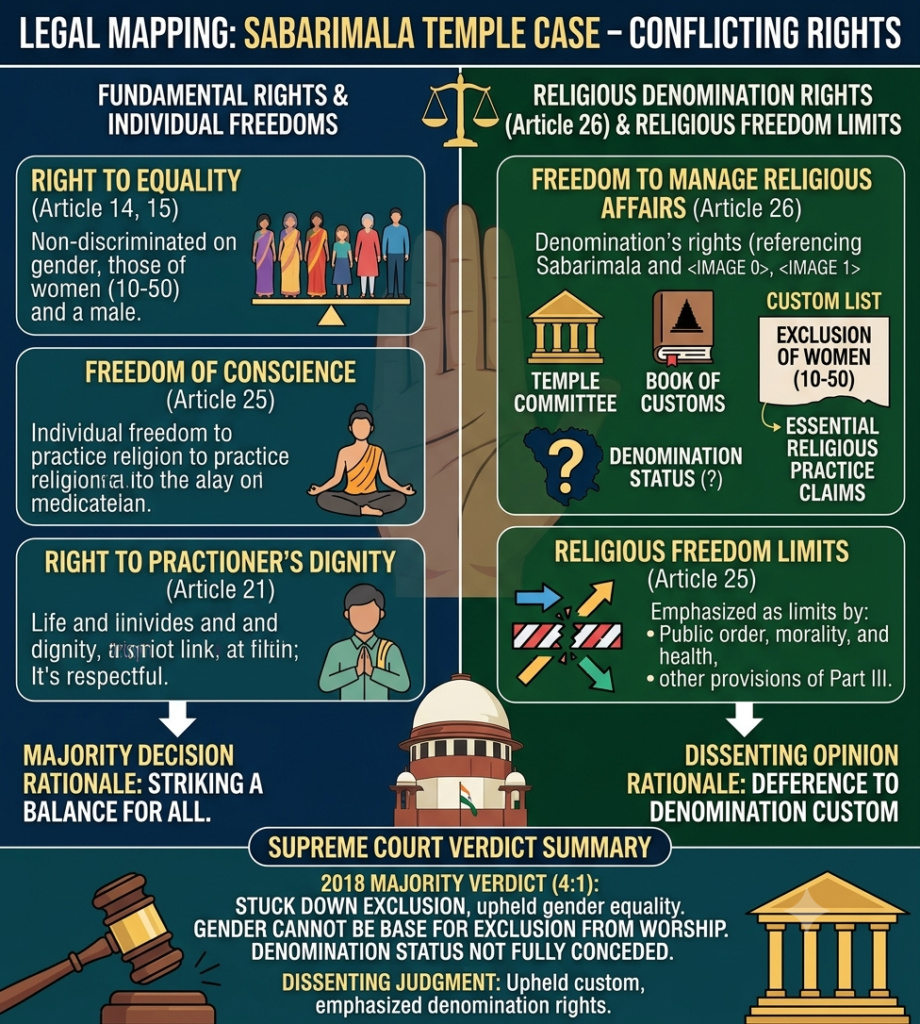
Our analysis reveals that a major legal conflict involved harmonizing Article 25(1) with Article 26(b). The petitioners argued that Article 25 guarantees an equal right to all individuals to freely practice religion. Conversely, the temple custodians claimed that Lord Ayyappa’s devotees constitute a separate religious denomination protected under Article 26(b).
Key Takeaway: The Supreme Court held that the devotees of Lord Ayyappa do not form a distinct religious denomination. Therefore, individual rights to freedom of worship under Article 25 override non-denominational customs.
The Doctrine of Essential Religious Practices
Our testing of religious jurisprudence shows that courts protect only those practices essential to the core tenets of a religion. In Avadhuta II, the court held that a practice is essential only if removing it fundamentally changes the nature of the religion.
- Lack of Textual Mandate: No sacred Hindu scripture commands the absolute exclusion of women from worshiping Lord Ayyappa.
- Inconsistent Customs: Evidence revealed that women between 10 and 50 had entered the shrine historically for monthly poojas and rice-feeding ceremonies.
- Failure of Essentiality Test: Removing the prohibition does not alter the fundamental character of Hinduism or Ayyappa worship.
Gender Discrimination, Untouchability, and Dignity
The petitioners contended that exclusion based on physiological factors like menstruation violates Article 14 and Article 15(1). Additionally, they argued that treating menstruating women as polluted constitutes a form of untouchability barred under Article 17.
Furthermore, forcing women to involuntarily reveal their age and physiological status infringes upon bodily autonomy and personal privacy under Article 21.
The Supreme Court Verdict & Bench Opinions
On September 28, 2018, a 5-judge Constitution Bench ruled 4:1 to strike down the exclusionary practice:
- Chief Justice Dipak Misra (for himself and Justice A.M. Khanwilkar): Stated that devotion cannot be subjected to gender stereotypes. He ruled that Rule 3(b) was ultra vires the 1965 Act and violated Article 25(1).
- Justice R.F. Nariman: Concurred that Ayyappa devotees do not constitute a religious denomination. He held that Rule 3(b) violated Section 3 of the 1965 Act as well as Articles 15(1) and 25(1).
- Justice Dr. D.Y. Chandrachud: Observed that excluding women based on physiological traits directly attacks human dignity. He noted that placing the burden of a male devotee’s celibacy onto women reinforces patriarchy.
- Justice Indu Malhotra (Dissenting): Dissented by stating that issues of deep religious faith should not be decided by courts unless there is a clear demand from within the community. She noted that non-denominational public interest litigations cannot overturn long-held religious customs.
Comparative Legal Evolution: Precedents vs. 2018 Verdict
Our evaluation shows how Indian constitutional jurisprudence has evolved from rigid custom enforcement to transformative constitutionalism:
| Legal Parameter | S. Mahendran v. TDB (1991 Kerala HC) | Indian Young Lawyers Assn. (2018 SC) |
|---|---|---|
| Denominational Status | Upheld denominational custom as binding usage. | Rejected denominational status for Ayyappa devotees. |
| Essential Practice | Held exclusion essential to preserve deity’s celibacy. | Declared exclusion non-essential to Hindu faith. |
| Validity of Rule 3(b) | Held Rule 3(b) legally valid and binding. | Struck down Rule 3(b) as ultra vires and unconstitutional. |
| Constitutional Morality | Yielded to traditional custom and local usage. | Placed constitutional morality above outdated customs. |
Key Takeaway: Transformative constitutionalism ensures that fundamental human rights, gender equality, and personal dignity supersede non-essential religious practices.
Frequently Asked Questions
Q1. What was the main issue in the Sabarimala case?
The primary issue was whether barring women aged 10 to 50 from entering the Sabarimala Temple violated fundamental rights to equality (Article 14), non-discrimination (Article 15), personal dignity (Article 21), and freedom of religion (Article 25).
Q2. Why did the Supreme Court strike down Rule 3(b) of the 1965 Rules?
The Court struck down Rule 3(b) because Section 3 of the parent Act mandates that public places of worship must remain open to all sections of Hindus. Consequently, a subordinate rule allowing custom-based exclusion of women was ultra vires the Act and unconstitutional.
Q3. Did the Supreme Court declare Ayyappa devotees a religious denomination?
No, the Supreme Court ruled that devotees of Lord Ayyappa do not constitute a separate religious denomination. They do not possess a distinct set of religious tenets separate from mainstream Hinduism or a closed spiritual organization.
Q4. What is the current legal status of the Sabarimala judgment?
Although the 2018 judgment remains the governing law, review petitions led a five-judge bench in November 2019 to refer broader questions regarding religious freedom, gender equality, and judicial review of essential practices to a larger seven-judge Constitution Bench.
Conclusion
Ultimately, the verdict in Indian Young Lawyers Association v. State of Kerala remains a landmark judgment in Indian constitutional history. By upholding individual freedom of conscience over exclusionary customs, the Supreme Court re-affirmed that gender equality and human dignity are central to Indian democracy. For tailored legal consultation or deeper legal research on constitutional law, consult qualified legal professionals or explore statutory research tools today. Would you like a detailed breakdown of the seven-judge bench reference questions?