Table of Contents
- Introduction to the Landmark NJAC Case
- What was the NJAC Case (SCAORA v. Union of India)?
- Historical Evolution: The Three Judges Cases
- Key Arguments Presented Before the Supreme Court
- The Verdict: Why the Supreme Court Struck Down the NJAC
- Frequently Asked Questions
Introduction to the Landmark NJAC Case
The judicial landscape in India faced an essential constitutional test during the hearing of Supreme Court Advocates-on-Record Association (SCAORA) v. Union of India. This historic dispute examined whether the legislature could alter the method of selecting judges.
The Parliament attempted to replace the decades-old Collegium system with a newly structured body. Consequently, legal scholars, lawyers, and public commentators followed every stage of the trial closely.
Written by Kapil Balhara | Technically Reviewed for Accuracy | Last Updated: October 2026
What was the NJAC Case (SCAORA v. Union of India)?
Key Takeaway: The NJAC case evaluated whether political participation in judicial appointments undermined the independence of the judiciary, which forms part of the Basic Structure of the Indian Constitution.
In 2014, Parliament passed the 99th Constitutional Amendment Act alongside the National Judicial Appointments Commission (NJAC) Act. Furthermore, this enactment aimed to create a six-member selection commission.
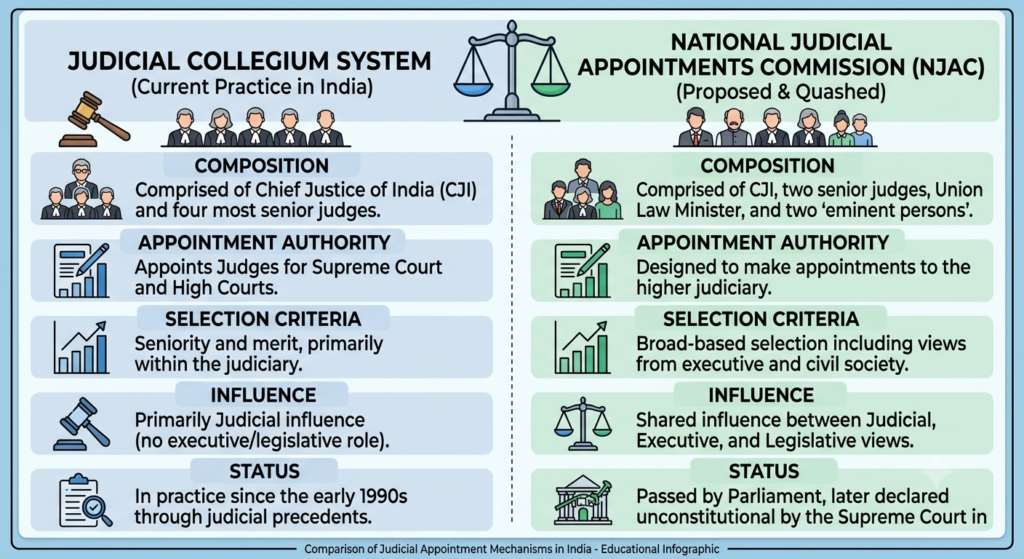
The proposed commission included the Chief Justice of India, two senior judges, the Law Minister, and two eminent persons. However, petitioners challenged both enactments before a five-judge Constitution Bench.
+-----------------------------------------------------------------------------------+
|                        COMPOSITION OF PROPOSED NJAC BOARD                         |
+-----------------------------------------------------------------------------------+
|  1. Chief Justice of India (Ex-officio Chairperson)                               |
|  2. Two Senior-most Supreme Court Judges                                         |
|  3. Union Minister of Law and Justice                                             |
|  4. Two Eminent Persons (Nominated by CJI, Prime Minister, & Leader of Opposition)|
+-----------------------------------------------------------------------------------+
Historical Evolution: The Three Judges Cases
To understand the 2015 judgment, one must analyze the legal precedents that established the Collegium framework. Additionally, these prior rulings shaped how the court interpreted executive participation.
- First Judges Case (1981): The Court ruled that “consultation” did not mean “concurrence”. Therefore, ultimate power rested with the executive branch.
- Second Judges Case (1993): A nine-judge bench overruled the earlier decision. Consequently, it gave primacy to the Chief Justice of India.
- Third Judges Case (1998): The Court reaffirmed judicial primacy via a Presidential reference. Moreover, it expanded the Collegium to include senior colleague judges.
Key Takeaway: The Second and Third Judges cases firmly established that judicial primacy during selection is necessary to shield appointments from executive pressure.
Key Arguments Presented Before the Supreme Court
Petitioners’ Arguments
First, senior counsel arguing for the petitioners asserted that judicial independence forms a basic feature of the Constitution. Therefore, any law compromising that independence violates the Basic Structure doctrine.
Second, they highlighted that allowing executive members a veto over judge selections creates serious conflicts of interest. Because the government is the largest litigant, giving ministers appointment powers invites improper influence.
Government’s Defense
Conversely, the Attorney General argued that the Constitution never intended to grant judges exclusive selection power. In addition, the defense pointed to Constituent Assembly debates to prove that full judicial vetoes were rejected.
Furthermore, the state asserted that checks and balances require legislative participation in selecting high constitutional officers. Thus, public accountability demanded replacing the secretive Collegium process.
The Verdict: Why the Supreme Court Struck Down the NJAC
On October 16, 2015, the five-judge bench issued a majority 4:1 judgment declaring both the 99th Amendment and the NJAC Act unconstitutional. Justice J.S. Khehar authored the leading opinion.
| Feature | Collegium System | NJAC Model (Declared Void) |
|---|---|---|
| Primary Authority | Judiciary (CJI + Senior Judges) | 6-Member Mixed Commission |
| Executive Say | Limited advisory feedback | Direct vote & veto power |
| Constitutional Basis | Judicial Interpretation (Art. 124/217) | 99th Constitutional Amendment |
| Status After 2015 | Restored fully | Struck down as void |
The Court held that the inclusion of political figures in the selection mechanism compromised institutional autonomy. As a result, the historic verdict restored the Collegium system entirely.
                          JUDICIAL SELECTION FLOW

   [ Collegium Recommendation ] ---> [ Executive Background Check ]
                ^                                |
                |                                v
     [ Reiteration by CJI ] <--- [ File Returned with Objections ]
- The Collegium initiates candidate names for judicial appointments.
- The executive performs background checks through administrative agencies.
- If objections arise, the file returns to the Collegium for review.
- Finally, upon reiteration by judges, the appointment must proceed.
Key Takeaway: The Supreme Court invalidated the 99th Amendment because political vetoes over judicial appointments directly damaged the Basic Structure of the Constitution.
Frequently Asked Questions
What is the SCAORA v Union of India case?
It is the landmark 2015 Supreme Court judgment where a five-judge bench struck down the 99th Constitutional Amendment Act and the NJAC Act.
Why was the NJAC Act struck down?
The Court ruled that giving executive members veto power over judicial appointments breached judicial independence and violated the Basic Structure doctrine.
What system currently governs judicial appointments in India?
The Collegium system, led by the Chief Justice of India and senior Supreme Court judges, currently governs appointments.
Need expert analysis on Constitutional law developments? Contact our legal research team today for updated case briefs and insights.