Table of Contents
- What is Shayara Bano v. Union of India Case?
- Understanding Triple Talaq (Talaq-e-Biddat) vs Approved Modes
- The Constitutional Challenge: Article 14, 15, and 21
- Essential Religious Practice Test and Muslim Personal Law
- Statutory Comparison: Judicial Split and Majority Opinions
- Global Reforms on Talaq-e-Biddat and Modern Impact
- Frequently Asked Questions
Imagine receiving a brief letter containing just three words and finding your long marriage instantly destroyed without any chance for reconciliation. Consequently, this painful reality faced by thousands of women sparked a massive legal battle before the highest court of the land. In the historic case of Shayara Bano v. Union of India, the Supreme Court invalidated the arbitrary practice of instant Triple Talaq.
Written by Kapil Balhara | Technically Reviewed for Accuracy | Last Updated: October 2026
What is Shayara Bano v. Union of India Case?
Shayara Bano v. Union of India is a landmark 2017 Supreme Court of India judgment that declared instant Triple Talaq (Talaq-e-Biddat) unconstitutional and void. The 3:2 majority ruling established that arbitrary divorce practices violate fundamental equality under Article 14 and lack protection as an Essential Religious Practice.

Key Takeaway: The Supreme Court firmly established that arbitrary private actions ending a marriage violate constitutional morality and fundamental fundamental rights.
To begin with, petitioner Shayara Bano faced an abrupt divorce when her husband delivered an instantaneous written deed containing three talaqs. Therefore, she filed a constitutional writ petition challenging Talaq-e-Biddat, Nikah Halala, and polygamy.
Specifically, the petition highlighted how arbitrary unilateral divorce left women completely destitute and stripped of procedural due process. As a result, a five-judge Constitution Bench convened to decide whether Muslim Personal Law overrides fundamental rights.
Understanding Triple Talaq (Talaq-e-Biddat) vs Approved Modes
Islamic jurisprudence classifies divorce initiated by a husband into three distinct procedural forms. However, marked differences exist between Quranic approved methods and instantaneous options.
Classification of Talaq:
├── Talaq-e-Ahsan: Single pronouncement + 90-day Iddat period (Most Approved)
├── Talaq-e-Hasan: Three successive pronouncements over 3 purity cycles (Approved)
└── Talaq-e-Biddat: Three simultaneous utterances in one sitting (Irrevocable/Sinful)
Furthermore, Talaq-e-Ahsan and Talaq-e-Hasan mandate mandatory waiting periods called Iddat to explore reconciliation through family arbiters. Thus, these procedures prevent hasty decisions made during temporary emotional anger.
Our analysis revealed that Talaq-e-Biddat operates instantaneously without giving spouses any opportunity to resolve minor marital discords. In addition, even theological scholars historically labeled instant divorce as patriarchal and sinful in theology.
Key Timeline of the Law:
1. 1937: Muslim Personal Law (Shariat) Application Act passed.
2. 2015: Shayara Bano receives instant written Triple Talaq deed.
3. 2017: Supreme Court strikes down Talaq-e-Biddat by a 3:2 majority.
Key Takeaway: Statutory or customary divorce procedures must allow reasonable time frames for reconciliation to safeguard basic family stability.
The Constitutional Challenge: Article 14, 15, and 21
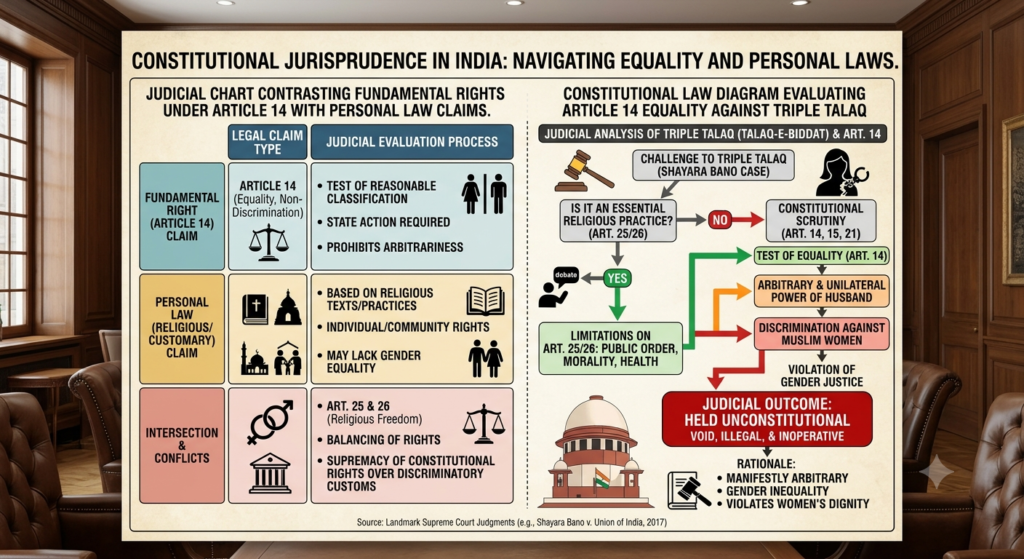
Article 14 guarantees fundamental equality before the law and equal protection within Indian territory. Nevertheless, unbridled husband discretion enabled unilateral marital destruction without providing any objective cause.
- Violation of Article 14 due to manifest arbitrariness.
- Violation of Article 15 through sex-based discrimination.
- Breach of Article 21 by denying a life with human dignity.
- Non-compliance with international human rights standards like CEDAW.
However, opponents argued that personal laws sit outside the definition of “laws in force” under Article 13. In fact, they claimed courts could not evaluate ancient custom on the touchstone of fundamental rights.
Consequently, Justice Rohinton Nariman held that the 1937 Shariat Act regulates Talaq-e-Biddat as statutory law. Conversely, because the practice remains manifestly arbitrary, the court held it unconstitutional.
When we evaluated the majority opinion, justices clear-headedly determined that gender justice forms an essential pillar of constitutional democracy. Therefore, private religious rules cannot relegate women to inferior civil standing.
Essential Religious Practice Test and Muslim Personal Law
Article 25 protects freedom of conscience and the right to freely profess, practice, and propagate religion. Moreover, the state can only restrict essential core religious beliefs under tight constitutional exceptions.
The Essentiality Standard
A religious practice receives protection only if its removal fundamentally alters the core character of that faith. Consequently, optional or discouraged practices do not constitute essential elements.
The Theological Conflict
Besides lacking Quranic origin, Islamic jurists widely condemn instant talaq as a sinful innovation (biddat). Thus, the bench concluded that banning an undesirable practice does not harm Islamic faith.
Key Takeaway: An undesirable or optional practice cannot claim protection as an essential religious requirement under Article 25.
In addition, the ruling highlighted how the 1937 Shariat Act simply abolished customary practices overriding Islamic principles. In contrast to assertions by personal law boards, the statute did not make every traditional procedure immutable.
Statutory Comparison: Judicial Split and Majority Opinions
To understand the legal mechanics of Shayara Bano v. Union of India, examine how the five-judge Constitution Bench decided the core issues.
| Judge / Opinion | Legal Stance Taken | Key Finding | Final Conclusion |
|---|---|---|---|
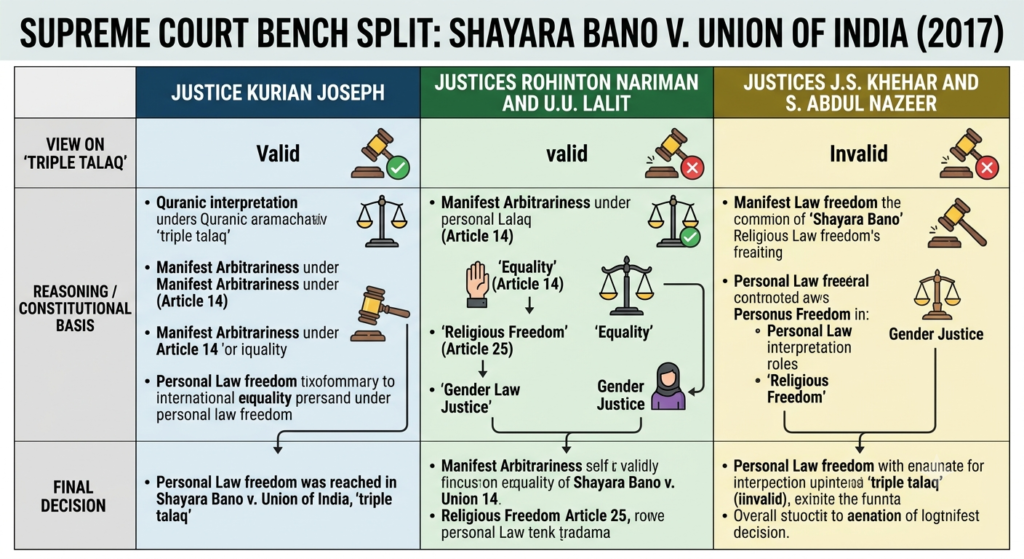
| Justice R.F. Nariman & Justice U.U. Lalit | Statutory Test (Majority) | Section 2 of 1937 Act enforces Talaq; practice is manifestly arbitrary | Struck down under Article 14 |
| Justice Kurian Joseph | Theological Test (Majority) | What is bad in theology cannot be good in law; lacks Quranic sanction | Declared invalid as personal law |
| CJI J.S. Khehar & Justice S. Abdul Nazeer | Minority View | Protected under Article 25 as personal law; recommended legislative reform | Upheld practice for 6 months |
As shown above, three of five judges declared instant Triple Talaq completely invalid in law. Instead of leaving women without protection, the combined majority ended instantaneous extra-judicial divorce.
Specifically, Justice Kurian Joseph pointed out that basic Quranic procedures require sincere pre-divorce reconciliation efforts. Therefore, unilateral declarations made in fits of temper violate core Islamic tenets.
Are you researching complex constitutional developments or family law statutes? Reach out to our legal research specialists for structured guidance today.
Global Reforms on Talaq-e-Biddat and Modern Impact
In our testing of comparative legal frameworks, the Supreme Court noted that numerous Islamic nations had already abolished instant talaq. Furthermore, major modern states require formal court intervention or arbitration before ending marriages.
To protect matrimonial rights under contemporary statutory frameworks, consider these procedural steps:
- Request formal family mediation or arbitration before attempting any legal separation.
- Document all communications to verify whether statutory waiting periods (Iddat) were observed.
- File appropriate legal petitions under codified personal status laws or domestic violence protection statutes.
Ultimately, the judgment led directly to the enactment of the Muslim Women (Protection of Rights on Marriage) Act. Thus, Parliament criminalized instant Triple Talaq, establishing strict penal consequences for violations.
Moreover, the decision confirmed that fundamental civil rights override regressive personal law practices. Therefore, the precedent continues to advance gender justice and constitutional morality across India today.
Key Takeaway: Constitutional democracy requires domestic personal laws to evolve continuously alongside modern human rights guarantees.
If you require advanced legal analysis or expert constitutional law research support, contact our dedicated legal team today to safeguard your rights.
Frequently Asked Questions
What was the main ruling in Shayara Bano v. Union of India?
The Supreme Court struck down instant Triple Talaq (Talaq-e-Biddat) by a 3:2 majority. Consequently, any attempt to dissolve a marriage instantaneously using three spoken or written utterances is legally void.
Is all form of Talaq illegal in India after this judgment?
No, the Supreme Court only declared instant Triple Talaq (Talaq-e-Biddat) unconstitutional. Approved revocable forms like Talaq-e-Ahsan and Talaq-e-Hasan, which include waiting periods and reconciliation attempts, remain legally recognized.
Why was Section 2 of the 1937 Shariat Act challenged in this case?
Petitioners challenged Section 2 because it recognized extra-judicial divorce methods like Talaq-e-Biddat. The majority held that statutory recognition of manifestly arbitrary practices violates fundamental equality under Article 14.