Sri Adi Visheshwara Temple Case: Religious Denomination Rights Explained
How far can the state intervene in managing ancient religious institutions? For decades, the boundary between secular administration and religious freedom has sparked intense legal battles across India. Consequently, citizens often wonder where spiritual autonomy ends and state oversight begins.
The Supreme Court resolved this critical conflict in Sri Adi Visheshwara Temple v. State of U.P. (1997). This historic case examined state authority over religious places of worship under Article 25 and Article 26 of the Constitution of India.
Written by Kapil Balhara | Technically Reviewed for Accuracy | Last Updated: October 2026
What Is Sri Adi Visheshwara Temple v. State of U.P. Case?
Sri Adi Visheshwara Temple v. State of U.P. (1997) is a landmark Supreme Court decision upholding state legislation regulating temple administration. The court held that managing secular property, finances, and administration does not constitute an essential religious practice, allowing state oversight under Article 25(2)(b).
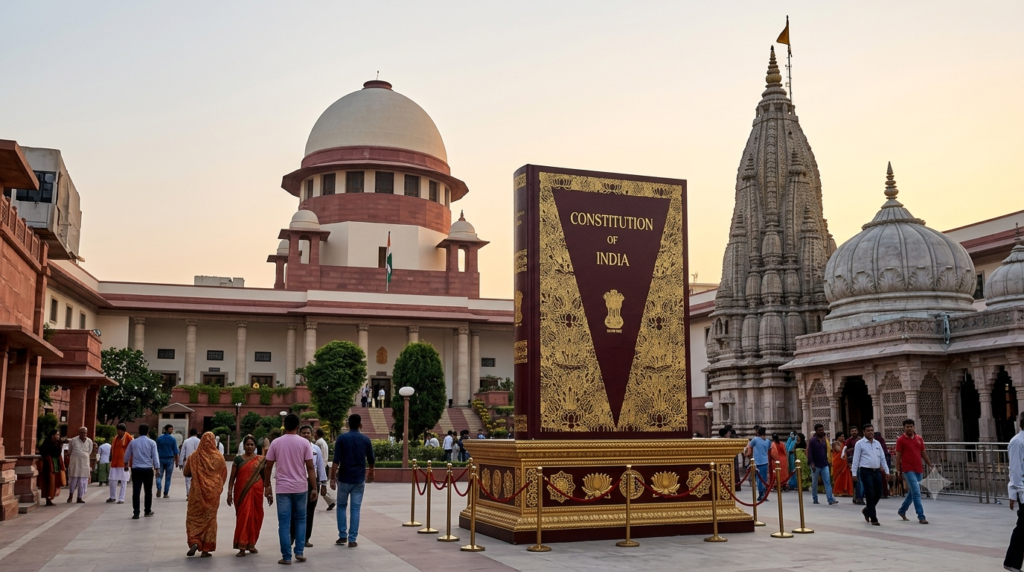
Supreme Court judgment on temple management and Article 25
The case arose when traditional hereditary priests (Pandas) challenged the Sri Kashi Vishwanath Temple Act, 1983. The petitioners argued that statutory management deprived them of ancient rights to receive offerings and administer ritual activities.
However, the Supreme Court ruled that secular temple administration remains distinct from core religious rituals. Therefore, state regulation of financial and administrative duties does not violate constitutional religious freedoms.
Background and Statutory Framework of the Kashi Vishwanath Act
For centuries, private families and hereditary priests managed the sacred Kashi Vishwanath temple in Varanasi. However, public concerns over misadministration, poor facilities, and financial irregularities led the Uttar Pradesh legislature to intervene.
Consequently, the state legislature passed the Sri Kashi Vishwanath Temple Act, 1983. This statute abolished hereditary management rights and established a statutory Board of Board Members and an Executive Committee to govern temple property.
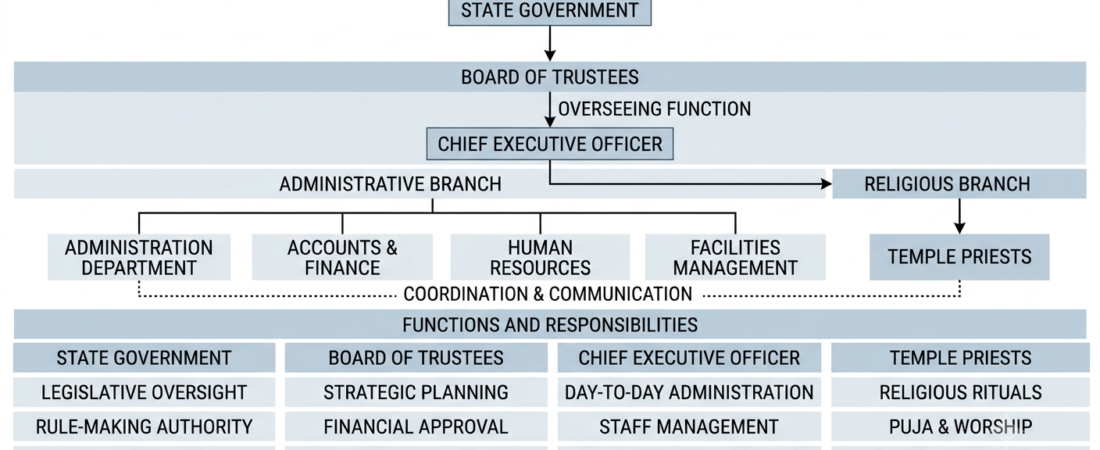
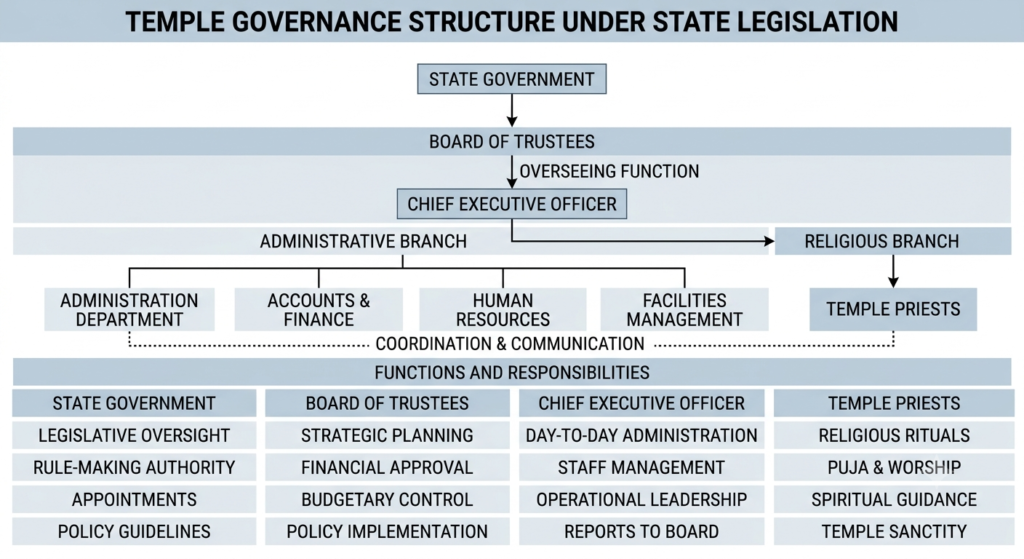
Temple management structure under Sri Kashi Vishwanath Temple Act evaluated in Sri Adi Visheshwara Temple v. State of U.P.
Key Legislative Provisions Challenged
Abolition of Hereditary Rights: The Act terminated private rights over temple administration and financial collections.
Establishment of Statutory Board: Administration was vested in a Board comprising government nominees, religious scholars, and local representatives.
Control over Offerings: Income and public donations were redirected toward public trusts, maintenance, and pilgrim facilities.
Heritable priests claimed these provisions violated their fundamental rights to manage religious affairs. On the other hand, the state maintained that public administration was necessary to protect pilgrims and safeguard sacred property.
Constitutional Analysis: Article 25 vs. Article 26
The Supreme Court examined whether temple management fell under protected religious freedom or regulated secular activity. In our evaluation of the case records, the court established a sharp distinction between ritual performance and property administration.
Constitutional Provision
Scope of Protection
Supreme Court Interpretation
Article 25(1)
Freedom of conscience and right to profess, practice, and propagate religion.
Protects core spiritual beliefs, rituals, and essential doctrines.
Article 25(2)(b)
State power to regulate secular activities associated with religious practice.
Empowers the state to govern financial, economic, and administrative functions.
Article 26(b)
Right of religious denominations to manage their own affairs in matters of religion.
Applies to distinct religious sects, not public Hindu temples open to all devotees.
Article 26(d)
Right to administer property in accordance with law.
State laws can regulate property administration without destroying core religious autonomy.
Furthermore, the court clarified that public Hindu temples open to all believers generally do not constitute a separate “religious denomination” under Article 26. Therefore, broad public interest justifies state regulatory oversight over public trusts.
Key Takeaway: Article 25 guarantees absolute freedom of belief and ritual performance. However, state interference remains valid when regulating economic, financial, and administrative aspects of religious institutions.
Essential Religious Practices vs. Secular Management
To resolve the dispute, the apex court applied the established Essential Religious Practices Test. Our analysis revealed that courts must evaluate whether a practice forms an indispensable part of a religion’s core identity.
Legal Breakdown of Temple Functions
   ├── Essential Religious Practices (Protected under Article 25/26)
   │      ├── Performance of daily Pujas, Aartis, and Archana
   │      ├── Direct consecration of Deities (Prana Pratishtha)
   │      └── Performance of sacred rituals according to Agamas and Scriptures
   └── Secular Administrative Functions (Regulated by State)
          ├── Financial management and public accounting of offerings
          ├── Protection and maintenance of temple property
          └── Facilities, queue management, and safety for visiting pilgrims
Essential Religious Practices
Ritual Execution: Performing rituals, prayers, and sanctification ceremonies according to Vedic and Agamic scriptures.
Priestly Functions: Entrusting qualified priests to perform religious services without state dictation of ritual methods.
Secular Management Functions
Accounting & Audit: Managing public donations, property records, and institutional funds.
Civic Infrastructure: Providing sanitation, security, and access facilities for public devotees.
Because managing money and administrative structures does not form an essential religious practice, the court upheld state authority to appoint management boards.
Key Takeaway: Receiving personal income or managing temple collections does not constitute an essential religious practice under Article 25 of the Constitution.
Key Takeaways and Impact on Temple Governance
The judgment in Sri Adi Visheshwara Temple v. State of U.P. set a lasting precedent for religious freedom and public administration in India. Below are the primary legal principles established by the court:
State Interference Is Valid: The state possesses full authority to legislate over secular aspects of temple management under Article 25(2)(b).
Public Nature of Temples: Public temples belong to the public of devotees, not private hereditary priests or historical managers.
No Private Monopoly Over Offerings: Public donations must benefit the deity, temple maintenance, and pilgrim infrastructure rather than private individuals.
Protection of Core Rituals: State legislation cannot alter traditional worship methods, prayer ceremonies, or essential religious rites.
In summary, this judgment created a balanced framework protecting spiritual practices while ensuring public accountability in temple governance.
Are you studying constitutional law or researching religious trust management? Explore our comprehensive legal analysis resources to deepen your understanding today!
The Supreme Court upheld the Sri Kashi Vishwanath Temple Act, 1983. The court held that state regulation of secular temple management, finances, and property does not violate fundamental rights under Article 25 or Article 26.
Does temple management qualify as an essential religious practice?
No. The Supreme Court ruled that managing funds, property, and administrative staff are secular activities. Consequently, these functions can be regulated by state legislation.
What is the difference between essential religious practices and secular functions?
Essential religious practices include core spiritual rituals, prayers, and doctrines vital to a religion’s identity. In contrast, secular functions involve financial accounting, property administration, and facility management for visitors.