Section 438 CrPC Interpretation: The Sushila Aggarwal Constitution Bench Judgment
Personal liberty is a cornerstone of Indian criminal jurisprudence. However, police officers sometimes abuse their power of arrest. To safeguard citizens from arbitrary arrest and disgrace, the Law Commission introduced Section 438 in the Code of Criminal Procedure (CrPC).
The landmark judgment in Sushila Aggarwal v. State (NCT of Delhi) answered critical questions about pre-arrest bail. Furthermore, a five-judge Constitution Bench settled long-standing conflicts regarding the duration of anticipatory bail.
Written by Kapil Balhara | Technically Reviewed for Accuracy | Last Updated: October 2026
What is Sushila Aggarwal v. State (NCT of Delhi) Case?
Key Takeaway: Sushila Aggarwal v. State (NCT of Delhi) is a landmark 2020 Supreme Court decision. A five-judge Constitution Bench ruled that protection granted under Section 438 CrPC does not automatically end when a charge sheet is filed or when trial courts issue summons. Thus, anticipatory bail usually lasts until the trial concludes.
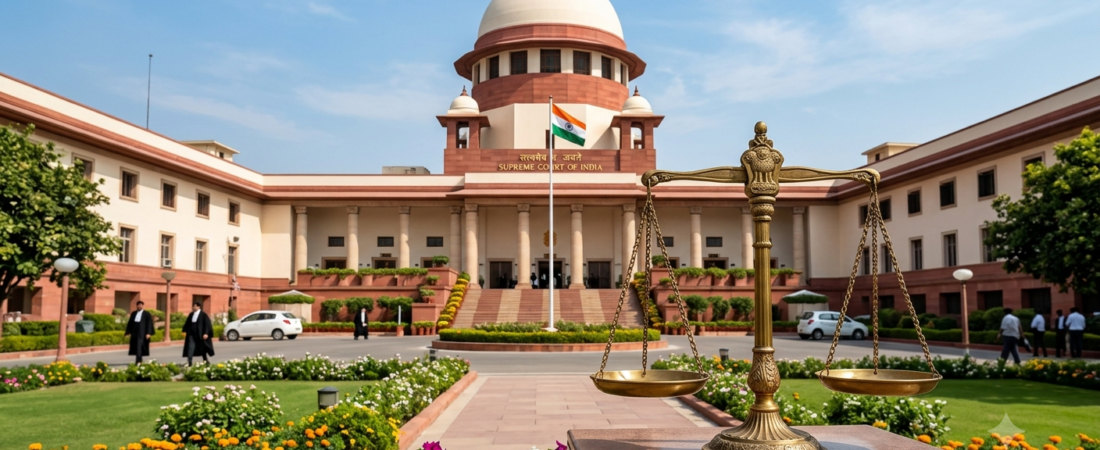
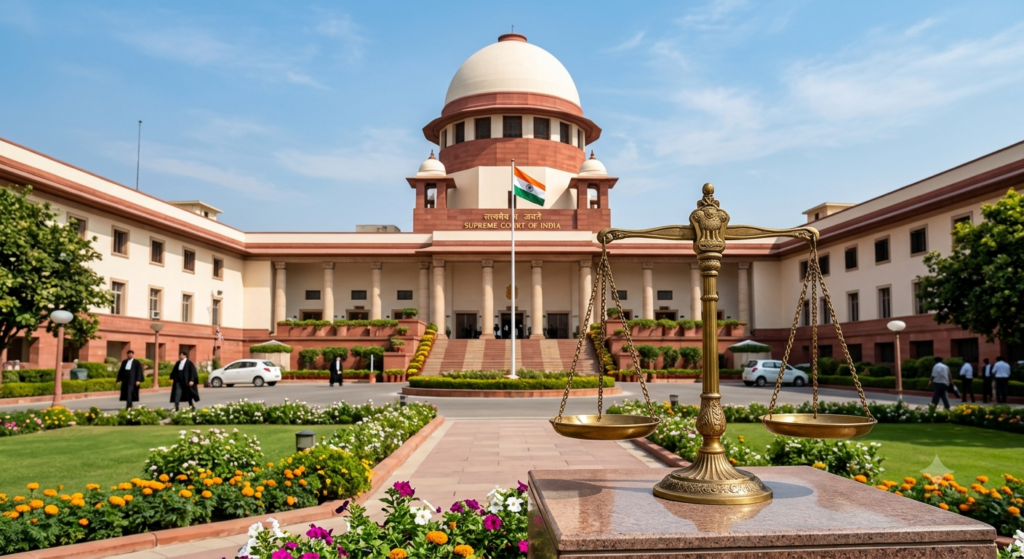
Supreme Court of India judgment on Sushila Aggarwal v. State NCT of Delhi
Historical Context and Legal Conflict
For decades, Indian courts delivered conflicting rulings on pre-arrest bail under Section 438 CrPC. On one hand, the court in Gurbaksh Singh Sibbia (1980) held that anticipatory bail should not be limited by time as a normal rule. Moreover, Siddharam Satlingappa Mhetre (2011) held that pre-arrest protection ordinarily lasts until the end of the trial.
On the other hand, cases like Salauddin Abdulsamad Shaikh (1996) held that anticipatory bail must be time-bound. Consequently, accused persons were forced to surrender and seek regular bail once the investigation concluded or charges were filed. Therefore, a larger bench was required to resolve these opposing views.
Key Questions Before the Constitution Bench
The three-judge bench referred two fundamental legal questions to the five-judge Constitution Bench:
Duration Limit: Should protection under Section 438 CrPC be limited to a fixed period so that the accused must surrender and apply for regular bail under Section 439?
Stage Limit: Does the life of an anticipatory bail order end automatically when the trial court summons the accused or frames charges?
Additionally, the court examined whether courts can impose conditions while granting pre-arrest relief.
Supreme Court Rulings and Guidelines
The Constitution Bench, comprising Justices Arun Mishra, Indira Banerjee, Vineet Saran, M.R. Shah, and S. Ravindra Bhat, answered both questions unanimously.
Essential Guidelines Established by the Court
No Automatic Time Limit: Protection under Section 438 CrPC does not end automatically upon filing a charge sheet. Instead, it usually continues until the trial ends.
Discretion to Impose Conditions: Courts can impose special time-bound conditions if specific facts warrant them. However, general time limits must not be imposed routinely.
No Blanket Orders: Courts must not issue blanket pre-arrest bail orders covering unspecified future crimes. The apprehension must relate to specific alleged offences.
Deemed Custody for Recoveries: Police can still carry out recoveries under Section 27 of the Evidence Act under the concept of “deemed custody” without revoking bail.
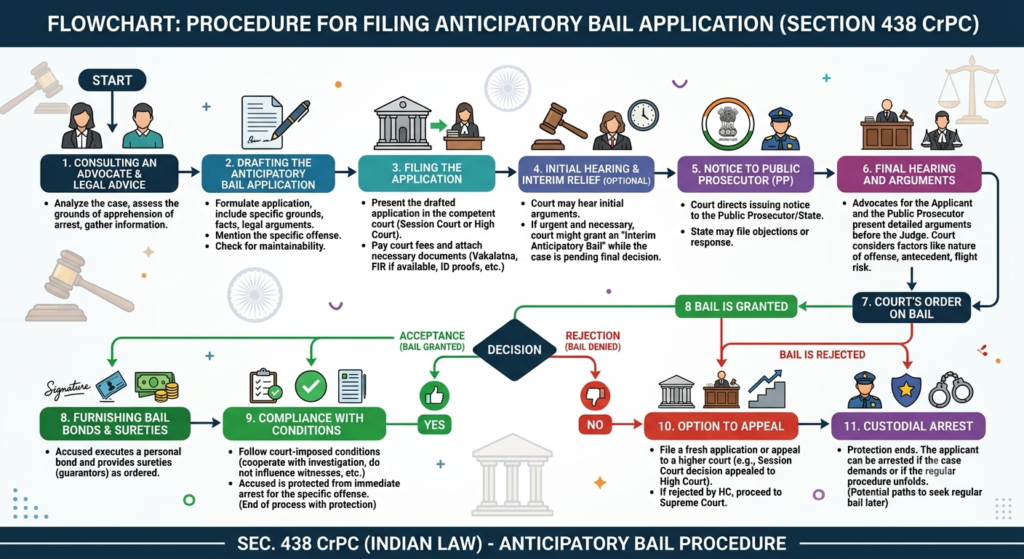
Flowchart showing Section 438 CrPC anticipatory bail procedure in Sushila Aggarwal case
Step-by-Step Process for Seeking Protection Under Section 438 CrPC:
1. Establish concrete facts showing a reasonable apprehension of arrest for a non-bailable offence.
2. File an application under Section 438 CrPC before the Court of Session or the High Court.
3. Serve notice to the Public Prosecutor to allow the state to present its case.
4. Obtain an interim order or final order with standard conditions under Section 437(3) CrPC.
5. Cooperate fully with investigating officers as mandated by court directives.
Comparative Analysis of Precedents
To clarify the legal transformation, the table below compares how different precedents treated pre-arrest bail before Sushila Aggarwal settled the law.
Case Law
Bench Strength
Stance on Time Limits
Current Legal Status
Gurbaksh Singh Sibbia (1980)
5 Judges
Normal rule is no time limit.
Reaffirmed & Upheld
Salauddin Shaikh (1996)
3 Judges
Bail must be of limited duration.
Overruled (Bad Law)
Siddharam Mhetre (2011)
2 Judges
No conditions can ever be imposed.
Partially Overruled
Sushila Aggarwal (2020)
5 Judges
Operates till trial ends unless special facts apply.
Current Binding Precedent
Key Takeaway: The Supreme Court overruled Salauddin Shaikh because restricting anticipatory bail duration infringed on personal liberty under Article 21 of the Indian Constitution.
Frequently Asked Questions
Does anticipatory bail expire when the police file a charge sheet?
No, anticipatory bail does not automatically expire when a charge sheet is filed. It generally continues until the conclusion of the trial unless the court specifies otherwise.
Can police arrest a person after anticipatory bail is granted?
Police cannot arrest the person for the specified offence as long as the individual complies with all court-imposed bail conditions. However, if conditions are violated, the prosecution can apply for cancellation under Section 439(2) CrPC.
Can a court impose a time limit on anticipatory bail?
Yes, courts retain the discretion to impose a time limit if peculiar facts or serious circumstances require it. However, time limits should not be imposed as a routine rule.
Conclusion & Legal Takeaways
The judgment in Sushila Aggarwal v. State (NCT of Delhi) successfully balances individual liberty with efficient police investigation. By ruling that pre-arrest bail does not automatically expire upon charge-sheet filing, the Supreme Court protected citizens from unwarranted harassment.
Are you currently handling a complex criminal matter involving pre-arrest bail under Section 438 CrPC? Contact our legal research team today for tailored assistance and case-law analysis!