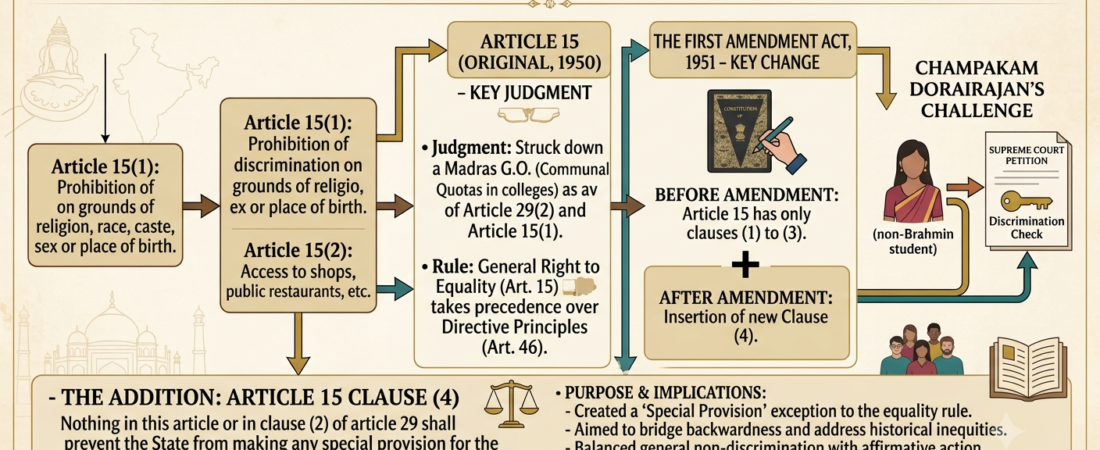
The landmark case of State of Madras v. Srimathi Champakam Dorairajan (1951) stands as one of the most significant legal disputes in Indian constitutional history. It forced the Supreme Court of India to clarify the boundary between Fundamental Rights and Directive Principles of State Policy.
Key Takeaway: Champakam Dorairajan v. State of Madras (1951) is a monumental Supreme Court judgment where a seven-judge bench ruled that government orders allocating medical and engineering college seats based on religion, race, and caste violated Article 15(1) of the Indian Constitution.
| Case Attribute | Legal Details |
|---|---|
| Petitioner | State of Madras |
| Respondent | Srimathi Champakam Dorairajan (and Srinivasan) |
| Bench | H.J. Kania C.J., Saiyid Fazl Ali, M. Patanjali Sastri, M.C. Mahajan, B.K. Mukherjea, S.R. Das, and Chandrasekhara Aiyar JJ. |
| Date of Judgment | April 9, 1951 |
| Primary Legislation | Communal General Order (Communal G.O.) of the State of Madras |
| Key Articles | Articles 13, 14, 15, 29(2), and 46 |
Written by Kapil Balhara | Technically Reviewed for Accuracy | Last Updated: October 2026
Table of Contents
- Factual Matrix: How the Dispute Reached the Supreme Court
- Key Constitutional Issues Raised
- Legal Analysis of the Supreme Court Judgment
- Historical Impact: The First Amendment Act of 1951
- Analytical Framework for Equal Opportunity Challenges
- Frequently Asked Questions
Factual Matrix: How the Dispute Reached the Supreme Court
In 1950, the State of Madras maintained an administrative practice known as the Communal General Order (Communal G.O.) to regulate admissions into state-run medical and engineering colleges. Under this executive order, available seats were apportioned among distinct religious and caste categories according to a fixed ratio.
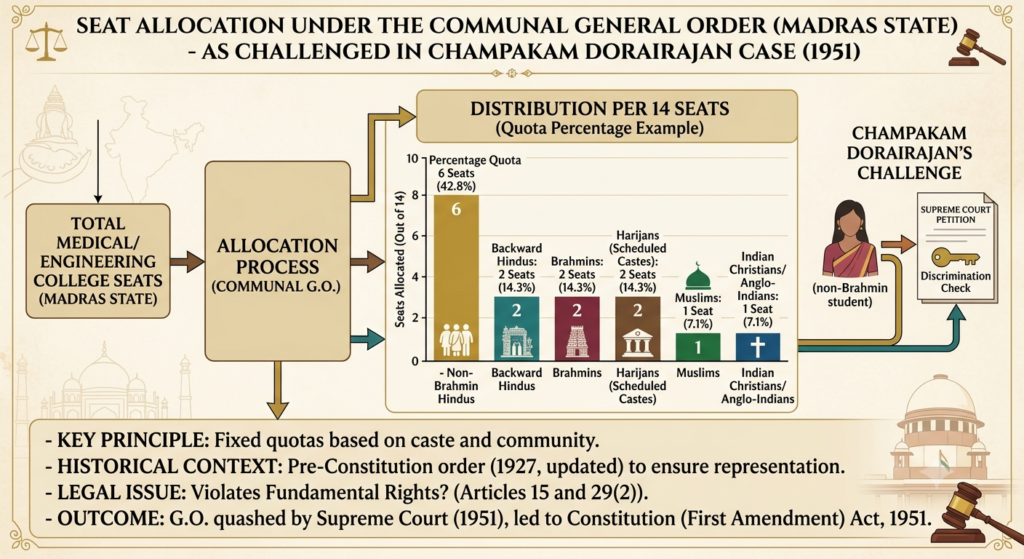
Champakam Dorairajan, a Brahmin woman, applied for admission to the Medical College at Madras. Despite securing high marks in her qualifying examinations, she was denied admission solely because the fixed quota allocated for her community had already been filled by applicants with higher marks.
Simultaneously, another applicant named Srinivasan faced an identical rejection when applying to the Engineering College at Guindy. Both applicants filed petitions under Article 226 of the Constitution before the High Court of Judicature at Madras, alleging that the Communal G.O. violated their fundamental rights.
The High Court ruled in favor of the applicants and struck down the Communal G.O. Consequently, the State of Madras appealed the decision directly to the Supreme Court of India.
Key Constitutional Issues Raised
The Supreme Court had to resolve critical constitutional questions regarding state-sponsored quotas and equality rights:
- Violation of Article 29(2): Does an administrative order restricting college admissions based on caste and religion violate a citizen’s right under Article 29(2)?
- Fundamental Rights vs DPSP: Can the Directive Principles of State Policy, specifically Article 46, override or restrict the enforceable Fundamental Rights in Part III?
- Scope of Equal Opportunity: Does the Constitution permit executive reservations in educational institutions without an explicit constitutional exception?
Legal Analysis of the Supreme Court Judgment
In our analysis of early constitutional history, this judgment established the foundational doctrine regarding the primacy of Fundamental Rights over Directive Principles. The seven-judge bench unanimously upheld the Madras High Court decision.
Protection Against Discrimination in Education
The Supreme Court focused heavily on Article 29(2), which explicitly prohibits denying any citizen admission into state-maintained educational institutions on grounds only of religion, race, caste, language, or any of them.
The State argued that the Communal G.O. was designed to advance social justice across all communities. However, the Court rejected this defense, holding that clear constitutional prohibitions cannot be bypassed by executive intent.
Key Takeaway: The Supreme Court held that classifying citizens by caste or religion for educational admissions violates Article 29(2), regardless of whether the state intends to achieve broader social welfare.
Fundamental Rights vs DPSP: The Subservience Doctrine
The State of Madras relied on Article 46, a Directive Principle directing the State to promote the educational and economic interests of weaker sections, particularly Scheduled Castes and Scheduled Tribes.
Justice S.R. Das, writing for the unanimous Court, rejected the argument that Article 46 could override Part III protections. The Court declared that Directive Principles must remain subsidiary to Fundamental Rights.
- Fundamental Rights are directly enforceable in courts of law under Article 32 and Article 226.
- Directive Principles of State Policy are non-justiciable under Article 37.
- Therefore, state legislative actions implementing Directive Principles cannot breach the fundamental guarantees in Part III.
Historical Impact: The First Amendment Act of 1951
The Supreme Court ruling generated immediate political and legal repercussions across India. Because the Constitution originally lacked a clause permitting affirmative action in educational institutions, Parliament acted swiftly to amend the Constitution.
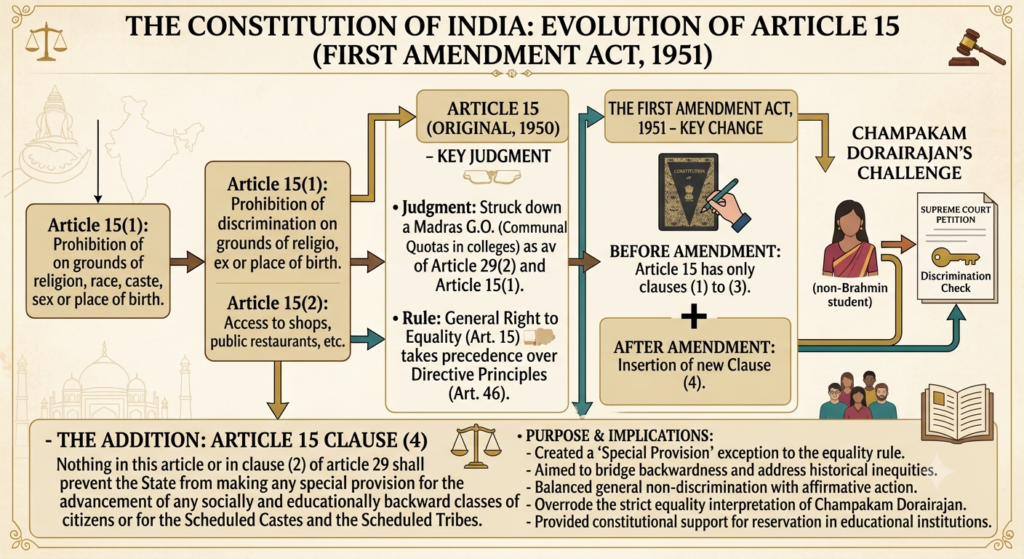
Prime Minister Jawaharlal Nehru introduced the Constitution (First Amendment) Act, 1951 in Parliament. This historical amendment introduced Clause (4) to Article 15, creating an explicit exception to equal treatment rules.
Key Takeaway: Parliament enacted the First Amendment Act of 1951 specifically to neutralize the outcome of Champakam Dorairajan, empowering the State to make special provisions for socially and educationally backward classes.
- Article 15(4) Added: Empowered the State to make special provisions for the advancement of socially and educationally backward classes or Scheduled Castes and Scheduled Tribes.
- Harmonious Construction: Laid the groundwork for modern reservation policy frameworks in Indian higher education.
- Expanded Judicial Review: Established that subsequent reservation schemes must undergo judicial scrutiny to prevent arbitrary classification.
Analytical Framework for Equal Opportunity Challenges
When evaluating legal disputes surrounding affirmative action and equal opportunity in India today, practitioners should follow a structured four-step framework:
Step-by-Step Equality Test
- Identify the Ground of Classification: Determine whether the state action differentiates citizens based solely on religion, race, caste, sex, or place of birth under Article 15(1) or Article 29(2).
- Verify Enabling Clauses: Check if the reservation scheme falls under specific enabling provisions, such as Article 15(4), Article 15(5), or Article 16(4).
- Assess Backwardness Criteria: Ensure that backwardness is determined using valid social and educational metrics rather than caste identity alone.
- Examine Cap & Proportionality: Verify whether the reservation percentages adhere to established judicial limits and maintain overall administrative efficiency.
If you are researching public law matters or preparing constitutional petitions, always read Champakam Dorairajan alongside subsequent landmark rulings like Indra Sawhney v. Union of India to understand how reservation jurisprudence evolved.
Frequently Asked Questions
What was the central holding of Champakam Dorairajan v. State of Madras?
The Supreme Court ruled that the Communal General Order of Madras violated Article 29(2) because it denied educational admissions based on caste and religion. It also established that Fundamental Rights supersede Directive Principles of State Policy.
How did the Indian government respond to this judgment?
Parliament passed the Constitution (First Amendment) Act, 1951. This amendment added Article 15(4), allowing the state to create special provisions and affirmative action policies for socially and educationally backward classes.
What is the relationship between Article 15 and Article 29(2)?
Article 15 provides a general protection against state discrimination, whereas Article 29(2) offers a specific right preventing discrimination against citizens seeking entry into state-funded educational institutions.
Conclusion
The judgment in Champakam Dorairajan v. State of Madras remains a pivotal turning point in Indian constitutional law. By enforcing strict adherence to individual equality rights, the ruling prompted Parliament to balance individual protections with social justice through constitutional amendments.