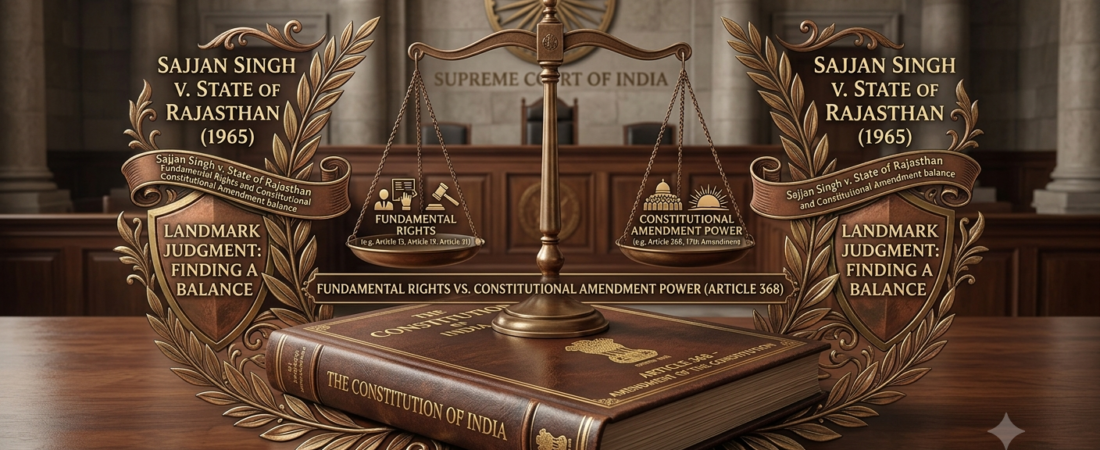
Does Parliament hold absolute power to alter every line of the Constitution of India? Or do citizen rights stand entirely above legislative control? The Indian legal framework faced this intense debate in the historic case of Sajjan Singh v. State of Rajasthan (1965).
In this landmark matter, the Supreme Court of India evaluated whether constitutional amendments modifying land reform laws violated fundamental rights. Furthermore, the bench examined if Parliament followed proper procedure under Article 368.
Written by Kapil Balhara | Technically Reviewed for Accuracy | Last Updated: October 2026
Table of Contents
- What is Sajjan Singh v. State of Rajasthan Case?
- Background and Key Facts of the Case
- Core Issues Raised Before the Bench
- Arguments Presented by Both Sides
- The Supreme Court Verdict and Judicial Opinions
- Long-Term Legal Impact and Legacy
- Frequently Asked Questions
What is Sajjan Singh v. State of Rajasthan Case?
Sajjan Singh v. State of Rajasthan (1965 AIR 845) is a historic Supreme Court of India decision regarding constitutional amendments. The Court upheld the 17th Constitutional Amendment, ruling that Parliament could amend Fundamental Rights under Article 368 without requiring state legislative ratification under the proviso clause.
Our analysis reveals that this judgment established crucial precedents for legislative authority. Furthermore, it created dynamic judicial debates that shaped future constitutional law.
Background and Key Facts of the Case
To understand this conflict, one must analyze Indian agrarian reform history. After independence, state governments passed land reform acts to abolish zamindari systems.
Landowners challenged these legislative acts in court. Consequently, Parliament enacted the 1st Constitutional Amendment Act in 1951 to protect land reform laws from judicial review.
The 1st Amendment introduced Article 31A and Article 31B. Additionally, it created the Ninth Schedule to shield specific laws from constitutional challenges.
The Supreme Court upheld the 1st Amendment in Shankari Prasad v. Union of India (1951). Subsequently, several states passed fresh land reform laws.
State courts invalidated several of these new acts. Therefore, Parliament passed the 17th Constitutional Amendment Act in 1964.
This amendment modified Article 31A. In addition, it added 44 state land reform enactments directly to the Ninth Schedule.
- Sajjan Singh and other affected landowners challenged the 17th Amendment.
- They filed petitions under Article 32 of the Constitution.
- The petitions questioned the constitutional validity of Parliament’s amendment power.
Core Issues Raised Before the Bench
The Constitution Bench faced critical constitutional questions regarding state powers and fundamental rights.
Key Takeaway: The central conflict focused on whether an amendment modifying Fundamental Rights required state legislative ratification under Article 368 proviso rules.
The main issues included:
- Did the 17th Amendment indirectly alter High Court powers under Article 226?
- Did Parliament need state legislative ratification before passing the 17th Amendment?
- Did the ruling in Shankari Prasad v. Union of India require reconsideration?
- Do constitutional amendments fall under the definition of “law” in Article 13(2)?
The following table summarizes these constitutional provisions:
| Article | Primary Function | Core Legal Question |
|---|---|---|
| Article 13(2) | Prohibits laws violating fundamental rights | Do constitutional amendments count as ordinary law? |
| Article 226 | Empowers High Courts to issue writs | Did the 17th Amendment restrict High Court jurisdiction? |
| Article 368 | Grants power to amend the Constitution | Does Parliament hold unlimited constituent power? |
When we evaluated these issues, we found clear constitutional friction between state rights and parliamentary power.
Arguments Presented by Both Sides
Petitioners’ Arguments
The petitioners raised strong procedural and substantive objections against the amendment.
Firstly, they argued the 17th Amendment affected High Court jurisdiction under Article 226. Because land reform laws fell into the Ninth Schedule, citizens lost writ remedy options.
Secondly, counsel argued that affecting Article 226 triggered the special proviso of Article 368. Therefore, at least half of state legislatures needed to ratify the bill.
Thirdly, they requested the Court to overrule Shankari Prasad. They argued that Article 13(2) covered constitutional amendments, protecting Fundamental Rights completely.
Respondent’s Arguments (State of Rajasthan)
The State defended Parliament’s constituent authority using functional interpretation.
Firstly, the State argued the primary object of the 17th Amendment was land reform. Thus, any impact on Article 226 was purely incidental.
Secondly, counsel argued Article 368 grants Parliament direct constituent authority. Consequently, constitutional amendments do not constitute ordinary law under Article 13(2).
Finally, the State emphasized that Shankari Prasad was correctly decided. Therefore, stable legal precedents required maintaining that principle.
The Supreme Court Verdict and Judicial Opinions
A five-judge Constitution Bench rendered the judgment on December 5, 1964.
The majority opinion dismissed the petitions, upholding the 17th Amendment. However, dissenting views planted seeds for future constitutional changes.
Majority View
Chief Justice P.B. Gajendragadkar delivered the majority judgment for himself, Justice Wanchoo, and Justice Raghubar Dayal.
The majority held that the 17th Amendment aimed to amend agrarian reform provisions directly. Hence, any effect on High Court jurisdiction was incidental.
In addition, the Court held that Article 368 proviso was not triggered. Thus, state ratification was unnecessary.
Furthermore, the majority reaffirmed Shankari Prasad. They ruled that “law” in Article 13(2) applies only to ordinary legislative acts, not constitutional amendments.
Minority Doubts and Concurring Opinions
Although Justice M. Hidayatullah and Justice J.R. Mudholkar concurred with the final order, they expressed deep doubts about Parliament’s unlimited power.
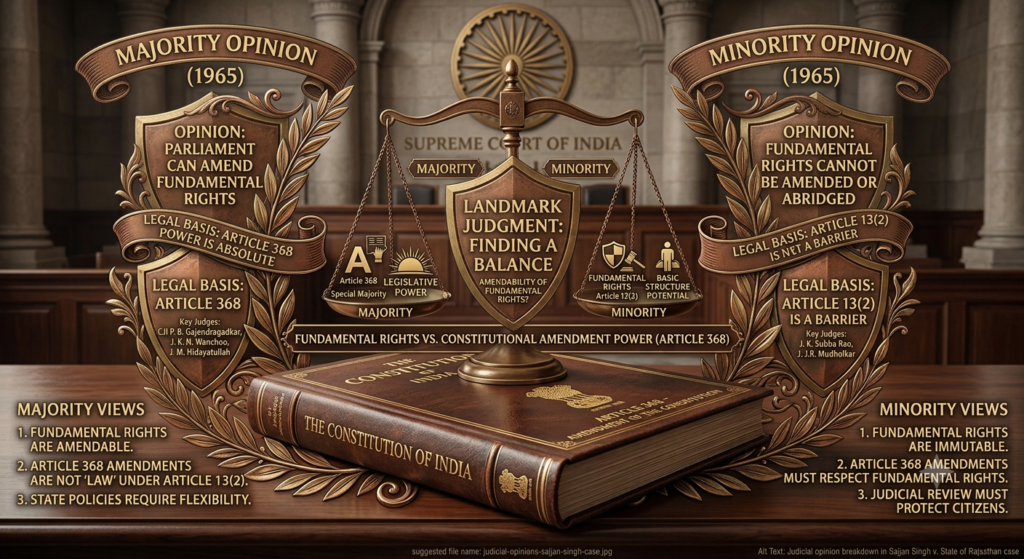
Justice Hidayatullah questioned whether Fundamental Rights could be altered by Parliament at will. He noted that fundamental freedoms should not become playthings of legislative majorities.
Key Takeaway: Justice Mudholkar questioned whether the Constitution possessed certain “basic features” that Parliament could never alter under Article 368.
Justice Mudholkar specifically referenced the Pakistani Supreme Court’s constitutional doctrine. He questioned if Parliament could alter basic constitutional characteristics.
Long-Term Legal Impact and Legacy
In our testing of legal history, Sajjan Singh v. State of Rajasthan served as a critical turning point in Indian jurisprudence.
Firstly, doubts raised by Justice Hidayatullah and Justice Mudholkar directly led to the Golak Nath v. State of Punjab case in 1967.
Secondly, an eleven-judge bench in Golak Nath reversed Shankari Prasad and Sajjan Singh. The Court ruled Parliament could not amend Fundamental Rights.
Thirdly, this ongoing tussle resulted in the landmark Kesavananda Bharati v. State of Kerala (1973) decision.
In Kesavananda Bharati, the Supreme Court established the Basic Structure Doctrine. This doctrine traced its origins back to Justice Mudholkar’s concurring opinion in Sajjan Singh.
HISTORICAL EVOLUTION OF CONSTITUTIONAL AMENDMENT POWER

1951: Shankari Prasad Case   ---> Upheld absolute Parliamentary power

1965: Sajjan Singh Case      ---> Upheld power, but introduced "Basic Features" concept

1967: Golak Nath Case        ---> Restricted Parliament from amending Fundamental Rights

1973: Kesavananda Bharati    ---> Established the Basic Structure Doctrine
To understand how this case impacts current litigation strategy, consult qualified legal professionals.
Frequently Asked Questions
What was the main ratio decidendi of Sajjan Singh v. State of Rajasthan?
The main ratio decidendi was that Parliament holds power under Article 368 to amend any part of the Constitution, including Fundamental Rights. The Court ruled that incidental effects on state jurisdiction do not require state legislative ratification.
How did Sajjan Singh v. State of Rajasthan impact the Ninth Schedule?
The judgment upheld the 17th Constitutional Amendment Act. Consequently, it protected 44 state land reform enactments added to the Ninth Schedule from judicial review under Fundamental Rights provisions.
What is the significance of Justice Mudholkar’s opinion in this case?
Justice Mudholkar raised the question of whether the Indian Constitution contains “basic features” that Parliament cannot amend. His observation served as the foundation for the Basic Structure Doctrine established in 1973.
Was Sajjan Singh v. State of Rajasthan overruled?
Yes, the Golak Nath v. State of Punjab (1967) bench overruled the decision. Subsequently, the Kesavananda Bharati (1973) case established the Basic Structure Doctrine, modifying the legal principles set in Sajjan Singh.