Written by Kapil Balhara | Technically Reviewed for Accuracy | Last Updated: October 2026
Table of Contents
- What Is Vishaka v. State of Rajasthan Case?
- Factual Background and the Incident Behind the Trial
- Constitutional Scope: Article 14, Article 19, and Article 21
- Reliance on CEDAW Guidelines and International Conventions
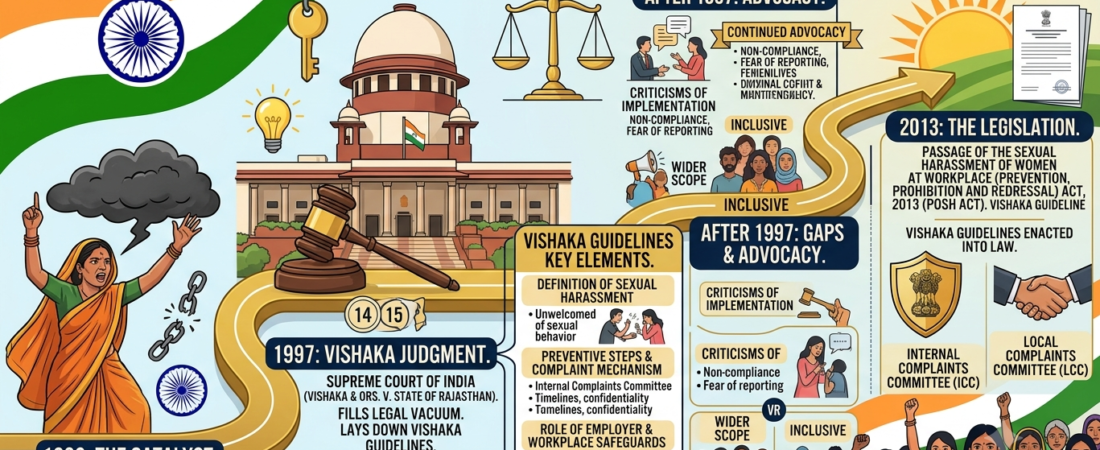
- The Vishaka Guidelines: Key Directions and Complaint Mechanism
- Transition from Judicial Guidelines to the POSH Act 2013
- Frequently Asked Questions
What Is Vishaka v. State of Rajasthan Case?
Key Takeaway: The Vishaka v. State of Rajasthan (1997) judgment created binding judicial guidelines to prevent workplace sexual harassment in India. The Supreme Court used international conventions like CEDAW to fill legislative voids and guarantee workplace safety for women under Articles 14, 19, and 21.
The landmark case Vishaka v. State of Rajasthan emerged in 1997 after social activists filed a class-action petition under Article 32 of the Constitution. A three-judge bench of the Supreme Court, led by Chief Justice J.S. Verma, Justice Sujata V. Manohar, and Justice B.N. Kirpal, established historical directions to curb sexual harassment at all workplaces.
Furthermore, the Supreme Court recognized that sexual harassment directly violates fundamental rights to gender equality, personal liberty, and professional freedom. Consequently, the Court declared these guidelines as binding law under Article 141 of the Constitution until Parliament enacted comprehensive legislation.

Factual Background and the Incident Behind the Trial
To begin with, the immediate catalyst for this writ petition was the brutal gang rape of Bhanwari Devi, a social worker in rural Rajasthan. She attempted to stop child marriage practices in her village as part of a state government program. In retaliation, powerful local men attacked her.
However, the criminal justice process revealed severe institutional barriers and safety hazards facing working women. Social action groups and NGOs, united under the name “Vishaka,” realized that existing civil and criminal laws lacked specific safeguards against workplace harassment.

Subsequently, activists approached the Supreme Court under Article 32. Their objective was not to litigate individual criminal charges, but to establish a legal framework that ensured workplace safety across public and private sectors.
Key Takeaway: The brutal attack on a public worker exposed a massive statutory void, prompting the judiciary to establish workplace safety rules.
Constitutional Scope: Article 14, Article 19, and Article 21
Besides addressing workplace misconduct, the Supreme Court analyzed how sexual harassment violates core constitutional guarantees.
Fundamental Rights Framework
First, the bench established that gender equality encompasses protection from sexual harassment and the right to work with human dignity.
Secondly, the Court highlighted that harassment breaches several specific articles of the Constitution:
- Article 14: Guarantees equality before the law and equal protection of laws.
- Article 15: Prohibits discrimination on grounds of sex.
- Article 19(1)(g): Guarantees the fundamental right to practice any profession or carry on any occupation safely.
- Article 21: Secures the right to life and personal liberty, which inherently includes living with dignity.
| Constitutional Provision | Legal Relevance in Workplace Safety |
|---|---|
| Article 14 | Guarantees gender equality and prevents arbitrary discrimination at work. |
| Article 15(3) | Empowers the State to create special protective provisions for women. |
| Article 19(1)(g) | Ensures women can pursue an occupation without a hostile work environment. |
| Article 21 | Protects the fundamental right to live and work with human dignity. |
| Article 42 | Mandates just and humane conditions of work as a Directive Principle. |
In our evaluation of Indian constitutional history, this judgment marked a defining moment where fundamental duties under Article 51A(e) directly informed judicial directives.
Reliance on CEDAW Guidelines and International Conventions
In the absence of domestic statutory provisions, the Supreme Court turned to international instruments to interpret fundamental rights.
Specifically, the Court relied on Article 51(c) and Article 253 of the Constitution, alongside Entry 14 of the Union List in the Seventh Schedule. These provisions allow international conventions consistent with fundamental rights to be read into domestic law.
  [ Legislative Vacuum in Domestic Law ]
                     │
                     ▼
  [ Reliance on CEDAW & Beijing Principles ]
                     │
                     ▼
  [ Harmonious Construction via Article 51(c) ]
                     │
                     ▼
[ Enforceable Guidelines under Article 141 ]
- Identify the statutory gap in domestic law regarding workplace safety.
- Examine international obligations under the UN Convention on the Elimination of All Forms of Discrimination against Women (CEDAW).
- Incorporate CEDAW General Recommendations 22 and 24 to define sexual harassment and mandate complaint mechanisms.
Furthermore, the Court noted that India ratified CEDAW in June 1993 and made official commitments at the Fourth World Conference on Women in Beijing. Therefore, international standards provided valid authorization to create enforceable domestic norms.
Key Takeaway: The judiciary used international law to expand domestic constitutional guarantees and fill legislative voids.
The Vishaka Guidelines: Key Directions and Complaint Mechanism
To ensure workplace protection, the Supreme Court issued exhaustive directions binding on all employers in public and private sectors.
Definition of Sexual Harassment
The Court defined sexual harassment as any unwelcome, sexually determined behavior, whether directly or by implication. This includes:
- Physical contact and advances
- A demand or request for sexual favors
- Sexually colored remarks or showing pornography
- Any other unwelcome physical, verbal, or non-verbal conduct of a sexual nature

Mandated Employer Duties and Redressal Machinery
Additionally, the judgment outlined specific preventive steps and redressal protocols:
- Express Prohibition: Employers must prominently publish and circulate prohibitions against sexual harassment.
- Complaints Committee: Organizations must establish a dedicated mechanism to handle grievances. The Complaints Committee must be headed by a woman, and at least half of its members must be women.
- Third-Party Involvement: To prevent internal coercion from senior management, the committee must include an external third party, such as an NGO representative.
- Disciplinary Action: Employers must initiate appropriate disciplinary action or criminal proceedings under the Indian Penal Code when conduct constitutes an offense.
Transition from Judicial Guidelines to the POSH Act 2013
While the Vishaka ruling governed Indian workplaces for sixteen years, it served primarily as a temporary measure until statutory law was enacted.
Consequently, Parliament enacted the Sexual Harassment of Women at Workplace (Prevention, Prohibition and Redressal) Act, 2013 (POSH Act). The POSH Act codified the judicial principles established in Vishaka v. State of Rajasthan into a formal statutory framework.
- Internal Complaints Committee (ICC): The POSH Act formalized the Vishaka committee structure into mandatory ICCs for offices with ten or more employees.
- Local Complaints Committee (LCC): The statute extended protection to informal and unorganized sector workers through district-level LCCs.
- Expanded Scope: The law broadened the definition of “aggrieved woman” and “workplace” to cover remote work, transport, and non-traditional environments.
Ultimately, the transformation from judicial guidelines into legislation demonstrates how judicial activism can bridge urgent social needs and statutory reform.
Frequently Asked Questions
1. What is the primary significance of Vishaka v. State of Rajasthan (1997)?
The judgment established the Vishaka Guidelines, creating the first legal framework to prevent and redress workplace sexual harassment in India.
2. How did the Supreme Court use CEDAW in this case?
The Supreme Court incorporated international standards from CEDAW into domestic law via Articles 51(c) and 253 to guarantee rights under Articles 14, 19, and 21.
3. What were the composition requirements for the Complaints Committee under Vishaka?
The Complaints Committee had to be chaired by a woman, consist of at least 50% women members, and include an independent third party, such as an NGO representative.
4. Which law replaced the Vishaka Guidelines in India?
Parliament enacted the Sexual Harassment of Women at Workplace (Prevention, Prohibition and Redressal) Act in 2013 (POSH Act), codifying and expanding upon the Vishaka Guidelines.