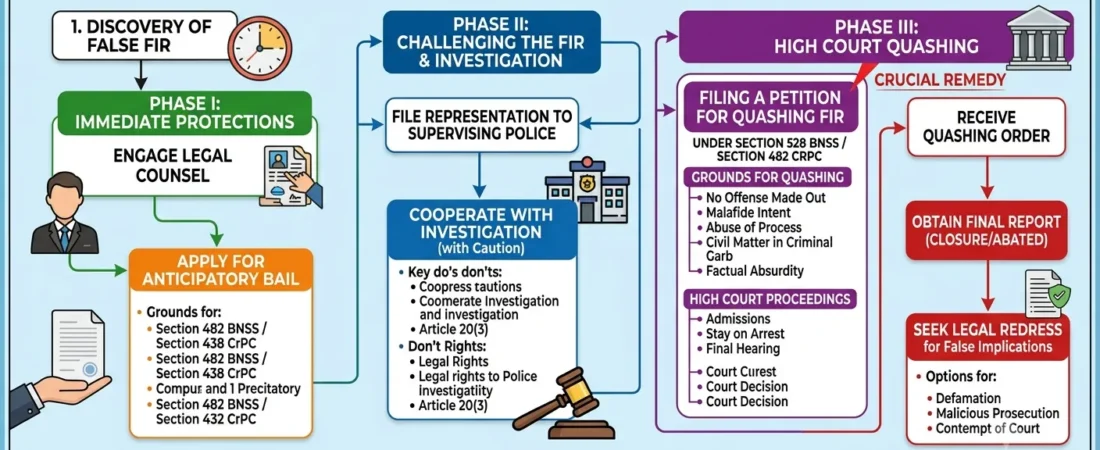
Discovering that someone filed a malicious police complaint against you triggers intense fear, panic, and overwhelming dread. Therefore, learning How to Protect Yourself Against a False FIR provides you with an ironclad defense strategy to preserve your liberty, reputation, and career.
Written by Kapil Balhara | Technically Reviewed for Accuracy | Last Updated: October 2026
Table of Contents
- Understanding False FIRs and Immediate Survival Steps
- Gathering Crucial Counter-Evidence and Building Your Alibi
- Securing Pre-Arrest Protection: Anticipatory Bail and Bail Remedies
- Quashing False FIRs in High Court under Section 528 BNSS
- Engaging Investigating Officers and Submitting Written Representations
- Filing Counter-Charges: Defamation and Legal Action for Malicious Prosecution
- Frequently Asked Questions
Understanding False FIRs and Immediate Survival Steps
False criminal allegations often stem from personal feuds, matrimonial disputes, property rivalries, or corporate extortion tactics. Consequently, understanding how to navigate the legal process early protects you from procedural traps and police misconduct.
Under Section 173 of the Bharatiya Nagarik Suraksha Sanhita (BNSS), police officers must record disclosures regarding cognizable offences. However, unscrupulous individuals frequently exploit this statutory mandate to fabricate false charges against innocent citizens.
Key Takeaway: Facing a false FIR requires calm, strategic planning rather than emotional panic. Never attempt to hide or abscond, as fleeing creates adverse inferences during bail hearings.
Definition and Summary Block
Learning how to protect yourself against a false FIR enables individuals to counter fabricated criminal allegations legally. Victims of false complaints can secure anticipatory bail, gather digital alibis, submit representations to investigating officers, petition High Courts for FIR quashing under Section 528 BNSS, and prosecute false complainants for malicious prosecution.
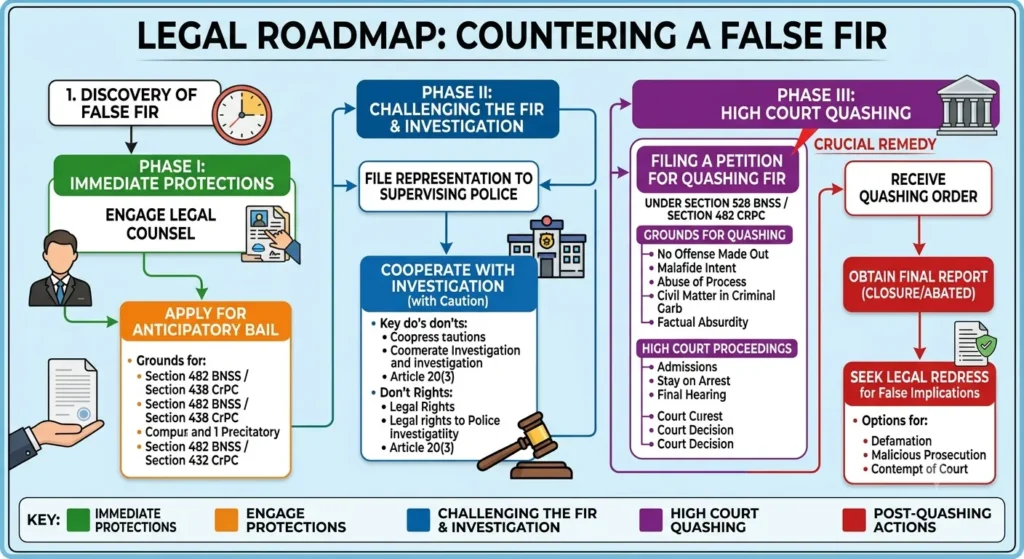
In our legal practice, we routinely evaluate cases where complainants misuse penal statutes. Therefore, review the comparative breakdown below to understand the distinct legal remedies available at different stages of a false prosecution.
| Legal Defense Remedy | Primary Statute / Forum | Timing of Execution | Primary Objective |
|---|---|---|---|
| Anticipatory Bail Application | Section 482 BNSS / Session Court or High Court | Immediately upon learning of a false FIR | Secures pre-arrest protection to prevent police detention |
| Written Representation to IO | Section 173 BNSS / Police Station / SP Office | During initial investigation stage | Places counter-evidence on official police record |
| High Court Quashing Petition | Section 528 BNSS / State High Court | Post-FIR registration or post-charge sheet | Nullifies the false FIR and cancels criminal proceedings |
| Regular Bail Petition | Section 480 BNSS / Magistrate or Sessions Court | If arrest has already occurred | Secures judicial release from police or judicial custody |
| Prosecution for False Information | Section 217 / Section 248 BNS / Criminal Court | Post-acquittal or post-quashing | Imposes criminal penalties on false complainants |
Gathering Crucial Counter-Evidence and Building Your Alibi
Establishing an undeniable factual defense early neutralizes false allegations before police complete their investigation. Therefore, gather objective electronic and physical evidence immediately.
Immediate Steps Upon Discovering a False FIR
The moment you discover a false FIR, obtain an official certified copy of the report. Under Section 173(2) BNSS read alongside Youth Bar Association of India v. Union of India (2016), FIRs must be uploaded on official police websites within 24 to 48 hours.
Read every single allegation in the FIR carefully with your defense lawyer. Identify specific claims regarding dates, times, locations, and alleged overt acts to pinpoint factual impossibilities.
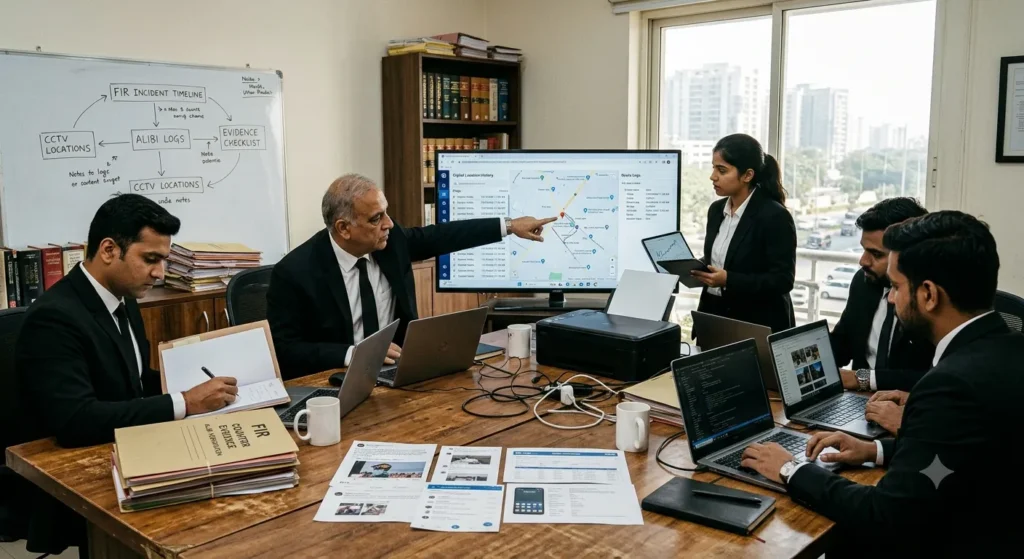
Collecting Alibis and Digital Location History
Building a solid plea of alibi demonstrates that you were physically present elsewhere when the alleged crime occurred. In Binay Kumar Singh v. State of Bihar (1997), the Supreme Court held that an alibi supported by credible proof completely disproves involvement.
Download your Google Maps timeline history, toll plaza FASTag receipts, credit card transaction slips, and ride-sharing receipts. These electronic records establish your precise geographic location during the alleged incident window.
Gathering CCTV Footage and Electronic Proofs
In our testing of defense workflows, securing third-party CCTV footage quickly prevents crucial evidence from being overwritten. Approach nearby commercial establishments, housing societies, or municipal traffic control centers to obtain raw footage.
In addition, preserve all WhatsApp chat histories, text messages, call detail records (CDR), and audio recordings. Under Section 63 of the Bharatiya Sakshya Adhiniyam (BSA) (formerly Section 65B Indian Evidence Act), electronic records accompanied by valid electronic certificates serve as primary courtroom evidence.
Key Takeaway: Preserve all original electronic media and devices without alteration. Do not delete chat histories or modify files, as metadata verification proves authenticity.
Securing Pre-Arrest Protection: Anticipatory Bail and Bail Remedies
Preventing illegal detention remains your highest priority when facing fabricated charges. Consequently, file for pre-arrest judicial relief immediately.
Applying for Anticipatory Bail to Avoid Arrest
To safeguard your personal liberty, file an Anticipatory Bail application under Section 482 of the Bharatiya Nagarik Suraksha Sanhita (BNSS) (formerly Section 438 CrPC).
You can approach either the Court of Session or the State High Court directly for pre-arrest bail. The court evaluates your lack of criminal antecedents, the nature of allegations, and the clear risk of malicious arrest.
In the landmark judgment of Sushila Aggarwal v. State (NCT of Delhi) (2020), a Constitution Bench of the Supreme Court held that anticipatory bail protection does not automatically expire upon charge sheet filing and can continue throughout the trial.
Legal Remedies for Illegal Arrest and Harassment
If police officers attempt to arrest you without adhering to statutory mandates, assert your constitutional safeguards under Article 22 of the Constitution.
In Arnesh Kumar v. State of Bihar (2014), the Supreme Court mandated that police officers must issue formal notice of appearance under Section 35 BNSS (formerly Section 41A CrPC) for offences carrying sentences up to seven years. Officers who make arbitrary arrests face disciplinary action and contempt proceedings.
Furthermore, in DK Basu v. State of West Bengal (1997), the Supreme Court laid down mandatory arrest guidelines, including right to legal counsel, family notification, and compulsory medical examination.
Securing Bail If Arrest Has Already Occurred
If police arrest you before securing anticipatory relief, file a Regular Bail application immediately under Section 480 BNSS (formerly Section 437/439 CrPC).
Highlight the lack of prima facie evidence, the absence of custodial interrogation needs, and the personal enmity driving the complainant.
In Sanjay Chandra v. CBI (2012), the Supreme Court reaffirmed that bail is the rule and jail is the exception, emphasizing that pre-trial detention should never operate as punishment.
Key Takeaway: Securing interim protection or anticipatory bail prevents custodial harassment, allowing you to fight the false charges effectively from outside jail.
Quashing False FIRs in High Court under Section 528 BNSS
When an FIR is manifestly absurd, malicious, or legally unsustainable, the State High Court possesses inherent powers to wipe out the criminal proceedings entirely.
Filing a High Court Petition to Quash False FIR
Approach the State High Court by filing a petition under Section 528 of the BNSS (formerly Section 482 CrPC). This statutory provision preserves the High Court’s inherent power to prevent abuse of court process and secure the ends of justice.
In your petition, present your electronic evidence, verified alibis, and documented proof of prior disputes. Request the court to quash the false FIR and stay all investigative proceedings pending final adjudication.
HIGH COURT QUASHING PETITION STRUCTURE UNDER SECTION 528 BNSS

IN THE HIGH COURT OF JUDICATURE AT [STATE NAME]
CRIMINAL MISCELLANEOUS PETITION NO. _____ OF 2026

IN THE MATTER OF:
[Your Name]                                      ... PETITIONER
                  VERSUS
State of [State Name] & Anr.                     ... RESPONDENTS

PETITION UNDER SECTION 528 OF THE BHARATIYA NAGARIK SURAKSHA SANHITA (BNSS)
FOR QUASHING OF FIR NO. [___/2026] REGISTERED AT POLICE STATION [PS NAME]

MOST RESPECTFULLY SHOWETH:

1. STATEMENT OF FACTS:
The Petitioner is an innocent citizen facing false criminal charges in FIR No. [___/2026] registered under Sections [Mention Sections] of BNS at Police Station [PS Name].

2. PROOF OF MALICE AND ABSURDITY:
The present FIR is a complete fabrication stemming from prior personal feuds. The Petitioner possesses documentary proof (Annexure P-1) demonstrating a complete plea of alibi.

3. GROUNDS FOR QUASHING:
A. The allegations in the FIR do not disclose any cognizable offence against the Petitioner.
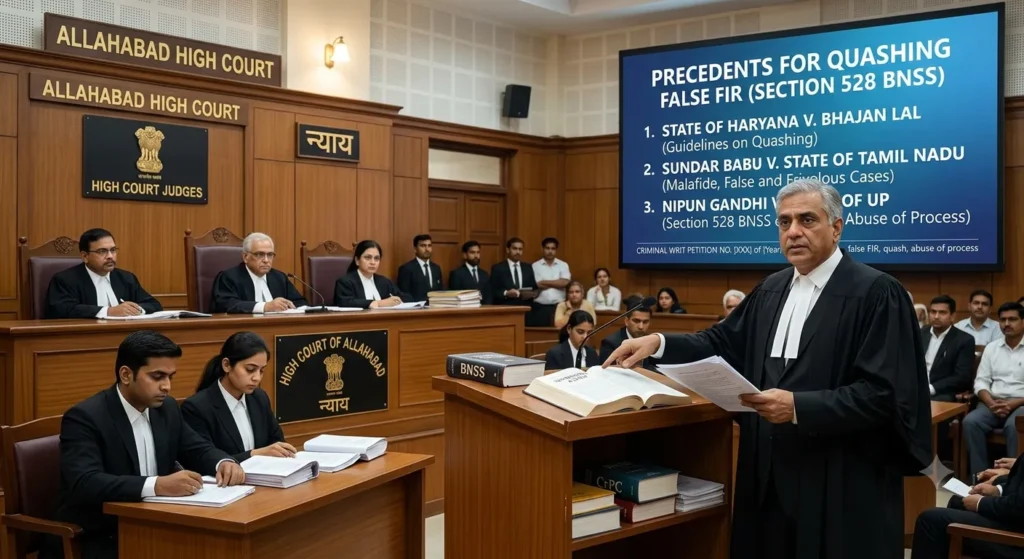
B. The criminal proceedings are manifestly attended with mala fide motives as per State of Haryana v. Bhajan Lal (1992).

PRAYER:
It is prayed that this Hon'ble Court may be pleased to quash FIR No. [___/2026] and stay all consequential proceedings.
Groundbreaking Precedents on FIR Quashing
In our legal analysis, relying on established Supreme Court precedents remains essential during High Court quashing arguments:
- State of Haryana v. Bhajan Lal (1992) Supp (1) SCC 335: The Supreme Court laid down seven golden categories where High Courts should quash FIRs, including cases involving clear malice, absurd allegations, or personal vengeance.
- Preeti Gupta v. State of Jharkhand (2010) 7 SCC 667: The Supreme Court warned against the growing trend of over-implicating innocent relatives in matrimonial criminal complaints, urging High Courts to quash exaggerated charges.
- Kahkashan Kausar @ Sonam v. State of Bihar (2022) 6 SCC 599: The court quashed false criminal proceedings against in-laws, holding that general and omni-bus allegations without specific overt acts cannot sustain a criminal trial.
- Neeharika Infrastructure Pvt. Ltd. v. State of Maharashtra (2021) 19 SCC 401: The court clarified that while High Courts should exercise caution, genuine cases showing manifest legal abuse justify immediate quashing and interim protection against arrest.
Engaging Investigating Officers and Submitting Written Representations
While preparing judicial petitions, actively engage with the assigned police investigation to influence the official police report.
Countering False Charges with Written Representations
Draft a formal, comprehensive written representation addressed to the Station House Officer (SHO) and the Superintendent of Police (SP).
Detail the exact background of personal enmity, outline factual contradictions in the complainant’s narrative, and attach certified evidence annexures.
Send this representation via Registered Post AD to create an undeniable administrative record that police officers cannot suppress.
Presenting Counter-Evidence to the Investigating Officer
Schedule a formal meeting with the assigned Investigating Officer (IO) alongside your legal counsel.
Provide physical copies of your CCTV footage, mobile location logs, bank statements, and witness affidavits under formal index receipts.
Under Section 193 of the BNSS (formerly Section 173 CrPC), the IO must evaluate all relevant material before submitting a final report to the Magistrate. If your evidence clearly proves innocence, the IO can file a Closure Report (Final Report) recommending case dismissal.
Key Takeaway: Forcing the IO to acknowledge your counter-evidence on record ensures that even if police file a charge sheet, your defense material remains part of the official court record.
Need immediate guidance on drafting a counter-representation? Contact our expert defense team today for a confidential case evaluation.
Filing Counter-Charges: Defamation and Legal Action for Malicious Prosecution
Once you clear your name from false charges, take aggressive legal action to hold false complainants accountable and recover financial damages.
Filing Defamation Cases Against False Complainants
Fabricated criminal charges cause severe damage to your social standing, professional reputation, and mental health. Consequently, file criminal defamation proceedings under Section 356 of the Bharatiya Nyaya Sanhita (BNS) (formerly Section 499/500 IPC).
In addition, file a Civil Suit for Damages in the competent Civil Court to claim monetary compensation for reputational harm, business loss, and legal expenses incurred.
Prosecuting False Complainants for Malicious Prosecution
When a court quashes the false FIR or acquits you fully, initiate criminal proceedings against the complainant under Section 217 and Section 248 of the BNS (formerly Section 182/211 IPC).
These provisions penalize individuals who knowingly give false information to public servants or institute false criminal charges with intent to cause injury. Complainants face rigorous imprisonment and fines upon conviction.
POST-ACQUITTAL COUNTER-ACTION WORKFLOW

[Step 1: Obtain Certified Copy of High Court Quashing Order / Court Acquittal]
      │
      ▼
[Step 2: File Criminal Complaint under Section 217/248 BNS for False Prosecution]
      │
      ▼
[Step 3: Issue Legal Notice for Defamation & Monetary Damages]
      │
      ▼
[Step 4: File Criminal Defamation Complaint under Section 356 BNS & Civil Suit for Damages]
Ultimately, taking decisive legal action against false complainants deters future harassment while restoring your dignity. Stand firm on the facts, utilize statutory protections, and let the law defend your innocence.
Frequently Asked Questions
Can police arrest me immediately after a false FIR is filed?
Police can legally arrest an accused in cognizable offences. However, for offences carrying sentences under seven years, police must issue a notice under Section 35 BNSS as mandated in Arnesh Kumar v. State of Bihar. Applying for anticipatory bail immediately prevents arrest.
How long does it take for a High Court to quash a false FIR?
High Court quashing proceedings under Section 528 BNSS typically take between two to six months depending on court backlogs. However, High Courts often grant interim stay on police investigation or grant protection against arrest during the very first hearing.
What happens if the police file a charge sheet despite proof of my innocence?
If the police file a charge sheet despite clear proof of innocence, file a quashing petition in the High Court against the charge sheet, or file a Discharge Application before the trial court under Section 250/262 BNSS before charges are formally framed.
Can I sue the police for registering a false FIR against me?
You can take legal action against police officers if they acted with clear malice, forged documents, or violated mandatory arrest guidelines under Arnesh Kumar and DK Basu. You can file departmental complaints with the Police Complaints Authority or approach the High Court for compensation.
Reclaim Your Peace of Mind and Liberty
Facing a false FIR is a deeply distressing experience, but you do not have to navigate it defenselessly. By taking fast legal action, securing anticipatory bail, and presenting undeniable counter-evidence, you can defeat fabricated charges completely.
Do not let malicious complaints ruin your future. Gather your proofs, consult expert defense counsel, and assert your constitutional rights to secure complete justice today.