
Written by Kapil Balhara | Technically Reviewed for Legal Accuracy | Last Updated: August 2026
Table of Contents
- Notice vs. Anticipatory Bail
- The Core Statutory Framework: BNSS 2023 vs. CrPC 1973
- Can You File Anticipatory Bail During Notice Compliance?
- Comparing Police Notice Compliance and Judicial Protection
- Applying for Bail Before Appearing: Step-by-Step Process
- Landmark Supreme Court and Delhi High Court Rulings
- Fatal Pitfalls Accused Individuals Must Avoid
- Frequently Asked Questions
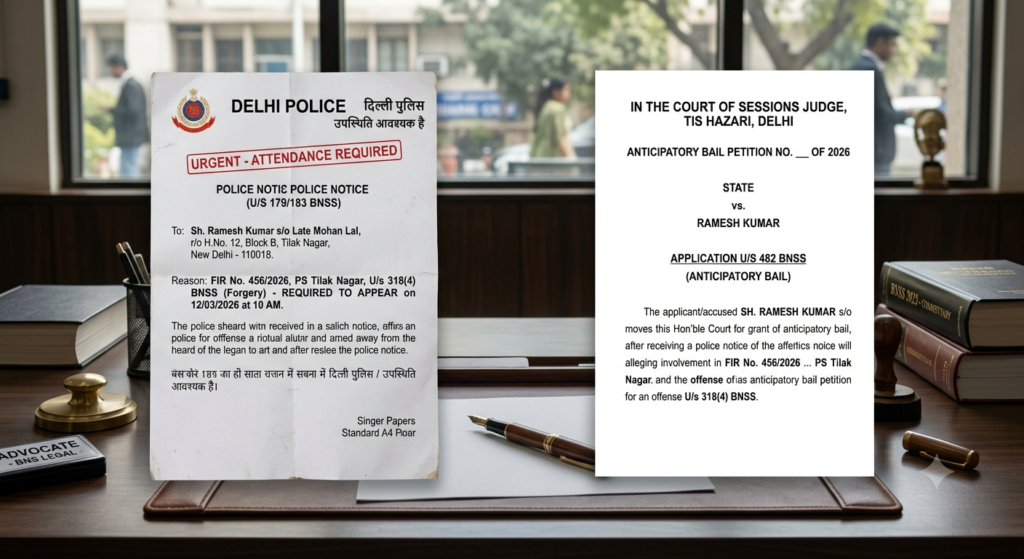
Receiving a police summons creates intense panic and confusion. You can file for anticipatory bail even after receiving a police notice in Delhi, India. Receiving an appearance notice does not take away your legal right to seek pre-arrest judicial protection.
Notice vs. Anticipatory Bail
Under Section 35(3) of the Bharatiya Nagarik Suraksha Sanhita, 2023 (BNSS) [formerly Section 41A CrPC], police issue appearance notices for minor offences. However, sub-section (5) permits immediate arrest if an investigating officer records reasons alleging non-cooperation. Anticipatory bail under Section 482 BNSS provides binding judicial immunity, protecting your fundamental personal liberty.
Key Takeaway: A police notice guarantees conditional immunity only. Securing anticipatory bail provides enforceable court protection against sudden arrest during interrogation.
The Core Statutory Framework: BNSS 2023 vs. CrPC 1973
Understanding the criminal procedure statutory provisions in India ensures you remain ahead of aggressive investigating officers.
Furthermore, procedural laws changed significantly with the rollout of the new criminal codes. Consequently, citizens must know how old provisions map to modern statutory frameworks.
Section 35(3) BNSS vs. Section 41A CrPC
Under Section 35(3) of the BNSS, an investigating officer must issue a notice of appearance when an offence carries a sentence up to 7 years.
To illustrate, police cannot make arbitrary arrests without documenting specific justifications. However, officers often use claims of “evasive answers” to trigger arrests under Section 35(5) BNSS.
Section 482 BNSS vs. Section 438 CrPC
Section 482 of the BNSS grants District Sessions Courts and the Delhi High Court wide powers to issue directions for pre-arrest bail.
In addition, this statutory remedy ensures innocent citizens do not suffer custodial humiliation due to false or exaggerated complaints.
Can You File Anticipatory Bail During Notice Compliance?
Yes, you can file an application for anticipatory bail while complying with a police notice.
In fact, the Supreme Court of India consistently affirms that receiving a summons notice establishes a clear, objective apprehension of arrest.
Because an official criminal inquiry has commenced, your fear of potential detention is legally well-founded, making your petition fully maintainable.
Comparing Police Notice Compliance and Judicial Protection
Choosing between trusting a police officer’s notice and seeking court intervention requires evaluating key legal dynamics.
| Legal Feature | Section 35 BNSS / 41A CrPC Notice | Anticipatory Bail (Section 482 BNSS) |
|---|---|---|
| Issuing Authority | Investigating Police Officer | District Sessions Court or Delhi High Court |
| Primary Objective | Mandates appearance for interrogation. | Grants judicial immunity against custodial arrest. |
| Arrest Risk Level | High risk if officer alleges non-cooperation. | Absolute protection when court conditions are met. |
| Statutory Power | Executive police power. | Judicial relief under constitutional mandates. |
| Compliance Term | Mandatory physical presence required. | Subject to court orders like surrendering passports. |
Key Takeaway: Relying solely on police assurance leaves you exposed. A court order granting anticipatory bail completely neutralizes arbitrary custodial arrest risks.
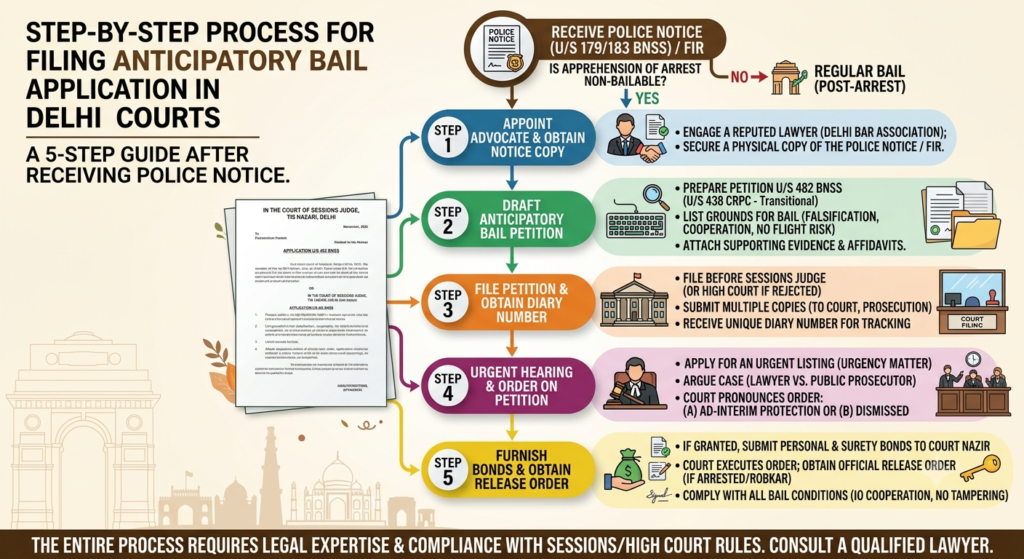
Applying for Bail Before Appearing: Step-by-Step Process
When facing complex financial disputes, matrimonial complaints under Section 85/86 BNS, or corporate allegations, follow this structured process before stepping into a police station.
- Analyze the Notice Details: Carefully record the FIR number, police station, penal sections, and the name of the investigating officer.
- Engage a Defense Advocate: Consult a qualified lawyer immediately to draft an urgent petition under Section 482 BNSS highlighting your clean antecedents.
- File in the Right Forum: Submit your petition before the competent Sessions Court at Patiala House, Tis Hazari, Saket, Rohini, Dwarka, or Karkardooma.
- Secure Interim Protection: Move an urgent application requesting interim relief. Courts regularly rule that no coercive steps shall be taken subject to joining the investigation.
- Serve Formal Notice: Send a legal communication by email and registered post to the investigating officer, confirming your readiness to cooperate under judicial protection.
Landmark Supreme Court and Delhi High Court Rulings
Judicial precedents govern how police officers handle personal liberty and statutory notices across India.
Arnesh Kumar v. State of Bihar (2014)
The Supreme Court mandated that arrest must remain an exceptional measure for offences punishable by up to 7 years imprisonment.
Furthermore, officers must complete a mandatory checklist justifying custodial detention before arresting any citizen who complies with notices.
Satender Kumar Antil v. CBI (2022)
In this landmark decision, the apex court emphasized that arbitrary non-compliance with notice protocols directly entitles an accused person to pre-arrest or regular bail protection.
Delhi High Court Precedents on Preliminary Inquiries
The Delhi High Court repeatedly reinforces that anticipatory bail remains maintainable even during preliminary inquiries prior to formal FIR registration.
Specifically, if a concrete threat to personal freedom exists, courts must protect the constitutional rights guaranteed under Article 21.
Fatal Pitfalls Accused Individuals Must Avoid
- Evading the Notice: Ignoring a police notice gives the officer legal grounds to issue non-bailable warrants or execute an immediate arrest for non-compliance.
- Attending Unprepared: Entering a police station without legal strategy leaves you vulnerable to coerced statements or sudden detention under claims of uncooperative behavior.
- Delaying Judicial Remedies: Waiting until hours before the deadline prevents your defense counsel from securing interim protective court orders.
- Contacting the Complainant: Trying to pressure witnesses or alter evidence guarantees the immediate cancellation or rejection of your bail petition.

Key Takeaway: Never ignore a formal police notice. Always combine written compliance with an immediate application for anticipatory bail to maintain full protection.
Frequently Asked Questions
Can police arrest me immediately after issuing a Section 35 BNSS notice?
Police cannot make routine arrests if you comply with the notice. However, if the investigating officer documents written reasons claiming you were non-cooperative, evasive, or required for custodial recovery, they can execute an arrest under Section 35(5) BNSS.
Does filing for anticipatory bail mean I am guilty?
No, seeking anticipatory bail is a constitutional right to protect yourself against arbitrary arrest and malicious prosecution. Courts view pre-arrest bail as a procedural shield, not an admission of guilt.
What happens if the Sessions Court rejects my anticipatory bail?
If the District Sessions Court rejects your petition, your defense advocate can immediately challenge the order by filing an urgent anticipatory bail application before the Delhi High Court under Section 482 of the BNSS.
Secure Your Liberty Today
Handling police notices requires swift legal action, clear technical knowledge, and strategic execution.
Do not wait for investigating officers to take coercive action. Protect your freedom by consulting a defense advocate to file for anticipatory bail today.
Disclaimer: This article is published solely for educational and informational purposes and does not constitute formal legal advice. Reading this content or communicating through this platform does not create an attorney-client relationship. If you are facing criminal proceedings or have received a police notice, consult a qualified criminal advocate immediately for case-specific legal guidance.