Written by Kapil Balhara | Technically Reviewed for Accuracy | Last Updated: September 2026
Table of Contents
- 1. The Core Legal Framework: Section 35(3) BNSS Explained
- 2. Consequences of Ignoring a Section 35(3) BNSS Notice
- 3. Written Reply vs. Physical Appearance: What Does the Law Require?
- 4. Legal Steps When Unable to Attend Police Questioning
- 5. Landmark Supreme Court Judgments & Protections
- 6. Frequently Asked Questions
Yes, responding to a 35(3) BNSS police notice issued under the Bharatiya Nagarik Suraksha Sanhita, 2023 is legally mandatory. Ignoring or evading this notice directly removes your statutory shield against arrest. Consequently, the investigating officer can seek a non-bailable arrest warrant or detain you for non-compliance under Indian law.
However, “replying” does not automatically mean walking into a police station unprepared or making self-incriminating statements. Furthermore, understanding how to handle a notice—whether through a formal written response, seeking an extension for a reasonable cause, or securing anticipatory protection—is essential to safeguarding your personal liberty.
1. The Core Legal Framework: Section 35(3) BNSS Explained
Section 35(3) BNSS is designed to prevent unnecessary arrests in offenses punishable by imprisonment up to 7 years. Under Indian criminal law, an investigating officer must issue a notice directing an accused or suspect to appear for questioning instead of physically arresting them immediately.
A Section 35(3) BNSS notice is a formal statutory directive issued by an investigating officer in cases where arrest is not immediately required, ordering a person against whom a reasonable complaint or suspicion exists to appear at a specified location and time to join the investigation.
In our testing of legal defense workflows, issuing a notice provides a transparent, trackable mechanism for both citizens and law enforcement officers.

SECTION 35(3) BNSS NOTICE ISSUED BY INVESTIGATING OFFICER
                        │
       ┌────────────────┴────────────────┐
       ▼                                 ▼
   COMPLIES WITH NOTICE             IGNORES / FAILS TO COMPLY
       │                                 │
       ▼                                 ▼
Statutory Protection Against      Arrest Permitted Under Sec 35(6) BNSS;
Arrest Under Sec 35(5) BNSS       Risk of Court-Issued Arrest Warrant
Key Takeaway: A Section 35(3) BNSS notice acts as a conditional shield. As long as you comply with its terms and cooperate with the investigation, the police cannot legally arrest you without recording special written reasons and obtaining judicial sanction.
Statutory Mapping: CrPC vs. BNSS & BNS Framework
With the implementation of new criminal laws across India, the old procedural framework of the Code of Criminal Procedure (CrPC) and Indian Penal Code (IPC) transitioned to the Bharatiya Nagarik Suraksha Sanhita (BNSS) and Bharatiya Nyaya Sanhita (BNS):
| Old Provision (CrPC / IPC) | New Provision (BNSS / BNS) | Legal Subject Matter |
|---|---|---|
| Section 41A CrPC | Section 35(3) BNSS | Mandatory Notice of Appearance before Police Officer |
| Section 41(1) CrPC | Section 35(1) BNSS | Powers of Police to Arrest Without Warrant |
| Section 174 IPC | Section 208 BNS | Penalties for Non-Attendance in Obedience to Public Servant Order |
| Section 82 / 83 CrPC | Section 84 / 85 BNSS | Proclamation for Absconding Person & Attachment of Property |
| Section 438 CrPC | Section 482 BNSS | Direction for Grant of Anticipatory Bail |
2. Consequences of Ignoring a Section 35(3) BNSS Notice
Failing to respond to a 35(3) BNSS police notice carries severe legal risks under Indian criminal jurisprudence. Therefore, immediate legal consultation is vital.
MISSING NOTICE DEADLINE
          │
          ▼
Non-Compliance Recorded under Sec 35(6) BNSS
          │
          ▼
Police Apply for Non-Bailable Warrant (NBW)
          │
          ▼
If Evaded: Proclamation Issued under Sec 84 BNSS (30 Days)
          │
          ▼
Property Attachment & Forfeiture under Sec 85 BNSS
A. Forfeiture of Statutory Immunity from Arrest
Under Section 35(5) BNSS, a compliant individual shall not be arrested for offenses punishable up to 7 years unless the officer records specific reasons in writing.
However, under Section 35(6) BNSS, if you intentionally omit or fail to comply with the notice, the police gain direct statutory authority to arrest you or apply to a Magistrate for a warrant.
B. Criminal Prosecution Under Section 208 BNS
Intentionally skipping or ignoring a lawful notice issued by a public servant is a distinct criminal offense under Section 208 of the Bharatiya Nyaya Sanhita (BNS).
Specifically, the law imposes a penalty of simple imprisonment up to 1 month, a fine up to ₹5,000, or both for non-attendance.
C. Proclamation as an Absconder under Section 84 BNSS
If the police cannot execute an arrest warrant because you are evading appearance, the Magistrate Court can initiate proclamation proceedings under Section 84 BNSS.
Furthermore, if you continue to ignore court orders after 30 days, you risk being declared a “Proclaimed Offender” (PO). As a result, courts can order the attachment and forfeiture of your personal properties under Section 85 BNSS.
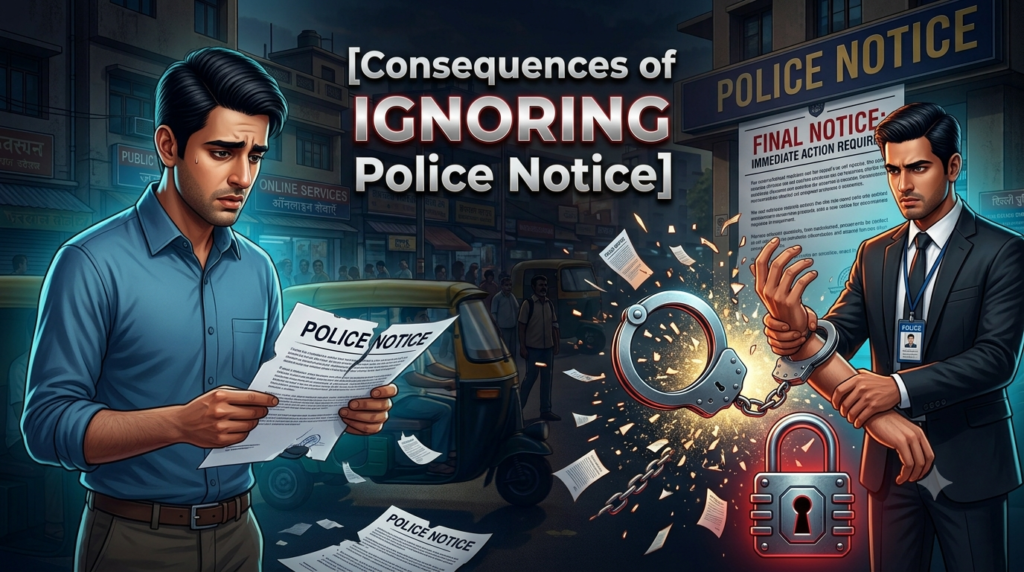
Key Takeaway: Ignoring a police notice does not make the problem disappear; instead, it upgrades a manageable investigation into an immediate threat of property attachment and physical arrest.
3. Written Reply vs. Physical Appearance: What Does the Law Require?
A common question among individuals summoned by police is whether sending a written reply via an advocate or email is sufficient, or if physical presence at the station is strictly mandatory.
Our analysis revealed that while a written reply protects your initial record, physical appearance remains the primary statutory requirement under most circumstances.
When a Written Reply is Sufficient
A formal written reply drafted by a criminal defense advocate can be submitted when:
- You require a temporary postponement due to reasonable cause for non-appearance (such as medical emergencies, official travel, or inadequate preparation time).
- You need formal clarification regarding the exact nature of allegations or the registered FIR/DD entry number.
- You are submitting pre-requested documents (such as bank statements, contracts, or identity proofs) to demonstrate willingness to cooperate.
When Physical Appearance is Mandatory
While a written response establishes initial compliance and good faith, Section 35(3) BNSS specifies that the notice directs the person to “appear before him or at such place as specified.”
Therefore, a written letter does not permanently replace personal appearance. You must eventually present yourself before the investigating officer unless a High Court or Sessions Court grants explicit exemption or interim protection.
Key Takeaway: Always pair an initial written reply with a clear commitment to appear at a rescheduled date. Never treat a written reply as a final settlement of a police summons.
4. Legal Steps When Unable to Attend Police Questioning
If you receive a 35(3) BNSS police notice but cannot appear on the designated date, follow this step-by-step checklist to protect your freedom:
- Establish Reasonable Cause
Document all valid reasons for postponement
Compile official evidence supporting your inability to attend. Valid grounds recognized by courts include certified medical reports, pre-booked travel, or short notice (less than 24-48 hours to comply). - Send a Formal Intimation & Adjournment Letter
Establish a verified paper trail
Do not rely on verbal phone calls with the police officer. Have your advocate draft and send a formal written representation via Speed Post, registered email, or physical delivery to the station diary with a receiving stamp. - Evaluate Anticipatory Bail Options
Protect against potential coercion
If you genuinely fear that appearing at the police station will result in immediate arrest despite Section 35 protections, file an application for Anticipatory Bail under Section 482 BNSS in the Sessions Court or Delhi High Court before appearing.
5. Landmark Supreme Court Judgments & Protections
The Supreme Court of India has repeatedly held that police notices must not be used as instruments of harassment or arbitrary detention.
Key Judicial Precedents
- Satender Kumar Antil v. CBI (2022): The Supreme Court ruled that for offenses punishable by up to 7 years, issuing a notice under Section 35(3) BNSS is the default rule, and physical arrest is a rare exception. Arresting an individual without recording specific written reasons violates constitutional rights.
- Arnesh Kumar v. State of Bihar (2014): Established mandatory procedural checks before making arrests under domestic disputes (such as Section 85 BNS / Section 498A IPC cases), making pre-arrest notices compulsory.
- Supreme Court Physical Notice Ruling (2026): The Apex Court clarified that police notices issued under Section 35 BNSS must be served physically on the individual. Service via casual messaging channels like WhatsApp or informal texts without official endorsement does not meet statutory requirements for depriving someone of liberty.
Key Takeaway: If a police officer arrests a compliant person without recording written necessity in the case diary, the officer faces departmental action and contempt of court proceedings under Supreme Court directives.
6. Frequently Asked Questions
Q1: Can the police arrest me immediately when I appear in response to a 35(3) BNSS notice? A: No, not ordinarily. Under Section 35(5) BNSS, if you comply with the notice and join the investigation, the police cannot arrest you unless the investigating officer records explicit written reasons demonstrating that detention is necessary to prevent evidence tampering, witness intimidation, or absconding.
Q2: What should I do if I receive a fake or informal police notice on WhatsApp? A: Supreme Court directives specify that formal Section 35 BNSS notices affecting personal liberty must be served physically with proper station stampings and IO credentials. If you receive an unverified digital notice, consult a lawyer to verify its authenticity with the station diary (DD entry) before responding.
Q3: Does filing a written reply protect me from a Non-Bailable Warrant (NBW)? A: A written reply showing “reasonable cause” for delay creates a documented paper trail demonstrating that you are not absconding. While it reduces the risk of an immediate NBW, you or your legal representative must follow up to ensure the IO accepts the extension and reschedules your appearance date.
A police notice under Section 35(3) BNSS is legally mandatory to address, but it should never cause panic. Ignoring the notice creates legal exposure to arrest warrants, criminal penalties under Section 208 BNS, and absconding proceedings. Always respond in writing, establish a clean paper trail, seek reasonable extensions if needed, and consult a defense advocate to accompany you during questioning.
Standard Legal Disclaimer: The information provided in this article is strictly for educational and informational purposes only and does not constitute formal legal advice or create an attorney-client relationship. If you have received a police notice or face legal action under BNSS or BNS provisions, you are strongly advised to consult a qualified criminal defense advocate to obtain advice tailored to your specific case and jurisdiction.