Written by Kapil Balhara | Technically Reviewed for Accuracy | Last Updated: September 2026
Table of Contents
- Understanding Delhi Police Notice for Appearance: Core Legal Framework
- First Immediate Steps After Receiving a Police Summons
- Crucial Steps Before Going to the Police Station for Inquiry
- Station Protocol: How to Record Attendance and Protect Rights
- Landmark Supreme Court Rulings Protecting Personal Liberty
- Frequently Asked Questions
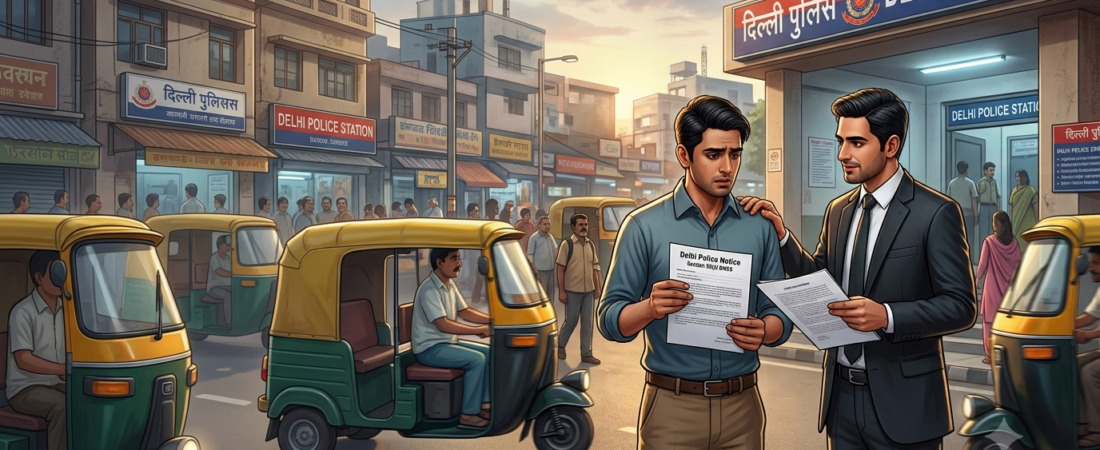
Receiving an unexpected notice from the station causes overwhelming panic and distress. However, getting a delhi police notice for appearance does not mean you are under arrest or automatically guilty of a crime.
In our legal practice, we routinely guide citizens through police inquiries safely. This complete guide explains your fundamental rights, the legal verification process, and exact steps to take before stepping into a station.
A delhi police notice for appearance is an official legal summons issued during an investigation. Under India’s procedural laws, it compels an individual to join an inquiry without immediate physical custody.
A delhi police notice for appearance is a statutory summons issued under Section 35(3) of the Bharatiya Nagarik Suraksha Sanhita, 2023 (BNSS). It directs an individual to cooperate with an investigation for offences carrying up to seven years of imprisonment, explicitly shielding compliant citizens from arbitrary arrest.
Historically, Section 41A of the Code of Criminal Procedure (CrPC) governed these safeguards. The law is codified under Section 35(3) of the Bharatiya Nagarik Suraksha Sanhita, 2023 (BNSS).
  [ Notice Issued under Sec 35(3) BNSS ]
                   │
                   ▼
  [ Full Compliance & Attendance Recorded ]
                   │
                   ▼
  [ Protection from Arrest Granted by Law ]
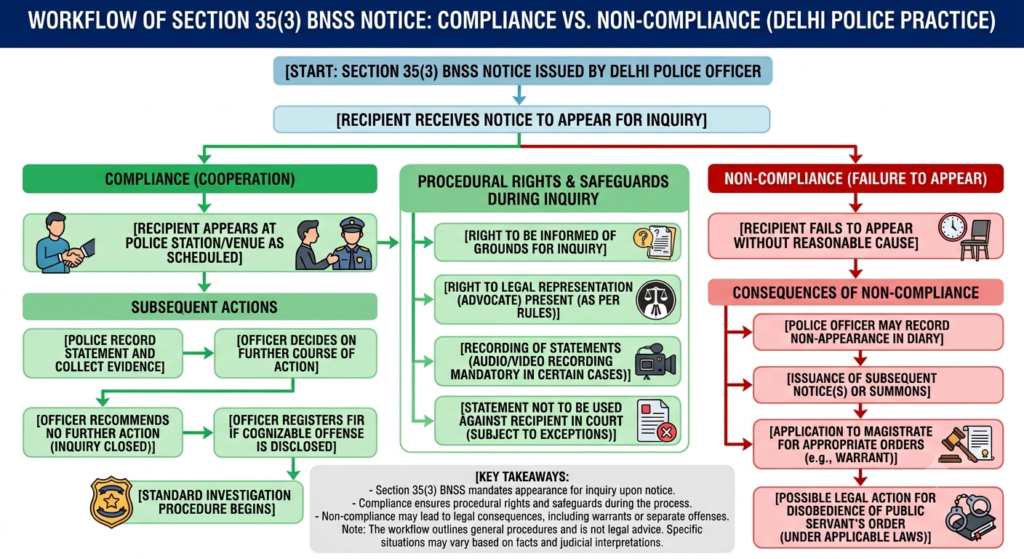
Section 35(3) of BNSS mandates that where arrest is unnecessary, the Investigating Officer (IO) must issue a notice. Therefore, the police cannot arrest you if you comply with the summons.
However, the IO can arrest a compliant person if they record written reasons proving physical custody is indispensable. Furthermore, Section 35(7) BNSS provides special protection for senior citizens above 60 years or infirm persons. For offences punishable with less than three years, prior permission from a Deputy Superintendent of Police is mandatory before arresting such individuals.
When a police notice arrives, panic often leads to critical errors. Taking structured, calm actions safeguards your legal standing.
How to Verify an Authentic Delhi Police Notice
Fake notices are increasingly used in cyber-fraud schemes, extortion attempts, and private civil disputes. Our analysis revealed that verifying authenticity immediately prevents unnecessary panic.
- Station Stamp & Serial Number: Authentic notices contain a unique serial number from the station register, a formal station stamp, and the IO’s signature.
- FIR or Daily Diary (DD) Entry Number: The document must clearly mention an FIR number or a Daily Diary Entry, along with statutory penal sections under investigation.
- Legitimate Mode of Delivery: Legitimate notices are served physically or sent through official station email protocols. Standalone WhatsApp messages or casual phone calls do not constitute valid legal service under Delhi High Court directives.
Contacting the Investigating Officer (IO) in Delhi
Before visiting the police station, establish formal contact with the officer. First, call the phone number listed on the document to verify the officer’s identity.
Next, request a copy of the First Information Report (FIR) or complaint details. If you cannot attend on the specified date due to illness or travel, send an email or speed post immediately. Request an extension in writing to establish a record of good-faith cooperation.
Key Takeaway: Never ignore a summons. Evasion gives the police grounds to claim non-cooperation and seek an arrest warrant from the magistrate.
Preparation before stepping into the station reduces risks significantly. When we evaluated past criminal defense cases, thoroughly prepared individuals managed interrogation far more effectively.
| Pre-Visit Checklist Item | Purpose & Legal Significance |
|---|---|
| Consult a Criminal Lawyer | Analyzes allegations and formulates a safe statement strategy. |
| Organize Valid ID Proofs | Carry original identity documents along with self-attested photocopies. |
| Collate Evidentiary Documents | Gather bank statements, emails, or chats supporting your innocence. |
| Inform Immediate Family | Ensures family members know the IO’s details, station location, and timing. |
| Draft Written Representation | Prepares a formal written response addressing specific allegations clearly. |
Navigating questioning inside a police station requires mental composure and a strict adherence to procedural rights.
Understanding Your Fundamental Rights
During questioning, you maintain the constitutional right against self-incrimination under Article 20(3) of the Constitution of India. You are not obligated to make statements that incriminate yourself.
Additionally, you have the right to meet your legal counsel during interrogation, as recognized under Section 33 of BNSS. While an advocate cannot sit next to you or answer questions directly, they can remain within visual distance to deter police coercion.

How to Record Attendance at a Delhi Police Station
Leaving the police station without formal proof of attendance is a dangerous mistake. Always follow these numbered steps to create verifiable proof of compliance:
- Sign the Daily Diary (DD) Register: Request the IO to record your entry and departure times in the station’s Daily Diary.
- Obtain an Endorsement on the Notice: Carry a duplicate copy of the Section 35(3) BNSS notice. Request the officer to sign, date, and stamp it as “Attended and Complied”.
- Submit Statements via Acknowledged Writing: When submitting written responses or documents, obtain an official receipt from the station diary branch.
Key Takeaway: Stamped proof of attendance serves as your primary evidence against claims of non-cooperation if the matter goes to court.
Judicial precedents strictly govern police powers, ensuring that notices are not used as tools for harassment.
- Arnesh Kumar v. State of Bihar (2014) : The Supreme Court mandated that arrest is an exception for offences punishable by up to seven years. Police must complete a mandatory nine-point checklist before making an arrest.
- Satender Kumar Antil v. CBI (2026) : The Supreme Court authoritatively confirmed that issuing a notice under Section 35(3) BNSS is the default legal requirement. Arrest cannot be made for routine questioning, and violating notice protocols entitles the accused to bail as a matter of right.
- Amandeep Singh Johar v. State of NCT of Delhi (2018) : The Delhi High Court laid down comprehensive guidelines mandating standardized notice formats, official logbook entries, and strict service receipts.
In our legal evaluations, courts consistently reprimand investigating agencies that bypass these binding precedents.
If you face harassment, coercion, or an imminent threat of illegal custody during an inquiry, take defensive legal action immediately. Applying for Anticipatory Bail under Section 482 of BNSS before visiting the station provides robust statutory protection against arrest.
Frequently Asked Questions
What happens if I ignore a Delhi Police notice for appearance?
Ignoring a notice under Section 35(3) BNSS constitutes non-compliance. This gives the police legal grounds to record your non-cooperation and apply to a Magistrate for a warrant or make an arrest under Section 35(6) BNSS.
Can the police arrest me even if I comply with the notice?
If you fully comply, the police cannot arrest you arbitrarily. To make an arrest after compliance, the Investigating Officer must record compelling written reasons demonstrating that custody is necessary under Section 35(5) BNSS.
Can my lawyer answer questions on my behalf at the police station?
No, your lawyer cannot answer interrogation questions on your behalf. However, under Section 33 BNSS, you have the right to consult your advocate and have them present within visual distance during the inquiry.
Need Immediate Legal Assistance?
Handling a police summons requires fast, strategic legal intervention to protect your freedom. Contact our senior criminal defense team today for confidential advice and assistance with station representation or anticipatory bail applications.
Disclaimer: This article is for informational purposes only and does not constitute formal legal advice. Reading this content does not establish an attorney-client relationship. If you received a delhi police notice for appearance, consult a qualified criminal advocate immediately for case-specific legal guidance.