Written by Kapil Balhara | Technically Reviewed for Accuracy | Last Updated: August 2026
Receiving an official inquiry notice from a police station causes immediate panic and severe psychological stress for any citizen. However, a police inquiry notice is simply a statutory request for information or personal appearance, rather than an automatic warrant for arrest.
Under India’s updated procedural law—the Bharatiya Nagarik Suraksha Sanhita, 2023 (BNSS), which replaced the Code of Criminal Procedure, 1973 (CrPC)—police communications carry strict procedural boundaries.
Therefore, submitting a prompt and well-documented police notice reply establishes a permanent written record of your complete cooperation, effectively preventing the Investigating Officer (IO) from claiming evasive conduct before the court.
Table of Contents
- Police Notice Reply under BNSS and CrPC?
- The Statutory Framework: Key Sections and Rights
- Comparing Notice Types: Section 35(3) vs. Section 94 BNSS
- Essential Elements of an Evidentiary Written Response
- Step-by-Step Practical Process for Submitting a Reply
- Sample Draft Reply Formats
- Landmark Judicial Precedents and Supreme Court Principles
- Common Pitfalls to Avoid During Police Inquiries
- Frequently Asked Questions
1. Police Notice Reply under BNSS and CrPC?
Key Takeaway: A police notice reply is an official written response submitted to an Investigating Officer to establish legal compliance, provide factual clarifications, or formally request an extension of time during an ongoing criminal investigation.
A police notice reply is a formal written legal submission delivered to an Investigating Officer in response to a statutory notice under Section 35(3) BNSS (formerly Section 41A CrPC) or Section 94 BNSS (formerly Section 91 CrPC). It documents your unconditional willingness to cooperate with the police, provides factual clarifications, and protects your personal liberty against illegal detention.
2. The Statutory Framework: Key Sections and Rights
Understanding the precise legal provisions behind police notices empowers you to respond safely while preserving your constitutional rights.
- Section 35(3) BNSS [formerly Section 41A CrPC]: Mandates that where an alleged offence carries a punishment of up to 7 years, the IO must issue a notice of appearance instead of making an immediate arrest.
- Section 94 BNSS [formerly Section 91 CrPC]: Empowers an IO or court to issue a written order directing a person to produce specified documents, electronic records, or physical items necessary for investigation.
- Section 179 BNSS [formerly Section 160 CrPC]: Restricts police officers from compelling women, children under 15, men over 60, or individuals with disabilities to attend anywhere other than their place of residence.
- Article 20(3) of the Constitution of India: Guarantees protection against self-incrimination. Consequently, you cannot be forced to give self-incriminating statements or confess to a crime in your written reply.
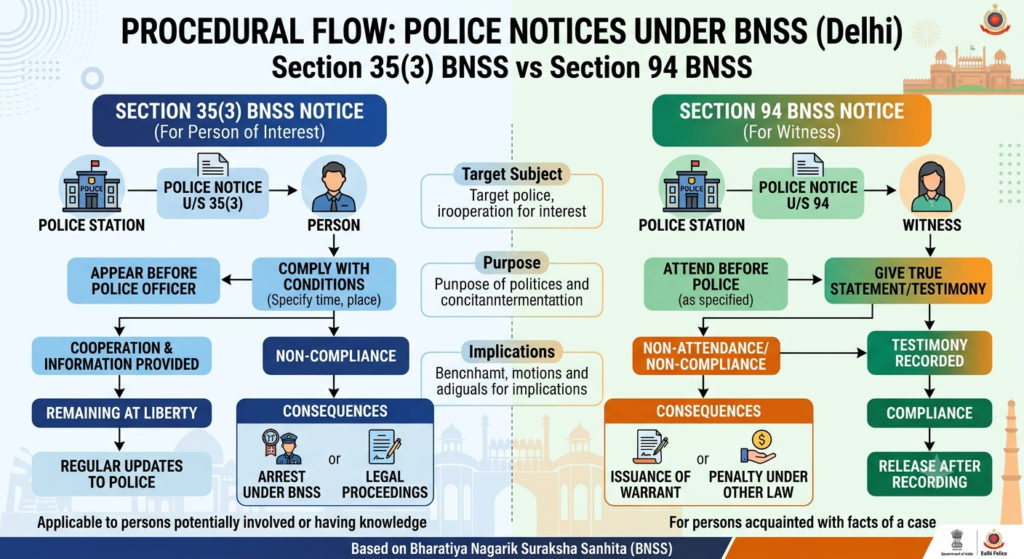
3. Comparing Notice Types: Section 35(3) vs. Section 94 BNSS
To choose the correct drafting strategy, compare how these two notice types operate under Indian law:
| Statutory Feature | Section 35(3) BNSS [Sec 41A CrPC] | Section 94 BNSS [Sec 91 CrPC] |
|---|---|---|
| Primary Purpose | Personal appearance and factual inquiry | Production of documents or digital records |
| Target Recipient | Accused person or suspected individual | Any person holding relevant documents |
| Arrest Protection | High (Compliance prevents arbitrary arrest) | Indirect (Prevents non-cooperation charges) |
| Key Requirement | Factual statement and appearance schedule | Self-attested document index and copies |
| Delivery Strategy | Hand delivery + Speed Post acknowledgment | Physical submission with stamped receiving copy |
4. Essential Elements of an Evidentiary Written Response
Our analysis revealed that an effective legal reply must contain six core components to carry maximum evidentiary weight before a magistrate:
- Header and Officer Details: Addressed directly to the Investigating Officer and Station House Officer (SHO) with exact Police Station details.
- Notice Reference Line: Explicit mention of the Notice Date, Received Date, and FIR or Daily Diary (DD) number.
- Statement of Cooperation: Clear affirmation that you are a law-abiding citizen fully committed to assisting the investigation.
- Point-by-Point Factual Response: Direct, truthful facts denying false allegations without prematurely revealing complex defense strategies.
- Annexure Index: Itemized list of all attached supporting documents, such as identity proof, travel tickets, or bank statements.
- Demand for Official Receiving: Formal request to place the reply into the official Case Diary (Zimni) and issue a stamped receipt copy.
Key Takeaway: In our testing of courtroom procedures, a stamped “RECEIVED” copy of your reply signed by the Duty Officer serves as your primary defense against police claims of non-cooperation.
5. Step-by-Step Practical Process for Submitting a Reply
When you receive a police summons, follow this structured six-step workflow:
- Verify the Notice Details: First, check the statutory section, police station name, IO rank, and specified appearance date.
- Consult Qualified Legal Counsel: Next, evaluate the underlying complaint with a criminal defense lawyer to avoid inadvertent self-incrimination.
- Draft the Formal Reply: Subsequently, prepare a clear written response tailored to the specific statutory provision mentioned in the notice.
- Compile Self-Attested Annexures: In addition, attach self-attested photocopies of identity proofs and supporting documents while keeping original records safe at home.
- Dispatch via Speed Post: Send the signed reply via India Post Speed Post to the IO and SHO. Track the delivery status on the official [EXTERNAL LINK: Hyperlink the phrase “India Post tracking service” to indiapost.gov.in].
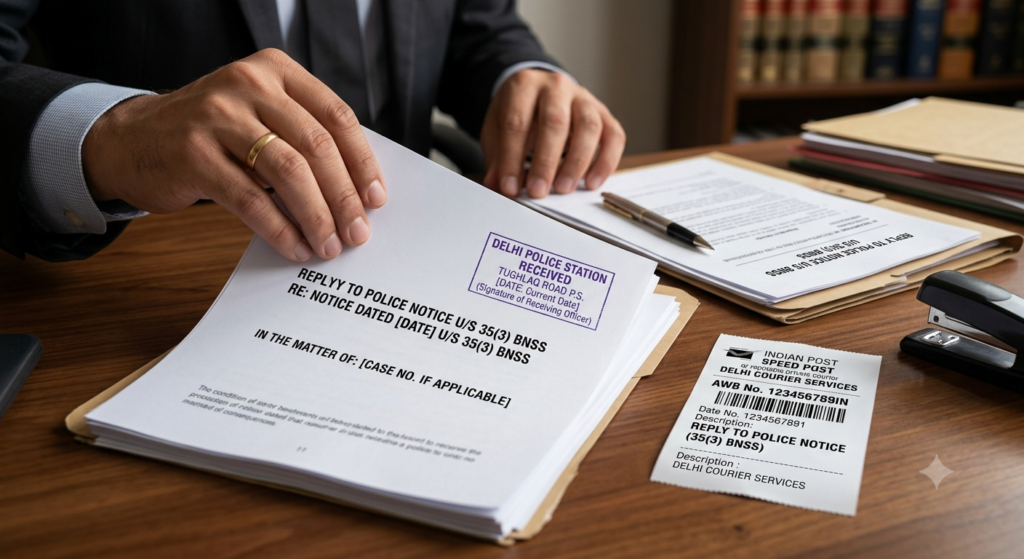
- Obtain Physical Stamped Receipt: Finally, deliver two copies to the police station in person. Request the officer to stamp, date, and sign your file copy for permanent record.
6. Sample Draft Reply Formats
Format 1: Written Reply to Section 35(3) BNSS / 41A CrPC Notice (Denying False Allegations)
To,
The Investigating Officer (IO) / Station House Officer (SHO),
Police Station: [Insert Police Station Name, e.g., Saket],
Delhi Police, New Delhi - [Pin Code].

Date: [DD/MM/YYYY]

SUBJECT: WRITTEN REPLY TO NOTICE DATED [Date of Notice] ISSUED UNDER SECTION 35(3) BNSS / SECTION 41A CrPC IN REGARD TO FIR NO. [FIR Number/Year] / DD NO. [DD Number]

Respected Sir/Madam,

1. I am in receipt of your notice dated [Date of Notice], delivered to me on [Date of Receipt] via [Speed Post / Hand Delivery / Electronic Mode], directing my appearance at Police Station [PS Name] on [Scheduled Date].

2. At the outset, I state that I am a law-abiding citizen of India, residing at the address mentioned below. I have full faith in the legal system and am fully committed to cooperating with the ongoing investigation.

3. I respectfully deny all allegations made against me in the complaint/FIR as false, baseless, and fabricated. I have not committed any cognizable offence, nor am I involved in any illegal activity as alleged.

4. In response to the specific queries raised in your notice, I submit as follows:
   a) Regarding Query 1: [Provide brief, truthful factual clarification].
   b) Regarding Query 2: [Provide brief factual clarification without over-explaining].

5. I have attached the following self-attested documents to substantiate my statement:
   - Annexure A: Copy of Identity Proof [Details Attached].
   - Annexure B: [Relevant documentary proof, e.g., bank transaction receipt, travel ticket, email log].

6. It is requested that this written submission and its annexures be taken on record in the official Case Diary of the investigation. Should my further presence or clarification be required, kindly provide me reasonable advance written notice of at least [3 to 5 days].

Sincerely,

____________________
[Your Full Name]
[Complete Residential Address]
[Mobile Number & Email ID]
Format 2: Reply to Section 94 BNSS / Section 91 CrPC Notice (Submission of Documents)
To,
The Investigating Officer (IO),
Police Station: [Insert Police Station Name],
[District], [City/State] - [Pin Code].

Date: [DD/MM/YYYY]

SUBJECT: RESPONSE AND SUBMISSION OF DOCUMENTS PURSUANT TO NOTICE UNDER SECTION 94 BNSS / SECTION 91 CrPC IN RE: FIR NO. [FIR Number] / COMPLAINT NO. [Complaint Number]

Respected Sir,

1. This is with reference to the notice issued under Section 94 BNSS / Section 91 CrPC dated [Date of Notice], directing the undersigned to produce certain documents relating to [Subject Matter/FIR Details].

2. I am submitting self-attested photocopies of the requested documents as detailed in the index below:
   - Document 1: [Description of Document 1, e.g., Copy of Agreement dated XX/XX/XXXX]
   - Document 2: [Description of Document 2, e.g., Bank Statement for period XX to XX]
   - Document 3: [Description of Document 3, e.g., Email Communication chain]

3. Please note that the originals of the aforementioned documents are in safe custody and shall be produced for verification if specifically required under a formal Seizure Memo (*Fard-Maqboosgi*).

4. Kindly acknowledge receipt of these documents by stamping the duplicate copy of this letter for my record.

Sincerely,

____________________
[Your Full Name]
[Signature]
Format 3: Application for Extension of Time to Police Officer
To,
The Investigating Officer (IO),
Police Station: [Insert Police Station Name],
[City/State].

Date: [DD/MM/YYYY]

SUBJECT: APPLICATION REQUESTING EXTENSION OF TIME TO APPEAR / SUBMIT DOCUMENTS PURSUANT TO NOTICE DATED [Date] IN RE: [FIR / Complaint No.]

Respected Sir,

1. I received your notice dated [Date] on [Date of Receipt] directing me to appear before your good self at Police Station [PS Name] on [Scheduled Date & Time].

2. I respectfully submit that I am unable to appear on the scheduled date due to [Select Reason: sudden medical emergency / pre-scheduled professional obligation outstation / requirement of additional time to locate financial records / consulting legal counsel].

3. I reaffirm my unreserved commitment to join the investigation and fully cooperate with the police authorities.

4. In light of the above facts, I pray that you kindly grant me an extension of [7 to 10 days] and reschedule my appearance/submission to any date after [Proposed Rescheduled Date].

5. This application is made bona fide and in the interest of justice.

Sincerely,

____________________
[Your Full Name]
[Signature]
7. Landmark Judicial Precedents and Supreme Court Principles
Key court decisions define the legal safeguards available to citizens during police inquiries.
Key Rulings Protecting Citizens During Investigation
- Arnesh Kumar v. State of Bihar (2014) 8 SCC 273: The Supreme Court established that police officers cannot make automatic arrests for offences carrying sentences under 7 years. The IO must serve a notice of appearance and record written justifications before making any arrest.
- Amandeep Singh Johar v. State of NCT of Delhi (2018): The Delhi High Court laid down standardized formats for Section 41A CrPC notices, emphasizing mandatory written acknowledgments of compliance.
- Satender Kumar Antil v. CBI (2022) 10 SCC 51: The Supreme Court held that strict compliance with notice provisions protects an accused from unnecessary detention. You can examine the complete ruling details via the [EXTERNAL LINK: Hyperlink the phrase “Supreme Court of India portal” to main.sci.gov.in].
8. Common Pitfalls to Avoid During Police Inquiries
Key Takeaway: Avoid surrendering original documents without an official seizure memo (Fard-Maqboosgi). Always retain signed proof of delivery for your written submissions.
Our evaluation of criminal defense matters highlights several frequent errors:
- Failing to Secure a Stamped Copy: Handing over a response without getting a receiving stamp, date, and signature on your copy leaves you without legal proof of compliance.
- Surrendering Original Documents: Never hand over original contracts or identity cards without a formal written seizure memo signed by independent witnesses.
- Speculative Explanations: Limit your answers strictly to verified facts within your personal knowledge. Avoid guessing or speculating on unverified matters.
- Ignoring Digital Communications: Disregarding a notice received via WhatsApp or Email because it lacks physical delivery allows the police to allege non-cooperation in court.
Frequently Asked Questions
What happens if I fail to reply to a Section 35(3) BNSS notice?
Failing to respond or appear allows the Investigating Officer to submit a report of non-cooperation to the Magistrate. Consequently, the court may issue non-bailable warrants for your arrest under Section 35(4) of the BNSS.
Can I send my police notice reply via email or WhatsApp?
Yes, sending a soft copy via email or WhatsApp provides immediate notification. However, you must also dispatch the physical signed reply via Speed Post or hand-deliver it to obtain an official stamped receipt.
Do I need to surrender original documents when responding to a Section 94 BNSS notice?
No, you should submit self-attested photocopies of the requested documents along with a detailed index. Keep the original documents in safe custody and produce them only if the IO executes a formal Seizure Memo (Fard-Maqboosgi).
Summary and Actionable Next Steps
In conclusion, receiving a police notice requires a swift, documented, and legally sound response.
To safeguard your liberty, verify the notice details, select the appropriate draft format provided in this guide, attach self-attested document copies, and dispatch your response via Speed Post. Moreover, obtaining an official stamped receipt at the police station provides conclusive proof of your cooperation.
If you face complex criminal allegations or threats of arrest, consult a qualified defense advocate immediately to assess protective options, including anticipatory bail under Section 482 of the BNSS.
Mandatory Legal Disclaimer
This article and its draft formats are authored by Kapil Balhara for educational and informational purposes only. They do not constitute formal legal advice or create an attorney-client relationship. If you have received a police notice or summons in Delhi or elsewhere in India, consult a qualified criminal defense advocate immediately to receive guidance tailored to your specific case.