
Receiving an official written summons from a police station causes immediate anxiety and confusion. Whether sent by the Delhi Police Crime Branch, Special Cell, Economic Offences Wing (EOW), or local police, a police notice to witness attendance demands immediate legal attention.
Issued under Section 160 of the Code of Criminal Procedure, 1973 (CrPC)—now governed by Section 179 of the Bharatiya Nagarik Suraksha Sanhita, 2023 (BNSS)—this document represents an evidentiary demand to assist an ongoing investigation. Crucially, it is not an order of arrest.
Written by Kapil Balhara | Technically Reviewed for Accuracy | Last Updated: September 2026
Table of Contents
- The Core Legal Framework: Section 160 CrPC vs. Section 179 BNSS
- Statutory Exemptions: Who CANNOT Be Summoned to a Police Station?
- Can an Accused Person Be Summoned Under Section 160 CrPC / 179 BNSS?
- Travel Allowance Rules for Witnesses Summoned by Delhi Police
- Step-by-Step Practical Process: Handling a Notice in Delhi
- Common Pitfalls & Key Judicial Precedents
- Frequently Asked Questions
1. The Core Legal Framework: Section 160 CrPC vs. Section 179 BNSS
Under the Indian criminal justice framework, an investigating officer (IO) holds the power to compel individuals who appear acquainted with case facts to join an investigation.
In our detailed analysis of the legal transition, we noted that Section 160 CrPC has been officially replaced by Section 179 BNSS. While the fundamental purpose remains unchanged, BNSS expands protections to account for severe medical conditions.
A police notice to witness attendance under Section 160 CrPC (Section 179 BNSS) is a formal statutory directive issued by an investigating officer requiring a person acquainted with the facts of a case to provide evidence or testimony, while granting specific statutory exemptions to vulnerable individuals.
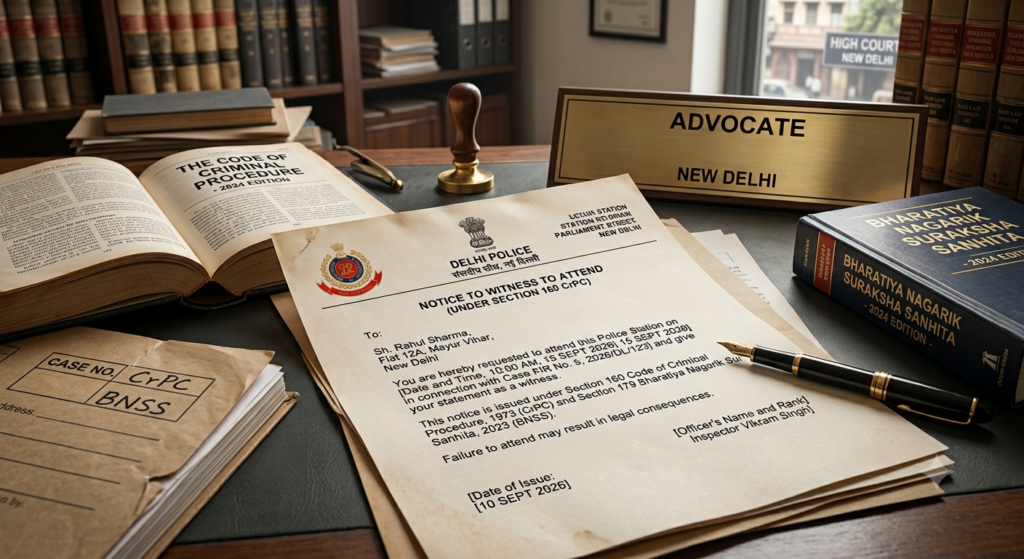
Comparative Statutory Provisions
| Legal Aspect | Section 160 CrPC (Former Code) | Section 179 BNSS (Current Law) |
|---|---|---|
| Primary Scope | Power to require attendance of witnesses | Power to require attendance of witnesses |
| Jurisdictional Limit | Within limits of IO’s station or adjoining station | Within limits of IO’s station or adjoining station |
| Exempted Categories | Women, males under 15, males 65+, disabled persons | Women, males under 15, males 60+, disabled persons, and persons with acute illness |
| Place of Examination | Residence of exempted person | Residence of exempted person (or police station only if witness voluntarily consents) |
| Expenses Allowance | State Government rules for travel/reasonable costs | Reimburses reasonable expenses incurred for attending at another location |
Territorial Limitations & Jurisdictional Boundaries
An investigating officer cannot issue a police notice to witness attendance to anyone located anywhere in the country. In fact, the law strictly limits the officer’s power to individuals residing within the limits of their own police station or an adjoining police station.
Consequently, if Delhi Police send a witness summons under Section 160 to someone residing outside these limits (such as in Mumbai or Bengaluru without adjoining station jurisdiction), the notice is procedurally defective. Thus, it remains open to challenge in court.
2. Statutory Exemptions: Who CANNOT Be Summoned to a Police Station?
The law explicitly protects vulnerable demographics from the stress and potential intimidation of visiting a police station. Specifically, the proviso to Section 160(1) CrPC and Section 179(1) BNSS mandates that specific categories of individuals shall not be required to attend at any place other than their residence.
Key Takeaway: If an exempted individual is summoned to a police station, forcing their attendance is an illegal directive. Therefore, the investigating officer must travel to the witness’s place of residence to record their statement.

Categories Protected from Police Station Visits
- Women Exemption (Any Age): A woman cannot be compelled to visit a police station for examination as a witness. Furthermore, under Section 179 BNSS, if a woman voluntarily consents in writing, she may attend the police station, but she cannot be forced.
- Senior Citizen Exemption: Under Section 179 BNSS, any male over the age of 60 years is exempt from visiting the police station. Additionally, BNSS reduced this threshold from 65 years under the old CrPC down to 60 years.
- Minors: Any male person under the age of 15 years cannot be called to a police station.
- Disabled Persons: Individuals with mental or physical disabilities receive strict statutory protection.
- Persons with Acute Illness: Introduced under Section 179 BNSS, individuals suffering from severe or acute medical conditions cannot be forced to leave their homes or hospital settings.
3. Can an Accused Person Be Summoned Under Section 160 CrPC / 179 BNSS?
A major point of legal friction in Delhi criminal investigations is whether an investigating officer can use a Section 160 CrPC witness notice to interrogate a suspect or accused person.
The Supreme Court’s Stance on Accused vs. Witness
The marginal heading of Section 160 CrPC refers to “witnesses,” but the body text uses the phrase “any person acquainted with the facts”.
In landmark rulings, the Supreme Court of India clarified that Section 160 applies primarily to witnesses or potential witnesses. For instance, in “Nandini Satpathy v. P.L. Dani (1978)”, the Apex Court ruled that a witness or accused cannot be compelled to answer self-incriminating questions during police examination.
- Constitutional Protection Against Self-Incrimination: Article 20(3) of the Constitution guarantees that no person accused of an offence shall be compelled to be a witness against himself.
- Section 41A CrPC / Section 35(3) BNSS vs. Section 160 CrPC: When police intend to summon an accused or suspect whose arrest is not immediately necessary, the law mandates issuing a notice under Section 41A CrPC (now Section 35(3) BNSS), which contains distinct safeguards, rather than misusing Section 160.
Key Takeaway: Investigating officers cannot legally use a Section 160 witness notice as a backdoor mechanism to interrogate an accused person while bypassing constitutional shields.
4. Travel Allowance Rules for Witnesses Summoned by Delhi Police
Attending a police station or inquiry takes time and financial expenditure. Fortunately, Sub-section (2) of Section 160 CrPC and Section 179 BNSS explicitly state that the State Government must make rules for paying reasonable expenses to individuals summoned.
In our legal practice across Delhi courts, we routinely advise witnesses on claiming these statutory allowances:
- Entitlement: If you are called to a police station or an outside venue that is not your residence, you are legally entitled to receive travel allowance (TA) and daily allowance (DA) covering reasonable transport and meal costs incurred.
- Delhi Police Practice: You can submit a written application to the Investigating Officer requesting the reimbursement of actual travel expenses based on government rates.
Need help navigating a complex police notice or summons? You can explore our professional criminal defense legal services to protect your rights.
5. Step-by-Step Practical Process: Handling a Notice in Delhi
If you or a family member receive a police notice to witness attendance in Delhi, follow this step-by-step checklist:
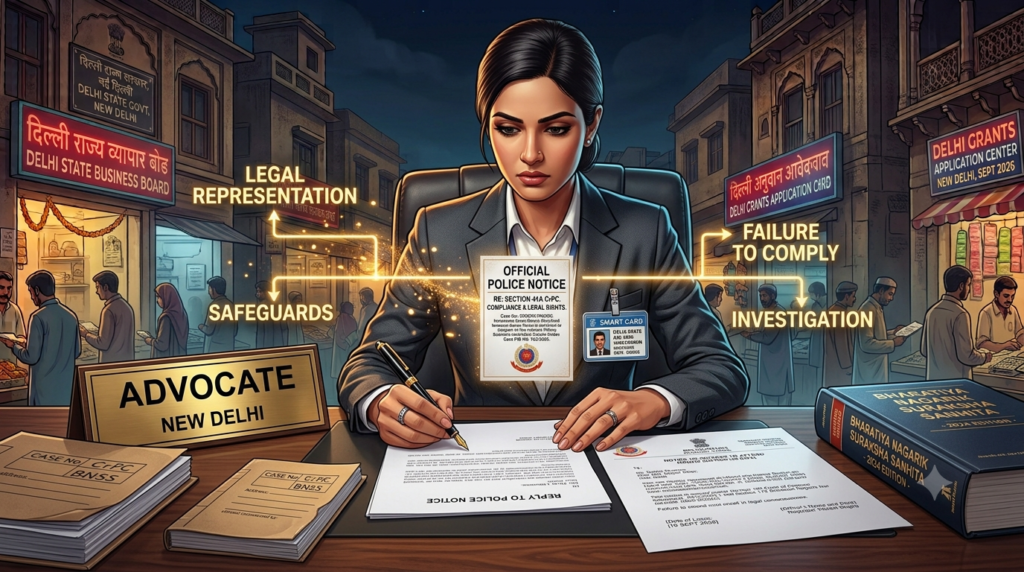
- Verify Notice Authenticity: First, check that the notice contains an official FIR number, DD (Daily Diary) entry, or Crime Number. Additionally, ensure it features the police station name, IO’s full name, rank, contact details, and official stamp.
- Determine Exemption Eligibility: Second, assess whether you fall under protected categories. If you are a woman, a male over 60 years old, under 15 years old, or suffering from an acute illness, do not panic because you do not need to visit the police station.
- Draft an Official Written Reply: Third, if you fall under an exempted category or reside outside the territorial jurisdiction, draft a polite, formal response signed by you or your legal representative stating:“I am in receipt of your notice under Section 160 CrPC / Section 179 BNSS. Please be informed that I am a woman / senior citizen (62 years old) / currently suffering from acute illness. Under the statutory proviso to Section 179(1) BNSS, I cannot be compelled to visit the police station. I am fully willing to cooperate with the investigation and invite the Investigating Officer to visit my residence at [Address] to record my statement.”
- Submission & Proof of Receipt: Fourth, send this written reply via Registered Post AD or speed post. Simultaneously, email it to the official Delhi Police email address of the concerned station or Deputy Commissioner of Police (DCP), while retaining the dispatch receipt.
- Attending the Inquiry (Non-Exempted Males): Finally, if you must visit the police station, you may be accompanied by an advocate who can remain present within a visible distance. Answer questions truthfully under Section 161 CrPC / Section 180 BNSS, but retain your right to refuse self-incriminating answers.
6. Common Pitfalls & Key Judicial Precedents
Pitfalls to Avoid
- Ignoring the Notice Completely: Simply ignoring a police notice can lead to the IO filing a complaint under Section 174 IPC / Section 208 BNS for non-attendance. Therefore, always respond in writing.
- Voluntarily Visiting Without Asserting Rights: Many women or senior citizens visit the police station out of fear, thereby waiving their statutory protection. Instead, assert your statutory right to be examined at home.
- Signing Blank Statements: Section 161(2) CrPC / Section 180 BNSS explicitly states that witness statements recorded by the police shall not be signed by the witness. Hence, never sign an oral statement recorded by police during investigation.
Key Judicial Precedents
- State Rep. by Inspector of Police v. N.M.T. Joy Immaculate (2004): The Supreme Court confirmed that Section 160 CrPC is meant specifically for securing the attendance of witnesses acquainted with the facts of the case, not for forced detention or unauthorized interrogation of suspects.
- Delhi High Court Guidelines on Police Harassment: The High Court has repeatedly observed that police officers cannot misuse witness summons to harass citizens or keep them waiting endlessly at police stations without recording entry in the Station Diary.
In summary, a police notice to witness attendance under Section 160 CrPC or Section 179 BNSS is a standard statutory tool for gathering factual evidence. If you belong to an exempted group—women, senior citizens above 60, minors, or those with acute illnesses—the law mandates that the police come to your residence.
Furthermore, if you receive an ambiguous notice or suspect that the police are treating you as an accused under the guise of a witness summons, seek immediate legal advice from an advocate to safeguard your rights.
7. Frequently Asked Questions
Can Delhi Police force a woman to come to the police station as a witness?
No, Delhi Police cannot force a woman of any age to visit a police station as a witness. Under the proviso to Section 160(1) CrPC and Section 179(1) BNSS, her examination must take place at her residence.
What happens if I ignore a Section 160 CrPC police notice?
Ignoring a Section 160 CrPC notice can lead to criminal prosecution for non-attendance under Section 174 IPC (or Section 208 BNS). Therefore, you should always submit a formal written reply explaining your position or claiming statutory exemptions.
What is the age limit for senior citizen exemption under Section 179 BNSS?
Under Section 179 BNSS, any male over 60 years of age is exempt from visiting a police station. This threshold was reduced from 65 years under the former Section 160 CrPC framework.
Are witnesses entitled to travel allowances when summoned by police?
Yes, under Section 160(2) CrPC and Section 179(2) BNSS, witnesses summoned to a police station or outside venue are legally entitled to receive reimbursement for reasonable travel and daily expenses from the government.
Standard Legal Disclaimer: The information provided in this article is strictly for educational and informational purposes only and does not constitute formal legal advice. Reading this post does not create an attorney-client relationship. If you have received a summons or notice from law enforcement agencies, you are strongly advised to consult a qualified advocate or legal professional to obtain advice specific to your case and jurisdiction.