Written by Kapil Balhara | Technically Reviewed for Legal Accuracy | Last Updated: August 2026
Table of Contents
- Quashing False FIR in Delhi
- The Core Statutory Framework: BNSS 2023 vs. CrPC 1973
- Understanding Statutory Legal Remedies and Penalties
- How to Handle False Police Notices: Step-by-Step Process
- Landmark Supreme Court and Delhi High Court Precedents
- Fatal Pitfalls Accused Persons Must Avoid
- Frequently Asked Questions
Receiving a police notice based on a fabricated complaint or a baseless FIR triggers extreme distress and immediate disruption. You can take swift legal action by submitting formal representations, filing a detailed legal reply, and petitioning the High Court for quashing false FIR proceedings to stop police harassment completely.
Quashing False FIR in Delhi
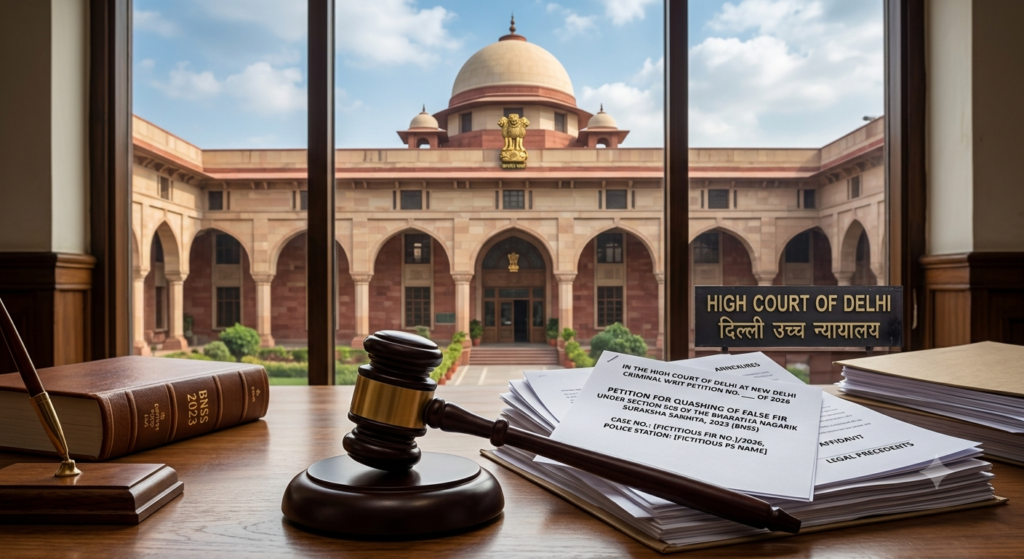
Under Section 528 of the Bharatiya Nagarik Suraksha Sanhita, 2023 (BNSS) [formerly Section 482 CrPC], the Delhi High Court possesses inherent powers to quash frivolous, fabricated criminal complaints. Additionally, filing representations to senior police officials and writ petitions under Article 226 protects innocent citizens from arbitrary arrest, extortion, and unlawful police overreach.
Key Takeaway: You do not have to wait for a chargesheet to fight a fake complaint. Moving the High Court early under Section 528 BNSS provides immediate shield against malicious prosecution.
The Core Statutory Framework: BNSS 2023 vs. CrPC 1973
When facing a false criminal complaint, understanding your statutory rights empowers you to transition from defense to proactive legal action. Furthermore, procedural laws changed significantly with the rollout of modern criminal codes across India. Consequently, citizens must understand how new statutory sections map to classic legal remedies.
Section 528 BNSS [formerly Section 482 CrPC]
Section 528 of the BNSS preserves the inherent powers of the High Court to prevent abuse of any court process. Therefore, if an FIR lacks genuine factual substance, the Delhi High Court can completely strike it down.
To illustrate, our legal analysis revealed that courts intervene swiftly when complaints stem from personal vendettas or civil monetary disputes.
Constitutional Writs under Article 226
Additionally, citizens can invoke Article 226 of the Constitution of India before the High Court. Consequently, judges can issue writs of Mandamus or Certiorari directing investigating officers to cease unlawful harassment and observe mandatory procedural safeguards.
Section 217 BNS [formerly Section 182 / 211 IPC]
Section 217 of the Bharatiya Nyaya Sanhita, 2023 (BNS) penalizes individuals who knowingly give false information to public servants. Specifically, bad-faith accusers face direct criminal liability, imprisonment, and heavy monetary fines.
Section 308 BNS [formerly Extortion Provisions IPC]
Moreover, Section 308 BNS applies when complainants weaponize police notices as leverage for financial extortion, matrimonial pressure, or land grabbing. Thus, the law provides rigorous counters against malicious accusers.
Understanding Statutory Legal Remedies and Penalties
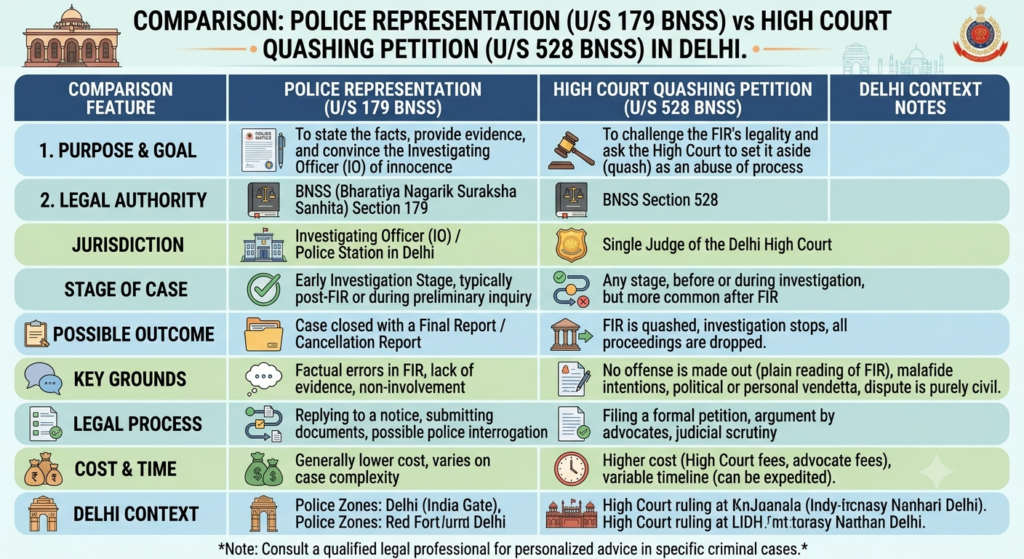
Evaluating remedies requires comparing forums, statutory goals, and relief options available under Indian law.
| Remedy / Legal Action | Forum / Authority | Primary Purpose | Key Relief Granted |
|---|---|---|---|
| Notice Reply & Representation | Joint/Deputy Commissioner of Delhi Police | Highlights malicious intent and lack of evidence early. | Prevents arbitrary arrest; directs fair/impartial inquiry. |
| Quashing Petition (528 BNSS / 482 CrPC) | Delhi High Court | Challenges the legality of the FIR or inquiry. | Complete striking down of the false FIR and proceedings. |
| Writ Petition (Article 226) | Delhi High Court | Enforces fundamental rights against police overreach. | Directs interim protection from harassment or coercion. |
| Counter Prosecution (217 BNS) | Competent Magistrate Court | Punishes the false complainant. | Imposes imprisonment and fines on the bad-faith accuser. |
Key Takeaway: Combining an administrative representation with a High Court quashing petition creates maximum leverage against extortionist complaints.
How to Handle False Police Notices: Step-by-Step Process
Navigating false criminal allegations in Delhi requires a disciplined, step-by-step approach to build an unassailable court record. In our practice, following this structured process consistently yields reliable judicial protection.
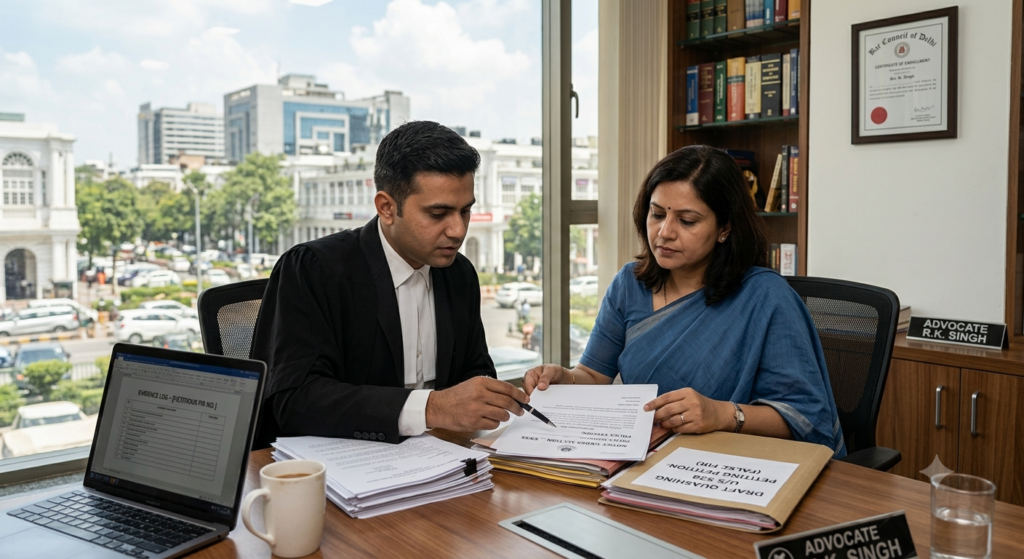
- Draft a Detailed Legal Reply to the Notice: Do not ignore a notice issued under Section 35(3) BNSS [formerly 41A CrPC]. Draft a precise written reply detailing the factual background, exposing contradictions, and establishing your full intent to cooperate with the law.
- Submit a Representation to the Joint Commissioner of Police: If local station officers act with bias or threaten arbitrary arrest, submit a formal written representation to the Joint Commissioner or Commissioner of Delhi Police. Highlight the extortionist nature of the complaint and annex supporting evidence like call logs, digital chats, and financial receipts.
- Collect Objective Alibi and Documentary Evidence: Gather indisputable proof early, such as bank transaction logs, location data, electronic messages, and independent witness statements that directly contradict the complainant’s narrative.
- File a Quashing Petition under Section 528 BNSS: Engage an experienced Delhi High Court advocate to draft a comprehensive quashing petition. The petition must prove that even if allegations are taken at face value, no prima facie offence is disclosed against you.
- Secure an Interim Protection Hearing: During the initial admission hearing, your counsel will press for interim orders staying the investigation, staying coercive steps, or directing that no adverse action be taken during the pendency of the quashing petition.
Landmark Supreme Court and Delhi High Court Precedents
Judicial precedents govern how courts handle false complaints and protect individual liberty across India.
State of Haryana v. Bhajan Lal (1992)
The Supreme Court established classic guidelines detailing when High Courts should quash criminal proceedings. Specifically, quashing applies when allegations are absurd, manifestly attended with mala fide intent, or where no cognizable offence exists.
Neharika Infrastructure Pvt. Ltd. v. State of Maharashtra (2021)
In this landmark ruling, the apex court clarified parameters for granting interim protection against arrest. Furthermore, judges emphasized that genuine cases of process abuse warrant immediate judicial intervention to prevent harassment.
Delhi High Court Directives on False Complaints
Moreover, the Delhi High Court consistently warns against using criminal law machinery as a tool for civil recovery or personal vendettas. Consequently, courts routinely impose heavy financial costs on false complainants while directing prosecution under Section 217 BNS.
Key Takeaway: High Courts will not hesitate to quash proceedings when you demonstrate clear mala fide intent or show that a civil dispute was artificially given a criminal color.
Fatal Pitfalls Accused Persons Must Avoid
- Making Verbal Statements at the Police Station: Agreeing to informal verbal discussions without a written record or legal counsel leaves you vulnerable to manipulation.
- Submitting Altered or Incomplete Documents: Presenting fabricated evidence to counter a false claim completely destroys your credibility before the High Court.
- Delaying Judicial Recourse: Waiting for police to file a chargesheet before approaching the High Court prolongs mental agony and increases overall arrest risks.
- Ignoring Summons Notices: Failing to reply formally to Section 35(3) BNSS notices gives police statutory grounds to claim non-cooperation and seek arrest warrants.
Frequently Asked Questions
Can the Delhi High Court quash an FIR before the police file a chargesheet?
Yes, the Delhi High Court can exercise its inherent powers under Section 528 BNSS [formerly Section 482 CrPC] to quash an FIR at any stage, including during ongoing investigation, if the allegations are manifestly false or legally unsustainable.
What should I do if police officers ignore my written representation?
If local police officers ignore your representation, your advocate can submit the representation directly to the Joint Commissioner of Delhi Police via registered post and email. Subsequently, this documented communication serves as critical evidence of police bias when filing your High Court quashing petition.
What penalties do accusers face for filing a false FIR in Delhi?
Under Section 217 of the BNS, individuals who knowingly provide false information to police face criminal prosecution, imprisonment up to two years, and monetary fines. Additionally, victims can file civil suits claiming damages for defamation and malicious prosecution.
Take Control of Your Legal Defense Today
Facing a false criminal complaint requires immediate legal strategy, meticulous evidence gathering, and decisive High Court action.
Do not allow bad-faith accusers or aggressive police notices to compromise your freedom. Protect your reputation by consulting a criminal defense advocate to initiate quashing proceedings today.
Disclaimer: This article is published solely for educational and informational purposes and does not constitute formal legal advice. Reading this content or communicating through this platform does not create an attorney-client relationship. If you are facing false criminal allegations or have received a police notice in Delhi, consult a qualified criminal defense advocate immediately for case-specific guidance.