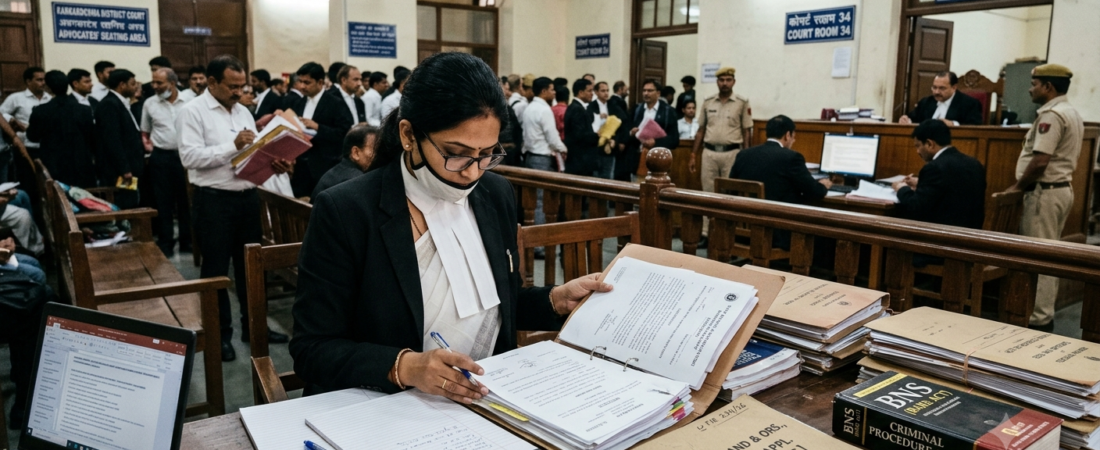
Written by Kapil Balhara | Technically Reviewed for Accuracy | Last Updated: September 2026
When a police officer arrests a family member in Delhi, securing swift legal intervention becomes an urgent priority. You must act fast because navigating the Indian criminal justice system requires choosing the precise legal remedy to safeguard personal liberty, as filing an improper application causes unnecessary jail time.
Table of Contents
- What Is Regular Bail Under Indian Criminal Law?
- The Statutory Framework: BNSS Rules vs. Historical CrPC Provisions
- Comparing Legal Remedies: Regular, Interim, and Anticipatory Bail
- Key Legal Grounds for Securing Regular Bail Under Section 483 BNSS
- Step-by-Step Regular Bail Procedure in Delhi District Courts
- Strict Consequences of Violating Court-Imposed Bail Conditions
- Landmark Supreme Court Judgments Safeguarding Personal Liberty
- Critical Pitfalls to Avoid and Strategic Action Steps
- Frequently Asked Questions
What Is Regular Bail Under Indian Criminal Law?
Understanding how courts evaluate post-arrest release is essential for families facing criminal litigation. In our defense practice, we consistently emphasize that physical detention must remain a temporary measure during active police investigations.
Regular bail is a statutory post-arrest judicial remedy granted under Section 480 and Section 483 of the Bharatiya Nagarik Suraksha Sanhita, 2023 (BNSS) [formerly Sections 437 and 439 CrPC] that releases an accused individual from police or judicial custody while the criminal trial remains pending.
Consequently, when an individual is taken into custody, filing a regular bail plea becomes the primary procedural mechanism to secure release from prison.
The Statutory Framework: BNSS Rules vs. Historical CrPC Provisions
The Indian Parliament enacted significant procedural updates, replacing the old Code of Criminal Procedure, 1973 (CrPC) with the Bharatiya Nagarik Suraksha Sanhita, 2023 (BNSS). Therefore, all contemporary bail applications must cite the updated statutory provisions.
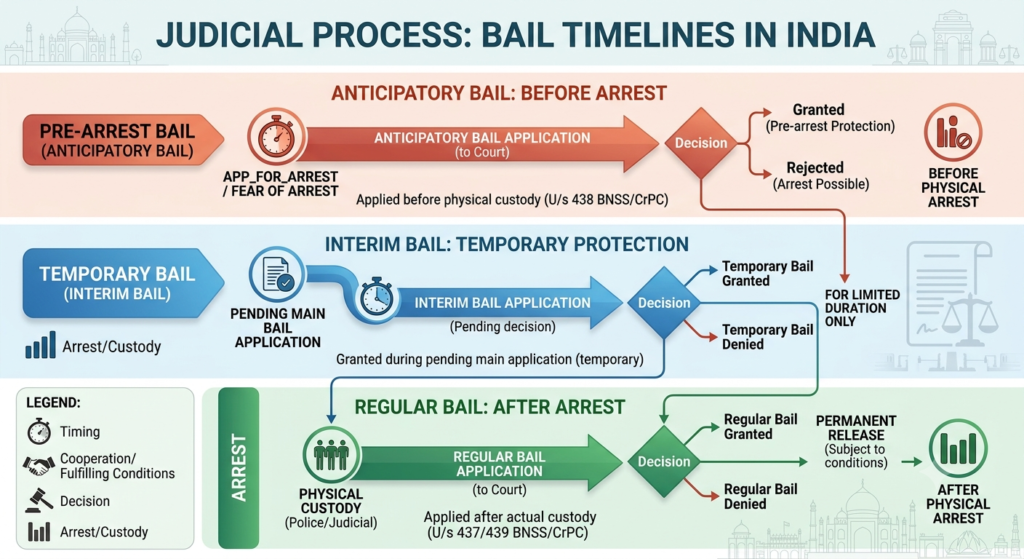
Under this statutory architecture, three primary mechanisms protect citizens facing criminal charges:
- Regular Bail (Section 480 & 483 BNSS / Section 437 & 439 CrPC): This remedy applies exclusively after an arrest occurs, while the accused remains in police custody or judicial detention.
- Anticipatory Bail (Section 482 BNSS / Section 438 CrPC): This relief applies prior to arrest when a citizen apprehends imminent arrest in a non-bailable offence.
- Interim Bail: This temporary relief shields an applicant for a short period while a main regular or anticipatory bail plea remains pending, or to address acute medical emergencies.
Comparing Legal Remedies: Regular, Interim, and Anticipatory Bail
To select the correct strategy, you must analyze the core operational differences between these three legal pathways.
| Feature / Criteria | Regular Bail | Interim Bail | Anticipatory Bail |
|---|---|---|---|
| Stage of Application | Post-arrest (accused is in custody) | During pending plea or emergency | Pre-arrest (apprehension of arrest) |
| Primary BNSS Provision | Section 480 & 483 BNSS | Judicial discretion (Article 21) | Section 482 BNSS |
| Duration of Relief | Lasts through trial completion | Fixed short period (e.g., 2–4 weeks) | Continues through trial upon arrest |
| Immediate Effect | Releases accused from jail | Suspends arrest or gives short release | Directs release if police make arrest |
| Court Jurisdiction | Magistrate, Sessions, or High Court | Magistrate, Sessions, or High Court | Sessions Court or High Court only |
Key Legal Grounds for Securing Regular Bail Under Section 483 BNSS
Courts do not grant regular bail as an automatic right in non-bailable matters. Instead, judges exercise judicial discretion based on established legal principles.
Key Takeaway: Furthermore, the primary principle of Indian criminal jurisprudence remains “Bail is the rule, jail is the exception” as laid down in landmark judicial rulings.
Core Factors Examined by Judges
- Nature and Gravity of Offence: Less severe offences receive faster relief. Conversely, allegations carrying life imprisonment or capital punishment receive rigorous scrutiny.
- Absence of Flight Risk: Demonstrating local residency in Delhi/NCR, family dependencies, and clean background records establishes that the accused will not abscond.
- Zero Risk of Evidence Tampering: Proving that the accused lacks the ability to influence prosecution witnesses or destroy documentary evidence.
- Completion of Investigation Steps: When police complete witness questioning, execute material recoveries, and file the formal chargesheet, continued detention becomes unnecessary.
- Special Statutory Provisions: In addition, Section 480 BNSS provides relaxed bail standards for minors under 16 years, women, and sick or infirm individuals.
Step-by-Step Regular Bail Procedure in Delhi District Courts
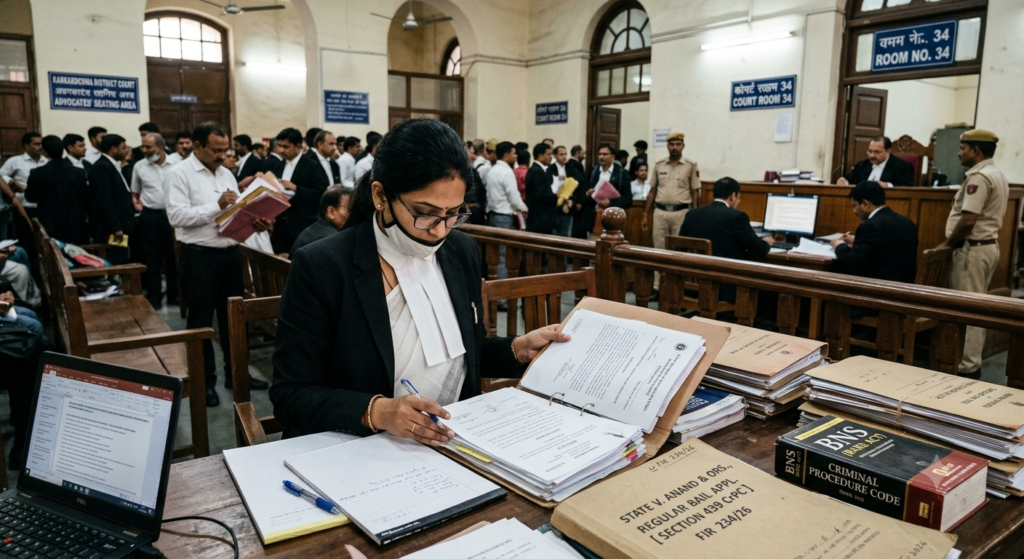
Navigating Delhi District Courts (such as Tis Hazari, Patiala House, Saket, Dwarka, Rohini, or Karkardooma) requires following a strict procedural sequence.
- Document Compilation: Gather the arrest memo, remand order copy, FIR transcript, identity cards, address verification documents, and surety financial records.
- Application Drafting: Your defense lawyer drafts the regular bail petition under Section 480 or 483 BNSS, highlighting your innocence and demonstrating why physical custody is unneeded.
- Filing and Court Listing: Submit the urgent petition before the jurisdictional Magistrate Court or District Sessions Court. The matter is listed for hearing within 24 to 48 hours.
- Notice and Police Status Report (SR): The court issues notice to the Public Prosecutor. Subsequently, the Investigating Officer (IO) submits a written Status Report detailing the case progress.
- Arguments and Bail Bond Execution: Counsel presents oral arguments. Upon receiving a favorable order, you submit personal bonds and local surety documents to secure release from Tihar or Mandoli Jail.
Strict Consequences of Violating Court-Imposed Bail Conditions
When granting regular or anticipatory bail, judges attach mandatory compliance directives under Section 480(3) and Section 482(2) BNSS.
- Non-Attendance on Trial Dates: Missing scheduled court hearings prompts the judge to issue a non-bailable warrant (NBW) immediately.
- Witness Interference or Threats: Contacting complainants or threatening prosecution witnesses triggers instant bail cancellation under Section 483(3) BNSS.
- Unauthorized Travel Overseas: Leaving the territorial jurisdiction or country without prior judicial permission leads to bond forfeiture.
- Forfeiture of Financial Sureties: Furthermore, courts initiate recovery proceedings against financial sureties under statutory forfeiture rules when conditions are breached.
Landmark Supreme Court Judgments Safeguarding Personal Liberty
Binding precedents established by the Supreme Court of India govern how lower courts evaluate regular bail petitions.
Key Precedents to Cite During Hearings
- State of Rajasthan v. Balchand (1977): Justice V.R. Krishna Iyer articulated the bedrock constitutional principle that “Bail is the rule, jail is the exception,” prioritizing personal freedom over pre-trial detention.
- Sanjay Chandra v. CBI (2012): The Apex Court clarified that courts must not withhold bail as a punitive measure before establishing guilt, even in complex economic offences.
- Satender Kumar Antil v. CBI (2022): The Supreme Court established categorization guidelines for offences, ordering trial courts to decide bail applications expeditiously without making routine arrests.
Critical Pitfalls to Avoid and Strategic Action Steps
In our trial analysis, we observed that simple administrative errors frequently delay jail release orders by several days.
Common Mistakes That Delay Relief
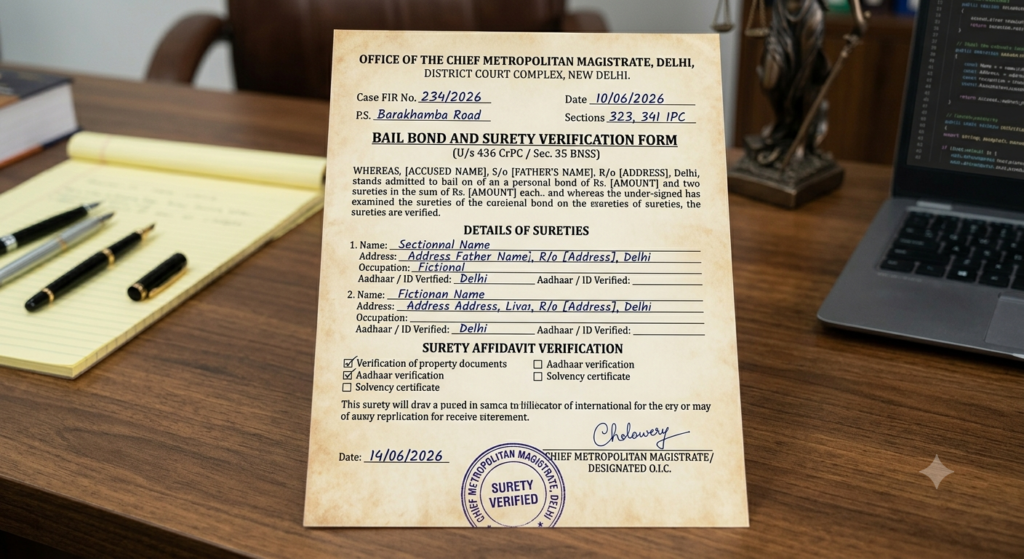
- Submitting Defective Surety Documents: Filing unverified land records, unclear identity proofs, or incomplete tax documents delays prison release.
- Concealing Past Criminal Background: Suppressing prior FIRs leads to immediate rejection once the IO files the criminal antecedent report.
- Bypassing the Sessions Court: Filing petitions directly in the High Court without compelling justifications often results in redirection to the District Court.
Recommended Action Plan
- Obtain Critical Case Records: Secure certified copies of the FIR, arrest memo, and remand order immediately after detention.
- Prepare Local Sureties Early: Keep local Delhi/NCR sureties prepared with valid identity proofs, address documents, and property records.
- Engage Senior Criminal Defense Counsel: Consult experienced defense advocates to draft a precise regular bail plea before local courts.
Frequently Asked Questions
What is the main difference between regular bail and interim bail?
Regular bail grants long-term protection throughout the trial period. Conversely, interim bail provides temporary relief (typically lasting a few weeks) while the main application remains pending or to handle an urgent medical emergency.
How long does it take to get regular bail in Delhi District Courts?
Magistrate Courts usually decide regular bail pleas within 2 to 5 days. Meanwhile, Sessions Courts typically take 3 to 7 days, depending on how quickly the Investigating Officer submits the police Status Report.
Can a court grant regular bail if police have not filed a chargesheet?
Yes. In fact, if police fail to file the chargesheet within 60 or 90 days (depending on offence severity), the accused earns an absolute statutory right to Default / Mandatory Bail under Section 187 BNSS.
What options exist if the Sessions Court rejects a regular bail plea?
If the Sessions Judge denies relief, the applicant holds an immediate statutory right to file a regular bail petition before the Delhi High Court under Section 483 BNSS.
Mandatory Disclaimer
This article is provided solely for general informational and educational purposes and does not constitute formal legal advice. Accessing or reading this material does not create an attorney-client relationship. Individuals facing arrest or criminal detention should consult a qualified criminal defense advocate immediately for professional guidance tailored to their specific case facts.