
Written by Kapil Balhara | Technically Reviewed for Accuracy | Last Updated: September 2026
Table of Contents
- The Core Legal Framework: Section 91 CrPC vs. Section 94 BNSS
- Can Police Demand Mobile Phones and Private Passwords?
- Step-by-Step Practical Process: Handling a Notice in Delhi
- Non-Compliance Consequences and Essential Legal Remedies
- Frequently Asked Questions
1. The Core Legal Framework: Section 91 CrPC vs. Section 94 BNSS
Receiving a section 91 Crpc notice (now governed under Section 94 of the Bharatiya Nagarik Suraksha Sanhita, 2023 / BNSS) from the Delhi Police can trigger intense anxiety for an accused person, a witness, or a business entity. However, a notice to produce documents is an evidentiary demand—not an immediate order of arrest—and it must operate within strict statutory limits and constitutional boundaries.
A section 91 CrPC notice (now Section 94 BNSS) is a formal statutory directive issued by an Investigating Officer or Court requiring a person to produce specific documents, electronic records, or tangible items deemed necessary or desirable for an ongoing police investigation, inquiry, or judicial trial.
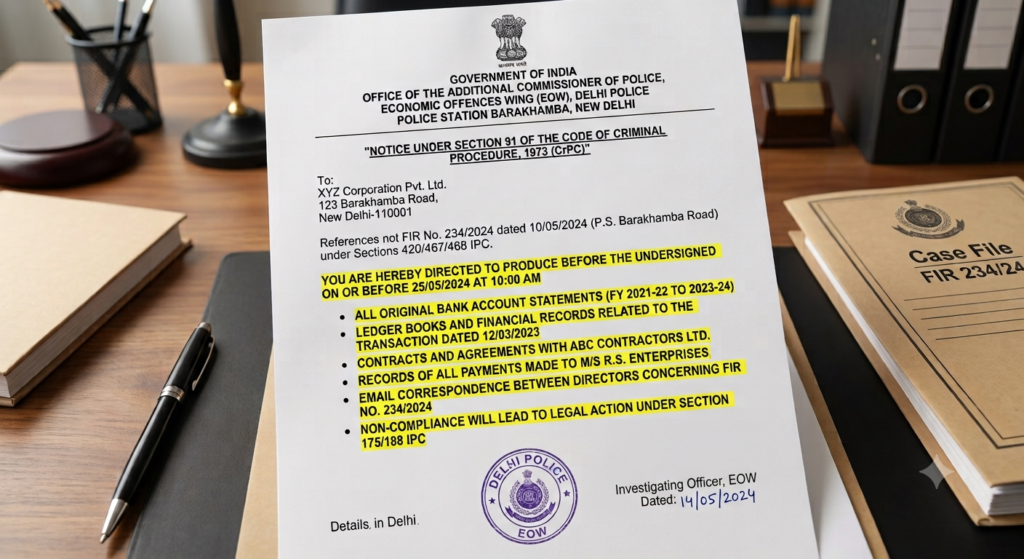
Statutory Transition: CrPC vs. BNSS
With the implementation of the new criminal laws, Section 91 of the Code of Criminal Procedure, 1973, has been replaced by Section 94 of the BNSS, 2023. In our legal evaluations of this transition, we observed that while the core power remains similar, the new law explicitly incorporates digital and electronic records into the statutory text.
| Feature / Aspect | Section 91 CrPC (Old Law) | Section 94 BNSS (New Law) |
|---|---|---|
| Statutory Provision | Section 91 CrPC | Section 94 BNSS |
| Issuing Authority | Court or Officer-in-Charge of a Police Station | Court or Officer-in-Charge of a Police Station |
| Target Material | Document or other physical “thing” | Document, electronic record, or other physical “thing” |
| Mode of Compliance | Personal appearance or submitting through an agent | Personal appearance, agent submission, or digital submission |
| Scope Limitation | Excludes postal and telegram items (covered under Section 92) | Preserves exclusions while explicitly expanding to digital records |
Furthermore, the investigating officer cannot use this power arbitrarily without demonstrating that the requested records are strictly relevant to the case.
Constitutional Shield: Right Against Self-Incrimination
A critical point of legal debate is whether an accused person can be issued a section 91 CrPC / Section 94 BNSS notice to produce documents that directly incriminate them. Under Article 20(3) of the Constitution of India, no person accused of any offence shall be compelled to be a witness against himself.
- State of Gujarat v. Shyamlal Mohanlal Choksi : The Supreme Court of India established that the term “person” in Section 91 CrPC does not include an accused person if the notice compels them to produce self-incriminating material based on personal knowledge.
- Creating New Evidence vs. Producing Existing Records: In recent judicial interpretations, the High Court of Delhi affirmed that Section 91 CrPC is purely a machinery to secure pre-existing, real evidence. Therefore, police officers cannot use Section 91 to compel an accused to apply their mind, compile brand-new lists, or write out self-incriminating details from personal memory.
Key Takeaway: The constitutional shield under Article 20(3) protects an accused person from being compelled to produce self-incriminating documents or create new evidence against themselves under a Section 91 notice.
2. Can Police Demand Mobile Phones and Private Passwords?
When Delhi Police issue a notice seeking personal smartphones, laptops, or bank records, significant privacy concerns arise. In our experience handling cyber crime and financial investigations, understanding the boundary between physical device seizure and mental compulsion is critical.
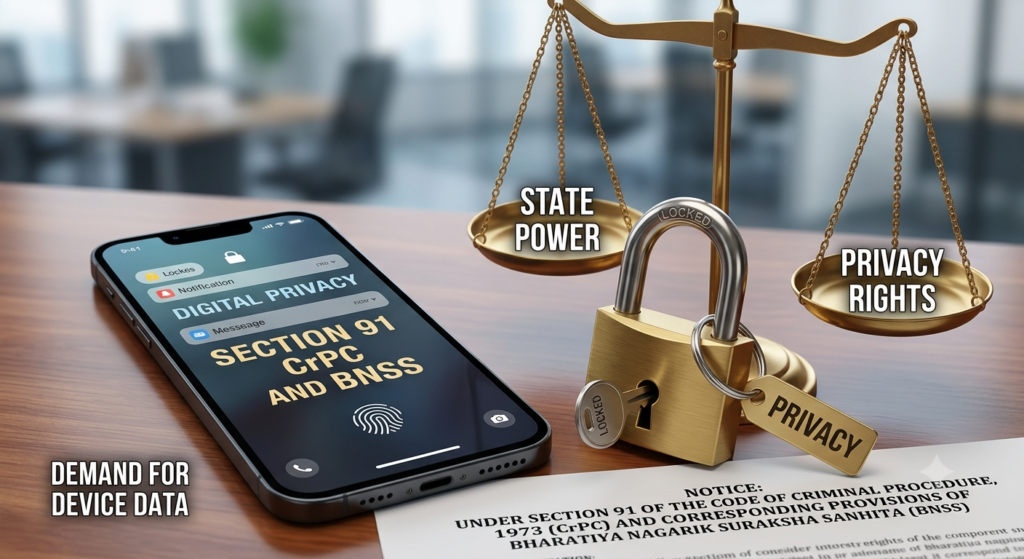
Physical Device Demands vs. Private Passwords
While police officers may seek a physical smartphone as material evidence under investigation, forcing an accused person to reveal private passcodes, PINs, or encryption keys involves mental faculties and personal knowledge.
Consequently, courts have held that compelling an accused to divulge passwords or unlock devices with personal knowledge violates the fundamental right against self-incrimination section 91 CrPC and Article 20(3). Although police may seize a device through a valid search warrant or technical examination, they cannot force an accused to testify against themselves via a written notice.
Time Limit to Submit Bank Statements to Delhi Police
When an Investigating Officer issues a notice demanding financial records or bank statements:
- Reasonable Time Frame: Section 91 CrPC / Section 94 BNSS notices specify a time and date for submission. The law requires the notice to give a reasonable timeframe, typically ranging from 3 to 7 days depending on the urgency.
- Requesting Extensions: If the requested bank statements involve older financial years or require official branch certification, your advocate can submit an interim written response requesting additional time.
In addition, providing properly indexed bank statements prevents unnecessary confusion during financial audits.
3. Step-by-Step Practical Process: Handling a Notice in Delhi
If served with a section 91 CrPC / Section 94 BNSS notice by the Delhi Police (such as the Crime Branch, Special Cell, Economic Offences Wing, or local police stations), follow this step-by-step process:
- Verify Official Details and Scope: Check that the notice bears an official FIR number, Crime Number, or Daily Diary (DD) entry, along with the official stamp and details of the Investigating Officer.
- Determine Your Legal Status: Identify clearly whether the police are summoning you as a third-party witness (such as a bank, landlord, or employer) or as a suspect/accused person.
- Seek Immediate Legal Representation: If you are a suspect, consult a criminal defense attorney before handing over personal digital records, passwords, or written statements.
- Compile and Index Pre-Existing Material: Gather only the specific, pre-existing documents mentioned in the notice. Avoid volunteering unrequested personal diaries, uncertified notes, or secondary electronic devices.
- Secure Official Acknowledgment upon Submission: Under Section 91(2) CrPC / Section 94(2) BNSS, a person complies by causing the document to be produced through an agent or submission letter. Always retain a copy bearing the Delhi Police station’s official receiving stamp and signature.
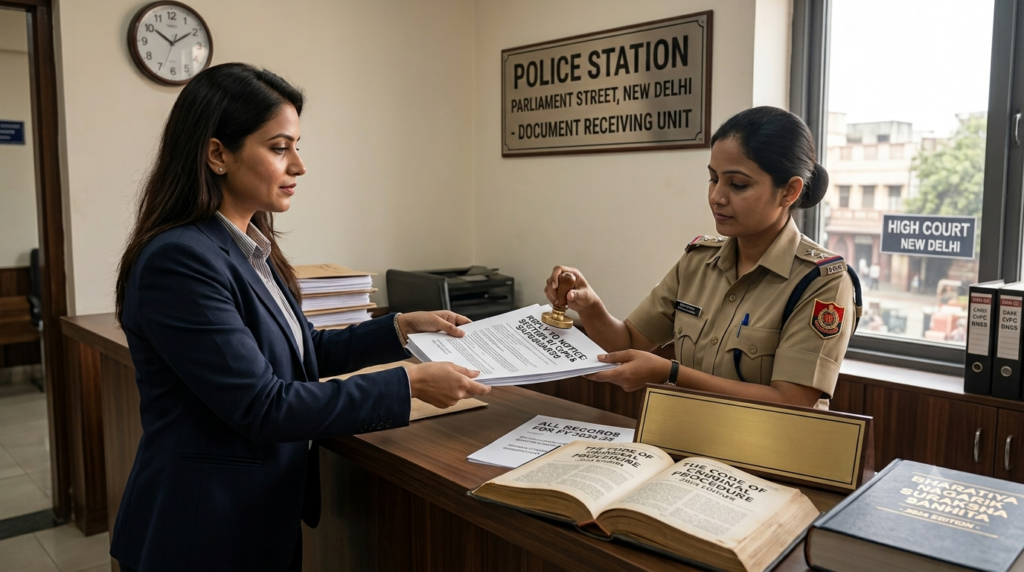
Key Takeaway: You do not always need to appear in person for a document notice; submitting the exact requested records through an authorized representative with a stamped receiving copy satisfies the legal requirement.
4. Non-Compliance Consequences and Essential Legal Remedies
Ignoring a valid statutory notice without a legal challenge or proper representation carries serious procedural risks.
Non-Compliance Consequences of Section 91 Notice
- Execution of Search Warrants: If a recipient fails or refuses to produce requested documents without valid legal grounds, the police can apply to a Magistrate for a search warrant under Section 93 CrPC (now Section 96 BNSS) to search premises and seize the material directly.
- Penal Prosecution for Disobedience: Willful disobedience of an order issued by a public servant can attract penal charges under Section 175 of the IPC (now corresponding provisions under the Bharatiya Nyaya Sanhita, 2024).
- Adverse Inferences in Trial: In formal court trials, persistent failure to produce documents in your possession can lead the court to draw an adverse inference against you.
Essential Legal Remedies in Delhi
- Challenging Overbroad Notices: If the notice represents a “fishing expedition” seeking vague, overly broad, or self-incriminating records, your advocate can file a petition under Section 528 BNSS (formerly Section 482 CrPC) in the High Court of Delhi to quash or modify the notice.
- Interim Protective Orders: Courts can issue specific directions limiting the scope of document demands or extending compliance timelines to ensure your constitutional rights remain protected.
Ultimately, a section 91 Crpc notice is an evidentiary tool for gathering facts, not an automatic precursor to arrest. However, navigating demands for mobile devices, private passwords, or personal financial records requires balancing active cooperation with your fundamental constitutional protections.
5. Frequently Asked Questions
Can police arrest me for not responding to a Section 91 CrPC notice?
Failure to comply with a Section 91 notice does not lead to an immediate arrest on the spot. However, the police can seek a search warrant from a Magistrate to seize the documents or initiate proceedings for disobeying a public servant’s order.
Does an accused person have to submit personal documents under Section 91?
An accused person cannot be compelled to produce personal documents that are self-incriminating, as protected under Article 20(3) of the Constitution of India and established by the Supreme Court in the Shyamlal Mohanlal Choksi case.
What is the difference between Section 91 CrPC and Section 94 BNSS?
Section 94 BNSS is the new law replacing Section 91 CrPC. While the legal machinery remains similar, Section 94 BNSS explicitly includes digital and electronic records and accommodates modern electronic modes of document submission.
Can Delhi Police force me to unlock my phone under Section 91?
Forcing an accused person to reveal personal passwords, PINs, or passcodes to unlock a phone violates the right against self-incrimination under Article 20(3). While police may seize the physical device, they cannot compel you to provide mental contents or passcodes against your will.
Standard Legal Disclaimer: The content provided in this article is strictly for informational and educational purposes only and does not constitute formal legal advice. Reading this article or interacting with its contents does not create an attorney-client relationship. Individuals or entities receiving a police notice or facing legal proceedings are strongly advised to consult a licensed legal professional or advocate to obtain advice tailored to their specific case and jurisdiction.