
Table of Contents
- Understanding Section 438 CrPC & Anticipatory Bail
- The Core Legal Conflict: Time-Bound vs. Lifetime Bail
- Sushila Aggarwal Case Details: The Supreme Court Verdict
- Key Legal Precedents Compared
- Practical Impact on Criminal Trials & Police Custody
- Frequently Asked Questions
Navigating the complex landscape of pre-arrest protection in Indian criminal jurisprudence often leads to one decisive landmark: Sushila Aggarwal vs State (NCT of Delhi). This historic Supreme Court ruling settled long-standing debates surrounding Section 438 CrPC and the duration of pre-arrest protection.
Written by Kapil Balhara / Placitum Advocates | Technically Reviewed for Accuracy | Last Updated: August 2026
Understanding Section 438 CrPC & Anticipatory Bail
Anticipatory bail serves as a crucial constitutional shield protecting individual personal liberty against arbitrary arrest. Introduced upon recommendations from the Law Commission of India’s 41st Report, Section 438 gives superior criminal courts power to grant pre-arrest relief.
Key Takeaway: Anticipatory bail is fundamentally an order directing that in the event of an arrest, a person shall be released on bail immediately upon execution of necessary bonds.

The statutory power under Section 438 of the Code of Criminal Procedure (CrPC) is exercisable exclusively by the High Court and the Court of Session. Moreover, this judicial protection addresses reasonable apprehensions of arrest regarding non-bailable offences.
However, confusion historically persisted regarding whether this judicial relief automatically expires once police file a chargesheet.
The Core Legal Conflict: Time-Bound vs. Lifetime Bail
For decades, conflicting decisions from different Supreme Court benches created significant confusion for trial courts and legal practitioners.
On one side, cases like Salauddin Abdulsamad Shaikh v. State of Maharashtra (1996) argued that anticipatory bail must necessarily be time-bound. Conversely, decisions like Gurbaksh Singh Sibbia v. State of Punjab (1980) and Siddharam Satlingappa Mhetre v. State of Maharashtra (2011) favored broader judicial discretion without arbitrary time limits.
To resolve these contradictions, a 5-Judge Constitution Bench evaluated two primary questions:
- Should protection under Section 438 CrPC be limited to a fixed period, forcing the accused to surrender and seek regular bail?
- Does the life of an anticipatory bail order end automatically when the trial court issues a summons or takes cognizance?
Sushila Aggarwal Case Details: The Supreme Court Verdict
In a unanimous landmark judgment delivered on January 29, 2020, the Constitution Bench held that anticipatory bail does not automatically expire upon chargesheet submission or trial court summoning.
In our analysis of the judgment, the Supreme Court established clear principles regarding pre-arrest orders:
- No General Time Limit: Ordinarily, protection granted under Section 438 CrPC does not contain an inherent expiration date.
- Duration of Protection: The relief usually continues till the end of the trial unless cancelled under Section 439(2).
- Judicial Discretion: Courts retain absolute discretion to impose specific time restrictions if special facts or circumstances justify doing so.
- Police Custody Rights: Granting pre-arrest protection does not restrict police powers to conduct investigations or seek custodial interrogation under Section 27 Evidence Act.
Key Legal Precedents Compared
The ruling in Sushila Aggarwal vs State (NCT of Delhi) reconciled forty years of conflicting judicial interpretation.
| Case Name | Bench Strength | Core Ruling on Duration |
|---|---|---|
| Gurbaksh Singh Sibbia (1980) | 5 Judges | Discretionary power; no mandatory restrictions should be read into Section 438. |
| Salauddin Shaikh (1996) | 3 Judges | Held that anticipatory bail MUST be limited in time. (Declared Overruled) |
| Siddharam Mhetre (2011) | 2 Judges | Held bail lasts till trial end, but incorrectly restricted judicial power to limit time. (Partially Clarified) |
| Sushila Aggarwal (2020) | 5 Judges | Reaffirmed Sibbia; normal rule is no time limit, but trial courts maintain discretion to limit duration when necessary. |
Key Takeaway: The Sushila Aggarwal ruling confirmed that Salauddin Shaikh and its derivative judgments incorrectly restricted constitutional liberties by imposing artificial time limits on bail.
Practical Impact on Criminal Trials & Police Custody
When we evaluated the practical applications of this judgment, several clear procedural rules emerged for trial lawyers and law enforcement alike.
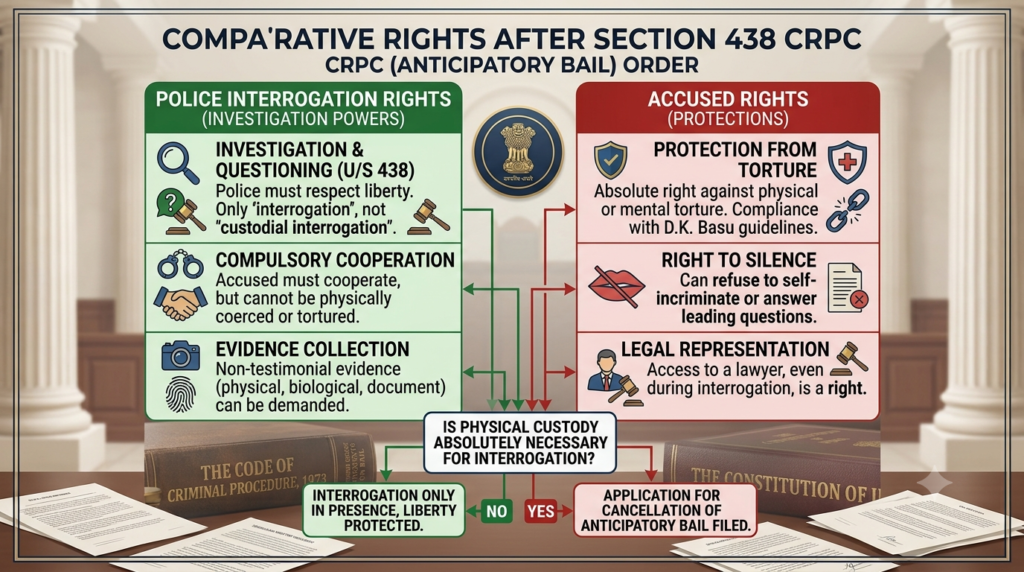
How Section 438 Operates During Investigation
- Filing the Application: The applicant files under Section 438 CrPC before Sessions Court or High Court apprehending arrest.
- Imposition of Conditions: Courts impose conditions ensuring cooperation with investigating authorities.
- Execution of Bond: Upon potential arrest, police release the individual after receiving bail bonds under Section 441 CrPC.
- Chargesheet & Cognizance: The magistrate issuing summons cannot issue a non-bailable warrant at the first instance if pre-arrest protection exists.
Furthermore, Section 438 does not create an absolute immunity shield against interrogation. The investigating agency can always move the court under Section 439(2) CrPC to seek cancellation of bail or police custody if new incriminating evidence arises.
Link to Download Sushila Aggarwal vs State (NCT of Delhi) Judgement
Frequently Asked Questions
Does anticipatory bail expire after the chargesheet is filed?
No. As established in Sushila Aggarwal vs State (NCT of Delhi), anticipatory bail does not automatically expire upon the filing of a chargesheet or final report by the police.
Can a judge place a time limit on anticipatory bail?
Yes. While the normal rule is not to limit the duration of protection, the court granting anticipatory bail maintains the judicial discretion to limit its timeframe if specific facts warrant such restrictions.
Can police ask for custody after anticipatory bail is granted?
Yes. Pre-arrest bail does not hamper the police’s right to conduct investigations or seek custodial interrogation for discoveries under Section 27 of the Evidence Act through proper judicial applications.
For expert legal representation or dedicated assistance with Section 438 CrPC applications, contact Kapil Balhara / Placitum Advocates today to safeguard your constitutional freedom.