Filing a Police Complaint? How to Write an FIR Application Correctly
Facing a crime leaves victims feeling devastated and uncertain about their next steps. Therefore, learning How to Write an FIR Application (Format & Draft Structure) empowers you to draft a legally flawless complaint that forces swift police action.
Written by Kapil Balhara | Technically Reviewed for Accuracy | Last Updated: October 2026
Understanding the Structural Framework of an FIR Application
Drafting an official complaint requires precise adherence to statutory principles. Consequently, structured complaints ensure police officers record cognizable offences without unnecessary delays.
Section 173 of the Bharatiya Nagarik Suraksha Sanhita (BNSS) governs the registration of First Information Reports. This provision obligates police personnel to record written complaints disclosing serious crimes.
Key Takeaway: A well-structured FIR application serves as the primary evidentiary foundation for your case. Clear factual drafting prevents defense lawyers from exploiting ambiguities during criminal trials.
Definition and Summary Block
Learning how to write an FIR application helps citizens present facts clearly to police authorities. An FIR application is a formal written complaint addressed to the Station House Officer. It details the occurrence of a cognizable offence, identifies perpetrators, specifies the crime scene, and requests immediate statutory investigation under penal laws.
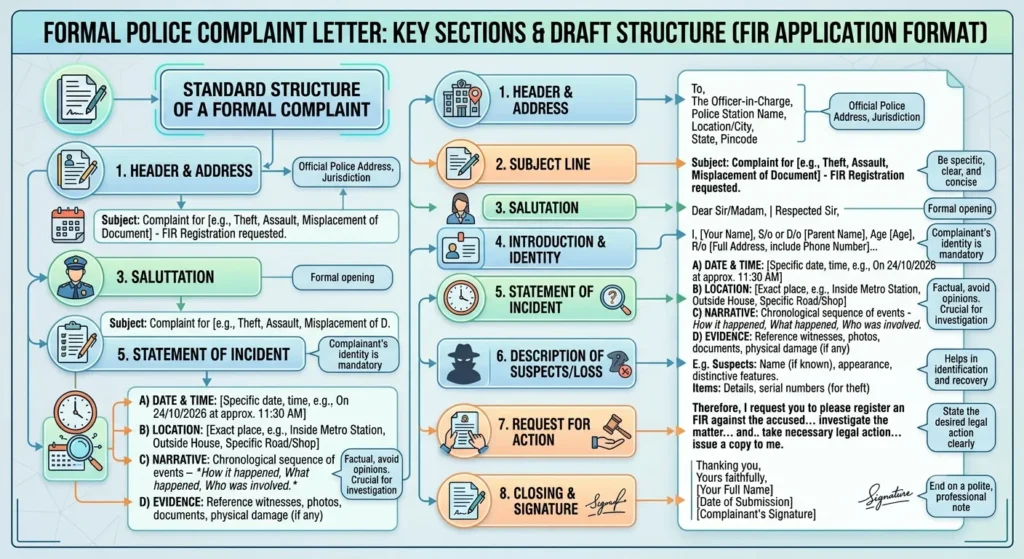
Diagram illustrating how to write an FIR application format and draft structure
In our legal practice, we frequently evaluate complaints drafted by citizens facing distressing circumstances. Therefore, review the comparison table below to understand how written applications differ from oral dictations.
Complaint Feature
Written FIR Application
Oral Complaint Dictation
Factual Accuracy
High precision because you control every written word
Risk of misinterpretation by recording officers
Documentary Proof
Retains physical receiving copy with official station stamp
Relies on station clerk’s manual transcription
Evidence Annexures
Allows attaching screenshots, receipts, and medical reports
Requires separate submission during later investigation
Legal Review
Can be reviewed by lawyers prior to submission
Recorded immediately without prior legal consultation
Statutory Authority
Section 173(1) BNSS
Section 173(1) BNSS
Essential Drafting Elements: Header, Subject, and Timeline
Organizing your complaint logically ensures station authorities grasp the severity of the offence immediately. Therefore, follow a standard legal letter architecture.
Always begin your written complaint with a formal, respectful header. Specifically, address the Station House Officer (SHO) of the local police station having territorial jurisdiction.
State the complete name of the police station, district, and city clearly at the top. In addition, include your own full contact details, current address, and phone number in the header block.
To,
The Station House Officer (SHO),
[Police Station Name],
[District / City Name], [State Name]

From:
[Your Full Name],
S/o or D/o [Father's Name],
R/o [Complete Residential Address],
Contact No: [Mobile Number],
Email ID: [Email Address]
Writing a Clear Subject Line
Your subject line must summarize the nature of the crime concisely. Specifically, state the core offence and mention relevant penal sections if known.
A vague subject line slows down administrative processing. Conversely, an explicit subject line alerts the duty officer to direct the matter to the appropriate desk immediately.
For instance, write “Application for Registration of FIR regarding Armed Robbery and Assault” instead of a generic title like “Complaint Letter”.
Establishing a Precise Incident Timeline
In our analysis, establishing a precise incident timeline remains the single most critical factor in criminal complaints. Clearly record the exact date, day, and time of the occurrence.
Furthermore, state the exact location where the crime took place. Include landmark details, street names, floor numbers, or GPS markers to establish territorial jurisdiction unambiguously.
If the offence occurred over multiple days, specify the exact starting and ending times. In State of Andhra Pradesh v. Goloconda Linga Swamy (2004), the Supreme Court held that while an FIR need not contain exhaustive details, a precise timeline prevents defense allegations of delayed fabrication.
Key Takeaway: Clear timelines eliminate defense arguments regarding unexplained delay in filing complaints. Always detail the exact sequence of events chronologically.
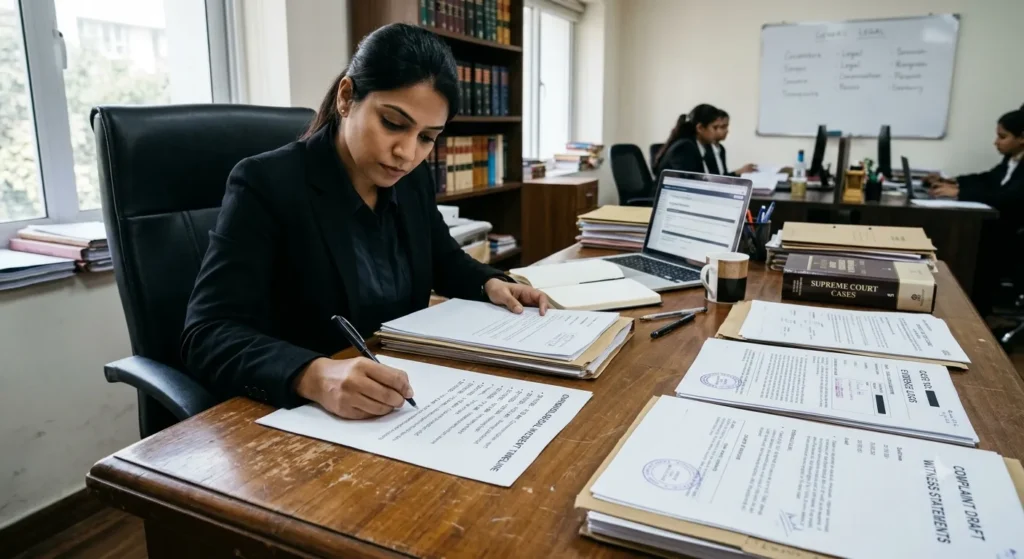
Legal professional drafting a clear incident timeline for an FIR application
Documenting Suspects, Eyewitnesses, Property, and Injuries
Detailed factual disclosures strengthen your complaint and guide the Investigating Officer effectively. Therefore, provide exhaustive particulars regarding all parties and damages involved.
Describing Suspects and Accused Persons
If the accused persons are known to you, list their full names, nicknames, addresses, and occupations. Mention any prior disputes or motives that led to the incident.
Conversely, if the perpetrators are unknown, describe their physical appearance with meticulous care. Note their height, approximate age, body build, skin tone, facial hair, clothing, voice, and unique identity marks like tattoos.
Additionally, record details of vehicles used by the accused persons. Write down license plate numbers, vehicle make, color, and any visible modifications observed during the incident.
Listing Eyewitness Contact Details
Including independent witnesses builds immediate credibility for your narrative. Therefore, list eyewitness contact details prominently within the body of your complaint.
State the full name, residential address, and phone number of every person who observed the crime. Describe their exact physical location relative to the crime scene during the occurrence.
In State of Uttar Pradesh v. Sughar Singh (1978), the Supreme Court observed that prompt disclosure of eyewitness names in the initial report minimizes doubts regarding subsequent witness tampering.
Mentioning Stolen Property or Injury Details
When reporting property crimes, provide a comprehensive inventory of stolen or damaged goods. List specific serial numbers, brand names, estimated market values, and unique identification marks.
Similarly, in cases involving physical violence, describe all bodily injuries clearly. Mention bleeding, fractures, bruises, or internal pain suffered by the victims.
In addition, specify if emergency medical care was administered at a hospital. State the name of the hospital and medical officer to facilitate police retrieval of the Medico-Legal Certificate (MLC).
Key Takeaway: Precise property descriptions enable police to issue immediate recovery alerts across border checkpoints and digital police networks.
Supporting Evidence, Common Errors, and Sign-off Procedures
Strengthen your written complaint by attaching verifying documentation and executing proper legal sign-off procedures.
Attaching Proofs Photos and Screenshots
In modern criminal investigations, digital and physical evidence play a crucial role. Therefore, attach clear copies of supporting documents directly to your application.
Digital Screenshots: Print out chat logs, fraudulent transaction records, email threads, or social media threats.
Physical Photographs: Include photos of bodily injuries, damaged property, forced locks, or crime scene footprints.
Financial Statements: Attach bank passbook entries, account statements, or UPI transaction reference receipts showing fraudulent transfers.
CCTV Footage: Mention the availability of video recordings from nearby security cameras and store them safely on a USB drive.
Common Mistakes That Lead to Rejection
Our review of rejected complaints reveals several repeating drafting errors made by citizens:
Omission of Specific Allegations: Using vague assertions like “they harassed me” without describing specific physical or verbal acts.
Exaggerating Claims: Adding false allegations against innocent family members of the accused, which damages overall case credibility.
Failing to Explain Delay: Leaving a time gap between the incident and filing without offering valid reasons such as medical hospitalization.
Incorrect Police Station Choice: Submitting the application to a police station that lacks territorial jurisdiction over the crime scene.
In Apren Joseph v. State of Kerala (1972), the Supreme Court clarified that delay in lodging an FIR is not fatal if the complainant provides a plausible explanation within the initial application.
Correct Way to Conclude and Sign the Complaint
Conclude your application with a formal prayer clause requesting specific legal action. Respectfully ask the Station House Officer to register an FIR and initiate an immediate investigation.
In addition, include a formal verification statement affirming that all facts stated in the complaint are true to your knowledge.
Finally, sign the document clearly using blue ink or affix your left thumb impression. State the date and place of signing right below your signature.
Key Takeaway: Always retain a photocopy of your signed application. Demand that the duty officer affix the official police station receiving stamp, date, and signature on your copy.
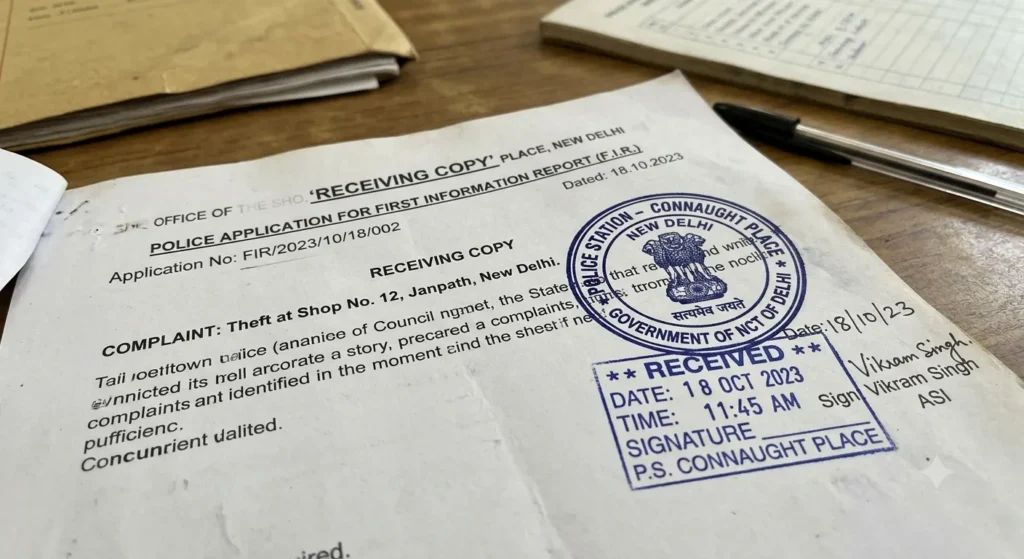
Stamped receiving copy of an FIR application showing official police station seal
Sample FIR Application Template Walkthrough
To assist you in drafting your own complaint, review the standardized template provided below. You can adapt this structure for various cognizable offences.
FORMAL APPLICATION FOR REGISTRATION OF FIR

To,
The Station House Officer (SHO),
[Name of Police Station],
[District/City Name], [State Name]

SUBJECT: Application under Section 173 BNSS for registration of FIR regarding [Mention Offence e.g., Theft / Assault / Cyber Fraud]

Respected Sir/Madam,

I, [Your Full Name], Aged about [Age] years, S/o or D/o [Father's Name], residing at [Complete Postal Address], Contact Number: [Phone Number], respectfully submit as follows:

1. INCIDENT TIMELINE AND LOCATION:
On [Date of Incident] at approximately [Time, e.g., 04:30 PM], a cognizable crime occurred at [Exact Address / Location of Scene].

2. DETAILS OF THE INCIDENT:
[Provide a clear chronological narrative of events. Describe how the incident started, what actions the accused performed, and how the crime concluded.]

3. DETAILS OF THE ACCUSED PERSONS:
[List names, addresses, and physical descriptions of accused persons, or state "Unknown Persons" alongside observed physical traits.]

4. DETAILS OF WITNESSES:
The following individuals witnessed the occurrence:
i. [Witness 1 Name], R/o [Address], Contact: [Phone Number]
ii. [Witness 2 Name], R/o [Address], Contact: [Phone Number]

5. PARTICULARS OF LOSS / INJURY:
[Detail stolen items with value/serial numbers, or describe physical injuries sustained.]

6. ATTACHED EVIDENCE:
i. Annexure A: Copy of Identity Proof (Aadhaar / Voter ID)
ii. Annexure B: Screenshots of fraudulent transactions / CCTV snapshots
iii. Annexure C: Medical treatment receipts / Hospital discharge summary

PRAYER:
It is therefore most respectfully prayed that your good office may kindly register an FIR against the accused persons under relevant statutory provisions and initiate a prompt investigation.

Place: [City Name]
Date: [DD/MM/YYYY]

Yours faithfully,

__________________
[Your Signature]
[Your Printed Name]
Need professional legal review for your draft? Contact our expert legal team today to ensure your application meets all procedural requirements.
Legal Action Steps After Filing Your Application
Submitting your application represents the beginning of the legal process. Consequently, proactive follow-up ensures officers process your complaint rapidly.
What Happens Right After the FIR Is Recorded
Once the Station House Officer accepts your application, the officer enters the details into the official Integrated Police Management System (CCTNS).
The SHO then generates an official FIR document carrying a unique registration number. Under Section 173(2) BNSS, the police officer must hand you an official copy free of cost immediately.
Subsequently, the SHO assigns an Investigating Officer (IO) to lead the case. The IO visits the crime scene, records witness statements under Section 180 BNSS, and collects physical evidence.
In Lalita Kumari v. Govt. of U.P. (2014), a Constitution Bench of the Supreme Court held that registration of an FIR is mandatory if the complaint discloses a cognizable offence.
However, if officers refuse to accept your written application, exercise statutory remedies immediately:
Superintendent of Police Intervention: Send your application via Registered Post AD to the Superintendent of Police or DCP under Section 173(4) BNSS.
Judicial Magistrate Petition: File a petition before the Judicial Magistrate under Section 175(3) BNSS seeking court directions for FIR registration.
Online Grievance Escalation: Log a formal complaint on your state police online grievance portal detailing police inaction.
In Youth Bar Association of India v. Union of India (2016), the Supreme Court further directed that copies of registered FIRs should be uploaded on official police websites within 24 to 48 hours to preserve public transparency.
Frequently Asked Questions
Can I write an FIR application in my native regional language?
Yes, you can write an FIR application in your native regional language or English. Under Indian criminal law, police stations are obligated to accept complaints written in the official language of the state or local area.
What should I do if the police refuse to give an acknowledgement stamp on my copy?
If police officers refuse to provide an acknowledgement stamp on your copy, send the complete application to the Station House Officer via Registered Post AD or Speed Post. The postal delivery receipt serves as valid legal proof of submission.
Is it mandatory to quote specific legal sections in my FIR application?
No, it is not mandatory to quote specific penal sections in your application. You only need to state the facts accurately; the police officers and legal experts will determine the appropriate statutory sections based on your statement.
Can someone else write and submit an FIR application on behalf of a bedridden victim?
Yes, any relative, eyewitness, or acquaintance can write and submit an FIR application on behalf of a bedridden or incapacitated victim. The application should clearly explain why the victim cannot physically appear at the police station.
Take Charge of Your Legal Remedy
Learning how to write an FIR application effectively empowers you to defend your rights and demand justice confidently. A well-crafted application leaves no room for officer ambiguity or defense exploitation.
Prepare your written document carefully, gather all supporting evidence, and insist on receiving your official stamped copy at the police station. Asserting your statutory rights ensures the legal system works for you.