
Written by Kapil Balhara | Technically Reviewed for Accuracy | Last Updated: September 2026
Table of Contents
- What Is Anticipatory Bail Under Indian Criminal Law?
- Statutory Framework: Section 438 CrPC vs. Section 482 BNSS
- Essential Legal Grounds to Secure Pre-Arrest Protection
- Step-by-Step Procedure in Delhi District Courts & High Court
- Comparative Analysis: Session Court vs. Delhi High Court
- Landmark Supreme Court Precedents Controlling Pre-Arrest Relief
- Crucial Pitfalls & Strategic Action Steps
- Frequently Asked Questions
What Is Anticipatory Bail Under Indian Criminal Law?
Facing a sudden threat of police arrest in Delhi creates immense personal and professional anxiety. Fortunately, the Indian judicial system safeguards personal liberty under Article 21 of the Constitution by granting pre-arrest protection. Understanding how this legal safety net operates is the first step toward securing freedom.
Anticipatory bail is a directional order issued by a Sessions Court or High Court instructing that, if an individual is arrested for a non-bailable offence, police must release them on bail immediately without taking them into custodial detention, subject to specific court-imposed conditions and investigation cooperation.
When an individual reasonable foresees an arrest stemming from a false, exaggerated, or malicious criminal accusation, moving a legal application before an arrest takes place becomes vital.
Statutory Framework: Section 438 CrPC vs. Section 482 BNSS
In our criminal defense practice at Placitum Advocates, we frequently advise clients on how criminal law reforms impact pending and fresh cases. Historically, pre-arrest bail was governed strictly under Section 438 of the Code of Criminal Procedure, 1973 (CrPC).
Under the updated criminal justice legislation, this statutory mechanism is codified under Section 482 of the Bharatiya Nagarik Suraksha Sanhita, 2023 (BNSS). Both statutory provisions grant concurrent judicial power to the Court of Session and the High Court.
Core Legal Essentials for Securing Relief
- Reasonable Apprehension of Arrest: You must establish a real, tangible threat of imminent arrest rather than a vague expectation. This threat usually arises from an FIR registered at a local police station, a criminal complaint, or a formal notice issued under Section 35(3) BNSS (formerly Section 41A CrPC).
- Non-Bailable Offence Mandate: Pre-arrest bail petitions apply strictly to non-bailable offences (e.g., criminal breach of trust, forgery, extortion, cheating, domestic harassment under BNS/IPC). For bailable offences, police officers must release the individual at the station itself.
- Absence of Mandatory FIR: As established in multiple judicial rulings, registration of a formal FIR is not a strict precondition for filing an application, provided credible accusations and an active apprehension of arrest exist.
Essential Legal Grounds to Secure Pre-Arrest Protection
Judges do not grant anticipatory bail automatically; it remains a discretionary, equitable judicial remedy. To succeed, your defense team must build convincing legal grounds within your petition.
Key Takeaway: Courts weigh the balance between individual personal liberty and the necessity of unhindered police investigation. Proving that custodial interrogation is unnecessary is the fastest path to interim relief.
Primary Grounds for Judicial Relief
- Frivolous or Malicious Accusation: Demonstrating that the criminal complaint stems from personal animosity, commercial disputes, matrimonial discord, or political rivalries.
- Deep Roots in Society: Establishing clean criminal antecedents, permanent residency in Delhi/NCR, family dependencies, and zero risk of absconding.
- Willingness to Cooperate: Explicitly undertaking to join police interrogations and produce documentary evidence whenever summoned by the Investigating Officer (IO).
- No Risk of Evidence Tampering: Proving that the accused lacks the influence or intent to threaten witnesses, alter records, or destroy digital evidence.
- Absence of Need for Custodial Detention: Showing that factual recoveries or interrogations can easily occur without physical detention or custodial confinement.
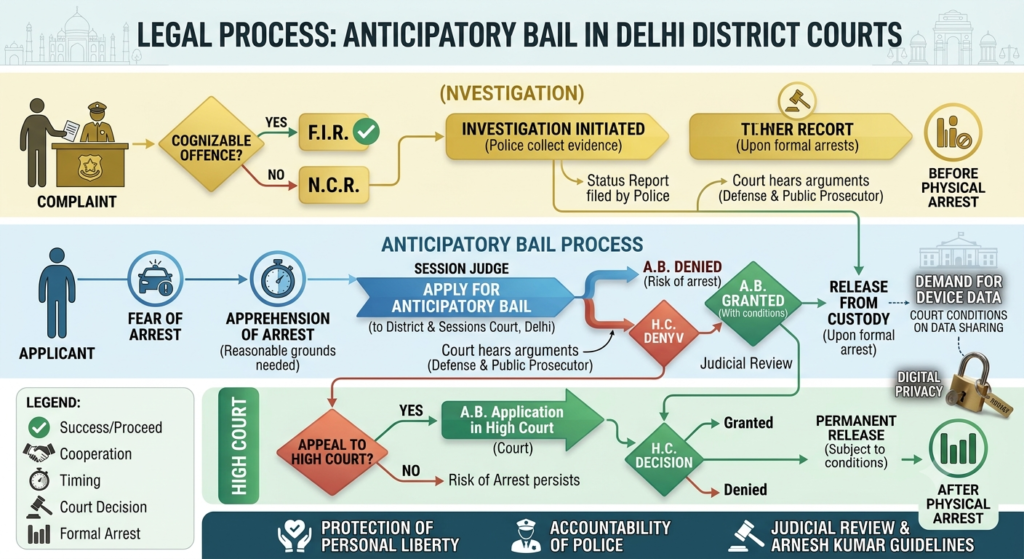
Step-by-Step Procedure in Delhi District Courts & High Court
Navigating Delhi courts requires strict adherence to practical procedural steps and practice directions established by judicial authorities.
1. Document Gathering & Legal Drafting:
   Gather residence proofs, background records, and evidence of innocence. Your advocate drafts the bail petition under Section 482 BNSS / Section 438 CrPC with a supporting affidavit and Vakalatnama.

2. Filing in the Competent District Court of Session:
   Submit the urgent application to the District Court holding territorial jurisdiction over the police station (e.g., Patiala House, Tis Hazari, Saket, Karkardooma, Rohini, or Dwarka).

3. Advance Notice & Police Status Report (SR):
   Serve an advance copy of the bail plea to the Public Prosecutor. The judge issues notice to the Investigating Officer (IO) to file a written Status Report (SR) on the next date.

4. Interim Protection Hearing:
   If an immediate threat of arrest exists before the IO files the Status Report, your counsel argues for urgent "Interim Protection" staying arrest until final disposal.

5. Final Hearing & Bail Order Execution:
   The court reviews the status report, police case diary entries, and oral arguments before issuing a final decision. If granted, you submit personal and surety bonds to finalize protection.
Comparative Analysis: Session Court vs. Delhi High Court
When evaluating where to initiate pre-arrest proceedings or evaluating appellate options, understanding jurisdictional differences is critical.
| Parameter | Court of Session (District Court) | Delhi High Court |
|---|---|---|
| Primary Role | First-instance court for local police jurisdiction | Appellate court or direct forum for complex matters |
| Listing Timeline | 24 to 48 hours for urgent hearing | 48 to 72 hours under regular listing procedures |
| Interim Protection | Frequently granted pending police Status Report | Granted based on severe legal flaws or high-stakes complexity |
| Primary Focus | Factual verification, local police status reports | Constitutional interpretation, legal precedents, trial court errors |
What Happens If the Sessions Court Rejects the Application?
Can anticipatory bail be rejected by a Session Court? Yes, rejection happens frequently when judges deem custodial interrogation necessary. However, a rejection at the district court level does not conclude your legal options.
Furthermore, an applicant retains the immediate statutory right to approach the High Court. When moving the High Court following a rejection:
- Obtain a certified copy of the Sessions Court’s rejection order without delay.
- Formulate clear legal challenges highlighting errors in the lower court’s reasoning.
- Seek an urgent listing before the roster bench to request ad-interim stay against police coercive action during transition.
Landmark Supreme Court Precedents Controlling Pre-Arrest Relief
Indian jurisprudence relies heavily on binding precedents established by the Supreme Court of India regarding personal liberty and pre-arrest protection.
Key Takeaway: Citing Constitution Bench precedents during bail hearings provides immense persuasive weight, preventing lower courts from imposing illegal or unnecessary restrictions on liberty.
- Gurbaksh Singh Sibbia v. State of Punjab (1980): A landmark Constitution Bench decision establishing that anticipatory bail powers under Section 438 are broad and discretionary, designed to uphold liberty, and should not be burdened by rigid judicial restrictions.
- Sushila Aggarwal v. State (NCT of Delhi) (2020): A 5-judge Constitution Bench confirmed that pre-arrest bail protection does not automatically expire upon the filing of a chargesheet or issuance of court summons; it can continue until trial completion unless cancelled for specific misconduct.
- Arnesh Kumar v. State of Bihar (2014): The Supreme Court strictly restricted routine arrests for offences carrying imprisonment terms up to 7 years, mandating compliance with formal notice procedures under statutory guidelines.
Crucial Pitfalls & Strategic Action Steps
In our direct experience managing complex criminal trials, litigants frequently commit preventable errors that undermine their applications. Avoiding these mistakes increases the likelihood of securing relief.

Frequent Mistakes to Avoid
- Suppressing Prior Criminal Antecedents: Hiding past FIRs or convictions causes immediate dismissal and risks perjury proceedings.
- Going Untraceable or Absconding: Fleeing from home or ignoring police communications projects guilt and damages judicial discretion.
- Directly Contacting the Complainant: Attempting private settlements or making contact during active proceedings can lead to immediate cancellation of protection.
Recommended Immediate Actions
- Maintain Calm: Avoid panic-driven actions such as hiding or evading lawful communications.
- Compile Defense Records: Gather bank statements, electronic messages, location records, and physical evidence establishing non-involvement.
- Engage Senior Counsel Early: Consult a qualified defense advocate to draft and file your pre-arrest petition before local authorities initiate coercive steps.
Frequently Asked Questions
How long does the anticipatory bail process take in Delhi courts?
Urgent applications in Delhi District Courts are typically listed within 24 to 48 hours of filing. If the court grants interim protection on day one, total disposal usually takes 3 to 7 days depending on how quickly the Investigating Officer files the status report.
Can anticipatory bail be granted after an FIR is registered?
Yes. Registration of an FIR is the most common trigger for seeking pre-arrest protection. You can file the application immediately after learning that an FIR alleging non-bailable offences names you or your relatives.
What mandatory conditions do courts attach to bail orders?
Courts routinely order applicants to join investigations whenever summoned, refrain from contacting or threatening prosecution witnesses, surrender passports if directed, and keep the IO updated regarding residential contact details.
Is anticipatory bail permanent until trial completion?
According to the Supreme Court ruling in Sushila Aggarwal, pre-arrest bail protection does not automatically lapse upon police chargesheet submission. It typically remains active through trial completion unless specifically revoked due to condition breaches.
Mandatory Disclaimer
This article is provided solely for general informational and educational purposes and does not constitute formal legal advice. Accessing or reading this material does not create an attorney-client relationship. Individuals facing potential arrest or criminal prosecution should consult a qualified criminal defense advocate immediately for professional guidance tailored to their specific case facts.